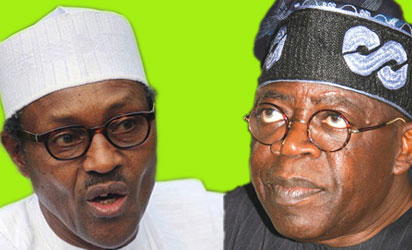
Buhari and Tinubu
By Obi Nwakanma
Bola Ahmed Tinubu, former governor of Lagos, and chieftain of the All Progressives Congress (APC) has called for all Nigerians to rally behind President Muhammadu Buhari in his bid to “clear the rot he inherited.”
This call was reportedly made at the Usmanu Danfodio University where Tinubu was honored with an honorary “Doctor of Business Administration,” by the Congregation of the University at its convocation.
“There is much to fix” declared Mr. Tinubu. “President Buhari is committed to fixing them. But he needs your support and patience. We must stand beside him, or else we may be knocked down and not stand at all.” Bola Tinubu’s call sounds eerily familiar.
It was the same call, in the exact tenor and language, made to Nigerians in the 1980s, when the military took over the government of Nigeria by force. First it was Buhari himself. Then Babangida. Then the relay. They all said to Nigerians, “stand with us, sacrifice, let us clear the rot.”
Every administration has been clearing a rot since 1967 and seem only to leave more rot to be cleared after they leave. Nigerians have always been asked to sacrifice and understand. The odd thing is Nigerians have been forced to make sacrifice, and have never benefited from these sacrifice.
Those who come blaring the horn of patriotism and sacrifice, end up masterminding the liquidation of Nigeria. Anyway, not to stray too far from the creases, Tinubu’s call is the call of reason. But might it not be too late in the day? Here’s the situation. President Buhari lost a great opportunity to rally Nigerians, and unify the country at the beginning of his presidency.
Buhari arrived power after a hotly contested election. Yes, the nation was divided. The elections were fiercely fought, and too many harsh words had been exchanged, and hard stances had been made, but former President Jonathan did the finest thing for which posterity will be very kind to him: he stepped up to the plate, and conceded the election, and urged his supporters, and all Nigerians to rally to the new president.
He was always clear that his ambition was not worth a single Nigerian life, and on the day of the elections, he made good his words. He chose honour over power. His gesture was exactly what president Muhammadu Buhari should have built on, to unify the country after a divisive campaign, and rally the nation to his vision and his program.
He had a great opportunity to clearly position himself as a unifier of Nigerians, and prepare Nigerian for the challenges that he might face, and on the need to shelve their differences for the moment, and return to the work of nation building in the interest of all Nigerians.
For weeks after his election, Nigerians waited for him. That was when he should have established his grounds, built a broader national coalition, and made wider strategic contact beyond his comfort zone.
Many of us were ready to help this president rise to the occasion. But it became quickly clear that President Buhari was not thinking in broad terms. His worldview was clearly too narrow for a nation like Nigeria, and for a challenge as unique as the current situation. He should not have been shocked by what he came to meet in office. He should have come with some policy frameworks.
First, it was clear to anybody who followed and understood global trends, from the last two years at least, that there was going to be a major slump in the price of oil.
It is shocking that the APC as a party, on whose platform Buhari arrived, had no Economic Policy Council, which should have fed their candidate all the data and all the economic intelligence by which he should have shaped his early economic policy from the get go.
APC still has no such body. The party simply exists only on paper, and has very little organogram, and Buhari arrived power on the whim of a capricious electorate that had no idea what change it was seeking, only that it wanted some kind of change.
Buhari promised Nigerians change, as we now see, based on capricious premise. His first promise was to curb corruption. Let me say a little about corruption in Nigeria: the fact that president Buhari uses and retains his official driver after hours on the account of Nigerian tax-payers, for instance, would be considered corruption in very many parts of the saner world.
The fact that Nigerian tax payers expend billions in feeding the president and his personal guests in Aso Rock would be considered corrupt in many parts of the world. Certain privileges which this president continues to enjoy and take for granted might be considered corrupt practices in many other parts of the world. President Buhari came to office, on the pledge that he would change things, and fight corruption.
Yet he has never considered some of these fundamental aspects of the national culture of corruption: the perquisites of the office of the president. Neither has he presented the National Assembly with any clear-cut reform proposal that would reposition the public service, create a leaner, more efficient federal bureaucracy, and close the sources of the leakages that continue right under his watch.
There would never be corruption in Nigeria if the civil service worked, and if it recruited and trained the best Nigerians based on merit, rather than on quota, and secure in their tenure, and so capable of containing the audacities of the transient and political arm of the state.
The president fights corruption like a fire brigade putting out spontaneous and selective fire. So, Nigerians have grown weary and distrustful of his declarations about corruption. The president says he inherited an empty treasury. Obasanjo reveals that he had over $30 billion left by Jonathan, and that he was lucky because when he came in 1999, oil was at $19 per barrel. Buhari has oil selling at $43 and ought not be raising economic alarm.
Buhari’s first moves, a most illogical and ill-advised one, was to alienate the South-East and the South-South of Nigeria; and frankly most of the South of Nigeria. From the moment he made that statement in the United States that he would favor those who voted him over those who voted against him. The president drew a powerful line on the sand.
Nigeria was no longer his constituency. He further lost the opportunity to unify Nigerians around him when he made the appointments into the presidential staff, and it was clear that the president, even though it was his right, and his call, to appoint his personal staff, has no intention of making a national appeal. He found no people in other parts of Nigeria, that he knew, and trusted enough to appoint into his presidential office.
He made a powerful statement. The president’s statements or lack thereof made it clear that he did not think the support, or interest of the East – a crucial segment of Nigeria- counted for anything. He chose to alienate one of the most powerful zones of the country: the East of Nigeria is not a place the president should want as his enemies because the East, though it is not obvious yet to Buhari, has strategic capacity. This President wasted the first opportunity to unify Nigerians when Jonathan conceded; he did it a second time when he made his appointments.
It is not up to Nigerians to rally behind the president. It is up to this president to begin to close all ranks, and reach out to all Nigerians, and be the president of all Nigeria. At the moment, a vast chunk of extremely alienated Nigerians do not trust him, and the number is growing. Buhari’s presidency is at the risk of stagnation if he fails to make the necessary moves.
Disclaimer
Comments expressed here do not reflect the opinions of Vanguard newspapers or any employee thereof.