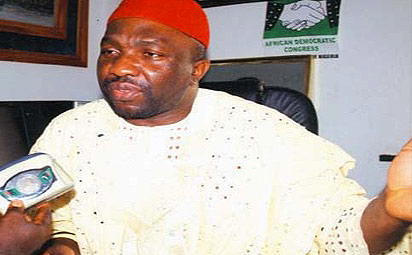
*Ralphs Okey Nwosu
Says the facts contradict the propaganda
By Lekan Bilesanmi
Chief Ralphs Okey Nwosu, National Chairman of the African Democratic Congress (ADC), says the opposition elements have not been objecive in assessing President Goodluck Jonathan’s performance.
We have come a long way in our political history. Have we made any progress?
Certainly yes; 16years of uninterrupted democracy, and the Jonathan government has been able to build a synergy with the arm of government that often truncates the nation,-building journey. We need to see it from this perspective and situate the dynamics we are in properly. Remember, the first republic was thwarted by the military. The second, the same military headed by Buhari. The third was still born and it is the same military factor. This time, in spite of the excesses of the political play, the security agencies are playing a new role of midwife and collaborative partnership. So, irrespective of the seeming difficult terrain, we have made progress.
Also, the government of Jonathan set a goal for itself as encapsulated in Vision 20:2020 from the start. They say that by the year 2020, Nigeria’s economy should be amongst the 20 strongest in the world. Last year, the country became number one in Africa, and 26th in the world. They are inching there. One of the most significant things that the Jonathan presidency has done is to kick start the transformation of our country. The only setback is in the power sector. We do not expect electricity to happen like a miracle but the people must be looped in to understand what is happening in that sector.
Until this time, the country is often rated at the bottom of any global comparative chart for quality of life/economy of nations, GDP, investment facilitation, etc. In the 2011 Failed States Index, the United States-based Fund for Peace assigned Nigeria the 14th position out of 177 countries analyzed, only ahead of the world’s 13 most miserable and war ravaged nations. The American Bipartisan Centre, on May 12, 2011, similarly, listed Nigeria among the world’s most fragile states. This is where we were from 2000 to 2010. Added to this, the Nigeria operating environment is fragile, complex, complicated and, for five years, it has been compounded by Boko Haram, insurgency, terrorism and kidnapping. To make things worse, since we have a President from the minority, the phenomenon known as majority tyranny has set in, majority disdain for a government headed by a South south minority man, and deliberate plots to keep the government unstable and unfocused. Most government systems have been infiltrated by those that do not want the government to succeed.

*Ralphs Okey Nwosu
Yet under this condition, the economy has made appreciable mark. The country now rates better on the Transparency International Corruption Index. Nigeria is rated about the 26th and one of the fastest growing economy, and the biggest economy in Africa. The GDP has appreciated considerably. The facts contradict the propaganda. The situation this government operates in is horrific and they are making progress in infrastructure, education, agriculture, industrialization, transportation etc.
Forget the propaganda and lies, we still have corruption but is Jonathan corrupt, or is it Ngozi? The Halliburton and NITEL scandals did not happen under Jonathan. Nigeria government then was not able to effect any convictions but we know that many Nigerians were convicted in the US, including a former President. We are not there yet but the figures are there to say we are making progress; we have better public servants now than before. The pension, subsidy and ghost workers scams are systemic things that have always been there, the Jonathan’s government uncovered them and has taken steps to reconstruct the systems to prevent such leakages and gaps. They are quietly combating scams, stealing and thievery in government.
Why has insecurity defied all efforts at ending it?
Nations in transition mode experience shocks and unpredictable upheavals. Whether it is US, Japan, China, read their histories. Before many important nations of the world transited from their yesterdays, their dark days, dark ages to what they have become today, they faced challenges. We have to go through some traumatic moments for the transformation journey to gain traction.
The institutions we have in place before all these challenges, including our defense infrastructure, are ineffective to steer the country in the direction of robust health in the new dispensation. As we get ready to confront the new challenges, we are equally building the institutional infrastructure and security architecture to carry a modern and transformed Nigeria nation. It is shortsighted to think otherwise and heap the blame on the present leaders. When people shout change this person, that one is not performing, the CDS, IG or officers like Mbu must go. I shake my head; these are sophisticated officers, highly trained and prepared for this transitioning. We want to taint them with our parochial politics, and ridiculous worldview. How many will you sack, and who can do this difficult job.
I protested when people were shouting that General Azazi must go, that he was incompetent, and all that. May God bless his soul. But since he left as NSA, and General Ihejirika left as Chief of Army Staff, has the security situation improved or gotten worse. So let us stop chasing shadow and try to understand the phenomenon playing out. The chief executives of the various military arms, state security and police that we have today are certainly better than their predecessors and are some of the best trained and disciplined officers in the system.
The issue of the Chibok girls; I empathize with the families, with President Jonathan, and with the entire people of Chibok. The truth will come to light someday. But if I were Mr President, I will ask Governor Kashim Shettima of Borno State to produce the girls. And that will still happen. Shettima must produce the girls; the immunity must not be forever. As National Chairman of ADC, I have been to Borno on two occasions after the kidnapping, and if you go there and keep your ears to the ground you will hear the true feelings of the locals about the dirty politics going on there. You recall that the US, UK, and France sent their troops to help within the first month. But after two weeks, they retreated, and that was the end of the story. What do you think happened? Go and read the letter former Governor Nyako, an erstwhile Chief of Naval Staff, wrote to northern governors. When you read that seditious letter deeply, then you will understand what is happening within the defense and security systems. I do not want to talk much but what is happening is upsetting. Luckily, President Goodluck Jonathan has the humanity to get us through this.
How would you access the government of President Jonathan and his transformation agenda?
I am a student of nation-building and transformation; I understand change, leadership, and system intricacies. I am not a professor neither am I a lecturer. I am a student, I am always learning. Leadership is in context; the context under which a leader works is important. Nigeria politicians come up with flowery manifestoes, captivating slogans full of propaganda and innuendos. But as soon as they get elected, it becomes a different ball game. President Jonathan has been different, he has held unto national transformation.
He has stayed on track, despite the challenges he is encountering with the national transformation. To me, if Nigeria must make progress, that is the way to go. Set the vision, define the mission, and stay on course. The other aspect now is how prepared are Nigerians for this journey. Transformation requires special understanding, communication, and skills. Do we have the men and women to lead the process? It also requires very effective management which Dr Okonjo-Iweala is providing.
I often hear government critics talk about Lee Kuan Yew; He is a good model I agree, but investigate what he went through in moving Singapore from the third world to a first world nation. Singapore is just about 5million people; actually, its indigenes and permanent residents are less than 3.8million. That is smaller than many Nigeria states, it is Nigeria divided by 38. We talk about leadership in context, the intricacies of leading a nation 50 years after the indirect British colonialist rule, a country of 175million persons with over 250 ethnic nationalities and languages, with religious differences. A country that has had a major civil war, and has been many years under military rule, with its unequal distribution of natural resources, etc. The climate and leadership challenges in Nigeria far outweigh what obtain in most countries of the world.
These critics hide under some micro and macro economic theories and paradigms but fail to contextualize things. When you struggle with some of these economists you pity them, I chuckle at their self righteousness because I know that they operate within a vision-limiting prism. They lack the large spectrum and farsighted perception of the social scientist and the creative thinker.
Gowon operated under a very harsh atmosphere; almost the same kind of climate is in place today but this time with even a more hostile elite. This is the condition under which Jonathan has to do his leadership. President Jonathan is a very authentic leader, he is struggling with the challenges of leading a country so complex and complicated, volatile and dysfunctional that is in a state of transition. I am a bit surprised at Prof Wole Soyinka.
I have variously tried to study Jonathan’s leadership style, until I listened to Soyinka’s address at the South/South summit in Asaba some years back. Soyinka crafted what I consider a pragmatic strategic leadership hybrid model to give wings to the federating units, regions, states, and local councils to explode; the path Jonathan is toeing. Prof said to the governors to feel free and take charge of “begin to call the shots, and relegate the centre to its rightful dimensions in any functioning federated democracy”. If Jonathan is not playing the role he presently plays, the governors will not be able to do that. Unfortunately, people seem to take the PPesident’s style for weakness. The governors rather than use the window opened by the Jonathan’s deliberative style to challenge their people to unleash their creative energies in transforming their states, mistook this for weakness and turned to throwing stones into the presidency; and abusing the same centre that has become least aggrandizing taking from Soyinka’s words. The governors started building fiefdoms and even dislodging the local councils.
I am baffled about Prof Soyinka because I thought he was one of the architects of the style knowing that the centre will take time to be constitutionally dismantled for effective nation building.
Recently, the administration of President Jonathan has received serious criticism from former President Obasanjo; do you think Obasanjo is doing the right thing?
I do not want to get into Obasanjo’s kind of patriotism and statesmanship. But look all over the world and tell me any advanced country or even any country at all where a former leader, who has had the opportunity and privilege to serve at the highest level, acts the way Obasanjo does. It is strange. The Council of State was created for a purpose. The Council of State will make more meaning, and it is in the best position to moderate the excesses of its members. However, a model community of former Presidents and the incumbent must be more decorous. Such model communities of ex-leaders in different planks should really be canvassed and put in place as it will enhance the quality of leadership in all strategic areas to advance nation-building. I will like to see a community of retired Chief Justices of the Federation, Chiefs of Defence Staff, Chiefs of Army staff, etc. But it should not be converted to patronage bodies.
Disclaimer
Comments expressed here do not reflect the opinions of Vanguard newspapers or any employee thereof.