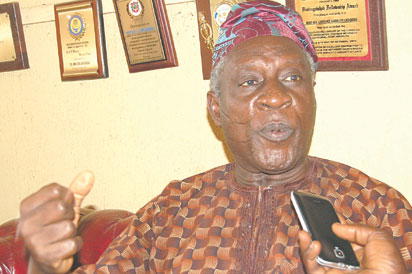
Mr. Ola Ajayi, Ibadan
Archbishop Ayo Ladigbolu is a voice to reckon with in the South-West. Since he retired from the Methodist Church Nigeria, 10 years ago, he has contributed to the progress of the zone. In this interview, the notable Yoruba leader speaks on issues in the polity.

To start with, the general elections are fast approaching after the initial postponement. How do assess the role of the electoral body, INEC?
I believe that INEC has done fairly well because, for the first time ever in the history of the country, INEC is providing us with permanent voter cards so that each Nigerian, who is registered as a voter, has a clear identity.
The card entitles him to elect his or her representatives To me, that is a major achievement. I am sure that INEC has taken advantage of the shift in the dates of the elections to ensure that Nigerians who would have been disenfranchised due to the poor distribution of the PVCs now have the opportunity to collect the cards. So far, I am sure they have completed the training of the adhoc staff and, barring unforeseen circumstances, the elections should hold on the dates that have now been set.
Taking this your approval into cognizance, how then can you describe the call by some people that Prof. Attahiru Jega should resign?
Resign? What for? I am not sure anybody should be saying that. But, if anybody is saying it, then it means they are standing face to face with reality of the gravity of such disaster because if for any reason, he should resign now, having come this far, then it is like somebody is staging a coup. If he should resign, then he would bring INEC into disrepute. He would disrupt all the arrangements that have been made for the elections. Only God knows what reactions of Nigerians will be to that. So, I am not in support of any call for Prof. Jega to resign because, as far as I am concerned, he has done his best in preparing for the elections and we should allow him to carry through.
Being so passionate on the progress of the Yoruba, how do you rate the disposition of President Jonathan to the zone in the last four years particularly on the distribution of political offices?
You will notice that a group to which I belong, Yoruba Unity Forum, was among those that openly confronted President Jonathan and we listed about 30 ways in which the Yoruba had been marginalized by his administration and the so many ways we have been pushed to nowhere especially at the centre in Abuja because, as you can see, that is still there. That imbalance has not been corrected.
The President is number one, the vice president is number two, the Senate President is number three, after that comes the Speaker of the House of Representatives, a position that had been zoned to the South-West but which, for different political and other reasons, eluded us. So, we are not there as far as the administration of Nigeria, at this moment, is concerned. That is the most glaring example of the marginalization that the Yoruba race has suffered under this President. There are several other examples.
I know the President has tried to respond to our raising up of this matter, our open protest. We published the details in the papers. In response to that, the Chairman of Federal Road Management Agency, FERMA, a distinguished Yoruba person, has been recently appointed. We know the President is trying but, I will still say I cannot give a pass mark in terms of how the Yoruba race has been treated and the positions given to us in this administration.
In spite of the low score you gave President Jonathan in the distribution of political offices, some Yoruba leaders, including you, were at a post-National Conference Summit where they endorsed his candidacy.
Cuts in…Yes, there was this National Confab Summit. I was specifically invited to that summit and given the assignment of praying as a clergyman. As a representative of the Church, I have a duty and responsibility to accept that kind of invitation to pray for the summit and for its deliberations which I very happily did. But, you will note, if you were there, that I told the summit that, as a clergyman, I could not be partisan, that I could not support or endorse any person or any party because of my responsibility to a universal Church where members belong to different political parties and affiliations.
But, as a Yoruba man, if any Yoruba event is taking place and the conveners feel like I should be a participant, I will attend, be it APC, PDP, Labour, Accord or SDP, but it does not mean an endorsement of any party or any person.
Looking at your contribution to the progress of Yoruba, you have granted many interviews and one is able to deduce that you have passion for Yoruba issues. Now, how do you feel now that it was the Afenifere that first made that pronouncement that it had endorsed President Jonathan? What do you have to say about the said endorsement?
I will like to decline any judgmental comment on the opinion of other Nigerians because people have reasons for any choice they make and, in the case of Papa Adebanjo, for example, he did state all the reasons he and his own group endorsed President Jonathan. I did not hear him hammering only on the fact of his incarceration and the incarceration of other Afenifere or Unity Party of Nigeria leaders including the late Ambrose Ali, Onabanjo and others. He stated other points which I am not going to reiterate for him so as not to be speaking for him.
But, he has the freedom of choice; as an elder statesman, he is free to choose whoever he pleases. But he is not the only Nigerian who will determine who becomes our President. So, let him choose whoever he pleases and others too have their own freedom of choice but I don’t want to criticise his statement at that particular summit.
Still on that summit, there was this general comment at the summit that President Jonathan, who initiated the National Conference, will implement its recommendations. Do you think he has that power as President, without him going through the legislature, to do as those people claimed at the summit.
Well, there is need for clarification and people need to hear this. At the very beginning of the issue of National Confab, I happened to be one of those leaders who agitated and I know that even the national leader of the APC, Asiwaju Ahmed Bola Tinubu, was also one of us. Chief Bisi Akande was also one of the agitators. Bishop Bolanle Gbonigi and I were, perhaps, the only two clergy men there then among them and we were all Afenifere and eventually, it became various other things including NADECO. But the idea of National Conference has been an idea in which the Yoruba have been in the forefront.
But, unfortunately, at the time that the President announced the convocation of that confab, there was a political divide and I believe that, on principle, it will be difficult for those people I had mentioned to now say they were going along with what the opposition party was sponsoring. So, their position, to me, was clearly understandable. But, I know that it doesn’t mean they do not believe in the product of the National Conference.
So, it’s going to be difficult for anybody to assume that if X party wins and because it did not or its leaders did not support the convocation of the National Conference and that they did not send delegates, then they are incapable of implementing the decisions and recommendations of that conference. People are already making that kind of mistake but then you can also see the argument on the other side; people are now saying this President initiated this thing, so his administration would be more passionate about implementing its recommendations and that is if he has the support of the National Assembly.
I was at an event where the President spoke and he was realistic enough to say people should vote so that there will be enough of their representatives in the National Assembly who will help to implement the recommendations of the National Conference. That’s the reality; so, if some politicians want to score points by looking at whatever it is to their own advantage and the Jonathan group is hammering on the National Conference as the aspiration of the Yoruba race, that’s politics as far as I am concerned and so let it be.
There is this allegation that N6billion bribe was given to some Christian leaders as bribe to mobilise for the President’s re-election. You represent the Church in one way or the other. What do you say concerning this allegation?
In the very first place, I do not believe that anybody in this country, in his right senses, could have given as much as six or seven billion naira to CAN to campaign against a presidential candidate. I do not, and I am saying that as Archbishop Ayo Ladigbolu, I do not believe that story is true. Only one person so far who claims to be a pastor has peddled that story and has insisted on the authenticity.
The leadership of CAN has denied it. Let me tell you, if such an amount of money had been given to CAN, at least I will have a share of it and I didn’t. I don’t know how they will share that kind of money and a bit of it will not come to me or to people I know. At least, as far as Oyo State and South-West CAN are concerned, there is nobody who has any trace of that kind of money. If CAN is not a campaign agent of a particular party, how come they will get that kind of ridiculous amount to allege or accuse anybody to have given to anybody or any organisation or any group to campaign for or against anybody. I don’t believe that story.
I had this belief too before but what now again sparked some kind of doubt was when Pastor Enoch Adeboye said the pastors that received the money should talk. I believe if he had not heard something, he would not have talked like that. The man that made the allegation said it again that he was sure that about six billion Naira or seven billion Naira was given to the Church.
Nigerians are very fond of cooking up stories. But, if you decide to buy it, then you are free to do so and, if you are uninterested, then you can ignore it, and that’s really what I will say. But, the fact that a prominent Church leader said if anybody had claimed that kind of money, let him speak up, it is a way of saying nobody that I know has taken it, but if anybody has done, let him speak up. That, to me, is not an affirmation that anything happened. I still stand by my own position and until I have proof that such a thing happened, I am there unmoved.
Lastly, do you believe in regionalism?
Well, regionalism! Yes, to an extent. I will say we are still in regions, even the six zonal arrangement that we have at the moment is a form of regionalism because we are saying we have not forgotten the old Western Region with all the South-West states together because that’s where they used to belong and the people in that area know best the needs of their people, the needs of their area and that’s one thing the APC did they call it regional integration; it was a sensible programme to bring all the states in the South-West together, to think together, because we are homogeneous to think together about what is going to be best for us within this arrangement called Nigeria.
Regions will still be regions and because you speak the same language, you have the same culture, you have the same basic needs and aspirations and you can work together better to foster the interest of your area, of your region,
then you can contribute something together to the national pot where everything will be melted together and shared by all Nigerians. I believe in that kind of positive regionalism but I do not believe in a tribal segregationalist kind of regionalism, that’s the difference.
Disclaimer
Comments expressed here do not reflect the opinions of Vanguard newspapers or any employee thereof.