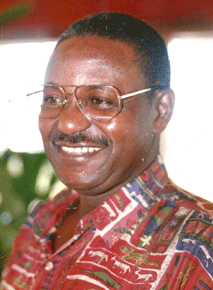
By Bishop Mathew Kukah
I do not remember when I first stumbled on Peter Enahoro or which of his articles I read first. All I know is how awestruck I was when I first read his article in Daily Times. His way with words was astonishing.
 He wrote with such ease and finesse, drawing his reader from being a bystander into the centre of his intellectual arena where he held court with authority. Sometimes, he wrote about simple things, but he often brought philosophy and deep thought into them. Sometimes he wrote about some ideas that were above my head then, but it was impossible not to read him. As a student, buying a newspaper was a rather tall order, because it was the domain of privilege and class.
It was with the coming of New African Magazine that I also matured and was in a position to ensure that I had a copy of the Magazine and could read him more often. Mr. Enahoro was always a great joy to read. One of the most memorable pieces I read in the 80s was his account of a meeting with Jerry Rawlings, “the Trial of JJ Rawlings”, a piece that clearly exposed Rawlings as acting under one influence other than normal.
I learnt later from the grape vine that the piece and another one, ‘The Secrets of Rawlings rule’ cost Enahoro his rights to enter Ghana while Rawlings held sway. I also read him along with the great Mohammed Babu of blessed memory.
In 1986, I resumed at the School of Oriental and African Studies, London. One day, I was walking to the then Dhilons bookshop across the street from SOAS when I saw the Africa Now Magazine sign board, pinned to the wall, Africa Now being the second magazine after the New African edited by Mr.Enahoro, both based in London.
I was quite excited and pressed the doorbell. I was allowed into the building and went straight to the receptionist. I was not sure I would have the chance to see Mr. Enahoro face to face but I just decided to try. I was told he had stepped out but one of the magazine’s political editors Ben Asante turned up to welcome me. Ben himself has perhaps remained if not the most faithful, then by far for me, the most loyal among friends or students of Mr. Enahoro.
After many years, I did get the chance to meet with Mr. Enahoro first, I think at a Conference on the Media and Africa in Badagary in the 90s. It was a great pleasure to see the great man at last. At the Conference, I recall one memorable observation he made about foreign reporting on Africa. It was poignant and has proved the best summary of most of what one can say about how Africa is often represented by the West.
He said something to this effect: What the average western journalist often does, he said, is to pin a clip of a story from Africa on his wall. He continues to return to the same note, merely adding a few lines by way of update each time a story comes up. That is how the West tends to report Africa, by updating these old stories. As the years have rolled by and one has gotten a bit more familiar with some these things, you realize that the old man was indeed correct in his assessment. The need to create our own narratives belongs to us all. How we equip ourselves for this role remains the challenge.
At a time when journalism is now literally at the crossroads in Africa, one must look back at the legacy of Mr. Enahoro and succumb to the sad conclusion: they don’t make them like this anymore. Journalism in Nigeria has lost most of its rigour, allure, professionalism and finesse. Managing the media has become more of politics and business, seeking to survive in the murky waters rather than an almost missionary zeal and sense of adventure. Yet, African leaders must think more clearly how to collaborate with the Media in a way that reinforces national development and integration. Successive governments have proved to be rather condescending, overbearing and suspicious of the media, often pitching their roles in adversarial terms.
Whereas African politicians are prepared to grant concessions to their business partners through tax concessions and other incentives, they have tended to neglect the media. The lack of industrial support by way of making access to equipment easier for media has made Nigerians reluctant in investing in the media.
Those who are brave enough to persist in this area have had to resort to many DIY strategies to get by. This is sad for a continent that is still struggling with so many problems. It was Professor AmartyaSen who argued that an open society, one with a free media can never die from famine because its openness enables it to call for help. Many Africans started struggling to set up their private outfits before Al Jazeera. Today, the story of Al Jazeera contrasts sharply with their African counterparts. The result is that we do not have a true African prism with which the world can see us.
Disclaimer
Comments expressed here do not reflect the opinions of Vanguard newspapers or any employee thereof.