By Adisa Adeleye
All over the democratic world, election periods are always picturesque, fascinating and often interesting. In Nigeria, the contending political parties make elections a peculiar business which soaks the naira in its billions. It is always a boom for the media and the printing industry.
It should be recalled that previous elections since the return of Democracy in 1999 have always been eventful with results also predictable because of the simple political structure – one strong political party and some minor, often internally divided, Opposition parties.
Many Nigerians would have made up their minds, irrespective of party promises, either because of religious bias or tribal sentiments. Thus, the ruling Peoples‘ Democratic Party (PDP) could be perceived as a truly Nigerian party
The present PDP is believed to be a political organ of the earlier military junta to install one of its own in government. It has grown over the past 15 years into an octopus, that it sees itself as the biggest political entity in Africa that is capable of ruling the country for the next sixty years.
 The complex structure of the PDP and its inability to manage its electoral victories in a troublesome decade seems to have affected adversely its internal cohesion to some extent. At times, the centre appears not able to hold properly, otherwise, things appear seemingly stable.
Many patriotic Nigerians, feeling so uncomfortable with the risk of Nigeria transforming alarmingly into a ‘one-party state, justifiably wished for a virile opposition party.
Indeed some small and medium political parties, with not much dissimilarities from the PDP, but united by the desire to chase out the ruling party emerged. The new opposition party registered as All Progressives Congress (APC) came to torment and shake the over confident ruling party. Since there is no marked ideological or philosophical difference in political and economic postures of the two parties, the traffic from one party to the other has become less hazardous. One comfortable home for one is a safe haven for the other. It is a matter of personal interest in a juicy and profitable political panorama.
However, the old and the new (not so new) have developed new gimmicks in a colourfully printed party manifestoes – promises made several times before but not fully accomplished. The manifestoes, though neatly packaged in lurid but different colours, are all towards the same objectives of security, political and economic stability.
There is no doubt that Nigeria, after 100 years of experiment (1914-2014) needs peace and stability to continue to survive as a nation. This lofty objective will not be achieved by mere sentiments or promises, no matter how elegantly produced in glossy prints or eloquently voiced at election rallies, but in action and attitude.
It is possible without any prompting by editorial excellence or oratorial sophistry for a true Nigerian to see and appreciate progress and innovation, if any. There is no doubt that Nigeria at 2015 is far different from pre-independence Nigeria, under British imperialism.
There have been impressive changes since 1960 which were unfortunately interrupted by the civil war of 1967 to 1970. If Nigeria is still witnessing a civil war (upsurge of terrorism) in the second decade of the 21st century, it points to one clear sign that the present Nigerian leaders have failed to learn from the lessons of history. Perhaps those who want a Change (if it is for better) have their points. Unfortunately, the parties‘ manifestoes have failed to be specific on the road to peace and stability.
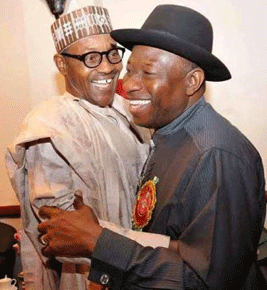
However, in the midst of dancing in colourful attires that follow the political rallies, some casual but relevant statements by the presidential candidates point to the right solution to the troubles of Nigerians and “with Nigeria” General Buhari (APC Candidate) was reported to have said, if elected the President, I will appoint the most eligible Nigerians into my Cabinet. President Jonathan was quoted as saying that “winners take all” attitude is the bane of Nigerian politics. It looks as if the two aspiring Nigerian leaders have the perfect answer – the composition of the
FG
It has been observed that the control and composition of the Federal Government has been the most fundamental problem of the country. If the ruling party wins, the party nominates its supporters to fill all available positions without any consideration for the opposition. As a means of strengthening its political position, the winner would also pick his supporters as representing the Opposition States. The selfish attitude tends to encourage divisive tendencies in Nigerian politics.
There is a common belief that the present insurgency in the North-east thrives on the lack of unity among the political leaders to tackle the problem. Once the Boko Haram insurgents realize that the fight is against the whole country, they and their foreign backers would face reality and disappear.
The two successful examples of ‘multi-national States are from Switzerland and Belgium. The Swiss Democracy sees to it that the Federal Government is made up of the contesting political parties. In Belgium, the political parties negotiate the composition of the Federal Government. The “winner takes all” mentality does not operate at the federal level.
The economy
It is surprising that at the time the price of the black gold – the mainstay of our economy is falling, the emoluments of the political office holders remain untouchable. The mighty Naira is being battered here and there.
Poser
How interesting would it be if there is a final debate between President Ebele Jonathan and his challenger, General Muhammed Buhari on the topic of Security. The venue should be SAMBISA FOREST with Chief Femi Fani-Kayode and Rotimi Amaechi as Moderators.
Disclaimer
Comments expressed here do not reflect the opinions of Vanguard newspapers or any employee thereof.