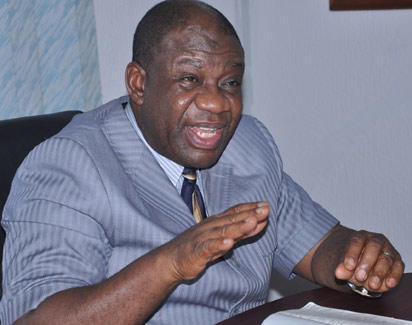
Prof Nebo
By Sebastine Obasi, Michael Eboh & Jonah Nwokpoku
Infrastructure vandalism, particularly of oil and gas pipelines, and power assets may soon become history as the Federal Government in conjunction with international consultants, is working out the modalities to provide digital surveillance of oil and gas, and power infrastructure.
The Minister of Power, Prof. Chinedu Nebo, disclosed this yesterday in Lagos, during an interactive session when he visited the Headquarters of Vanguard Media Limited, publishers of the Vanguard Newspapers.
The visit was originally scheduled to hold on Tuesday, but was aborted because according to the minister, he missed his flight on account of “national duty, and could not get into Lagos until past 9pm.”
Only in the last couple of weeks, two of such major pipelines, the Trans Niger Pipeline, and the Trans Forcados Pipeline, TNP, were hacked into in multiple points, leading to production losses as well as drop in power generation, as the plants were starved of gas supply.
The minister however said the situation was now under control, as generation capacity has ebbed up again to above the 4,000 megawatts, band, Nigeria’s highest capacity till date.
Although he did not give further details as to the identity of the consultants, or how much the project would cost, but only said, “it was a very capital intensive project and will cost millions of dollars to execute.”
Vandalism has become one of the biggest challenges faced in the energy industry in general, with attendant colossal losses running in millions of dollars in terms of crude oil and gas production as well as power generation shortages.
The menace has so far defied logical solution as multiple joint task forces, JTFs, set up on regularly have had little or no effect on the activities of the vandals, despite the hundreds of millions of Naira in taxpayers money used in maintaining the JTF outfits.
Nebo explained that the government had to take this bold step, as this was now the only way to safeguard infrastructure in Nigeria.
In the meantime, the government is also planning to include the Nigeria Air Force, NAF, in the JTF team to provide aerial surveillance for these facilities to reduce the spate of vandalism on them.
IOCs shun digital surveillance
It is not yet clear nor was it clarified by Nebo whether government was going to undertake the digital surveillance project alone, as the multinational oil and gas companies owners of these assets, have constantly shunned delving into it because of its huge capital outlay. Most of these assets are in joint venture operations by the multinationals.
Indeed, the outgoing Shell Country Chair, operators of the pipelines in his last press conference, vehemently said Shell preferred to continue using the manual surveillance as it has been doing, in addition to the JTFs’ work.
He argued that Shell would rather deploy such monies into other more beneficial projects than the highly technical, and capital intensive digital surveillance. He noted that because of the high level of technology deployed in these digital assets, it would not be cost effective to use them in Nigeria, where they can also be easily compromised, as almost everything else in the country.
Developments in power
Nebo, who said government’s promise to Nigerians and take away as far as power is concerned, is that “we will get there, to a situation of stable power supply, as everything has been put in place to ensure that we do,” however refused a timeline foe getting to the Promised Land.
Rather, he disclosed that significant success had been recorded across the electricity value chain – generation, transmission and distribution, adding that over the next couple of weeks, President Goodluck Jonathan will commission more power projects that will substantially improve on supply.
Specifically, he said that technical power losses, which were estimated at over 30 per cent in the past, has now been significantly reduced to about 13 percent, even as he said that the distribution companies, DISCOs, have not fared better, as their commercial losses still ranged between 50 and 55 percent losses.
The development he noted has contributed immensely to the high incidence of estimated billings by the DISCos, who are struggling to recover costs while still able to pay for their electricity supply from the generation companies.
He said: “We cut back technical losses substantially to about 13 percent. Unfortunately it is not so with commercial losses. More than 50 per cent of Nigerians are not metered. Some who are metered circumvent the metres and do connections that are illegal. Also, many people are not paying their energy bills.
“Many people are using electricity without the knowledge of the electricity companies. And that is why some of these companies reported a colossal loss of over 50 percent, some of them even 55 percent.
“So who pays if there is a tariff adjustment? So at the end of the day, it is those who pay that are forced to pay more. This is because it is those who you see that you will get your money from.”
He however disclosed that “The companies are committed to reducing commercial losses gradually, and NERC is working hard to hold them to their promise because it is part of their business plan.
“But until people are metered and metering becomes prevalent all over the country, commercial losses therefore reduce substantially, distribution companies are going to find it difficult to pay for the electricity they consume. This is because; it is like putting money in a pocket with holes.”
Exploring value chain opportunities
Besides, he noted that apart from the successes recorded along the value chain, multiple sources of power generation are being explored in addition to the traditional sources of thermal, hydro, to include solar, wind, coal and a host of others.
In particular, he said that solar can rescue Nigeria from the current energy quagmire, as it held more potential than all other sources of power combined.
With regard to the myriad of issues bedeviling the sector, the minister gave the assurance that the Power Ministry, in conjunction with the Nigerian Electricity Regulatory Commission, to sort out issues relating to overbilling through which consumers are being exploited, poor power supply, and shortages of meter and a host of others.
Specifically, he said the Federal Government, has directed the DISCOs to deploy meters to a vast majority of Nigerians, so as to address the issue of estimated billings, as contained in the work plans they signed on acquiring the assets.
He added that this was part of the reasons government was procuring about one million meters manufactured locally, to alleviate the plight of Nigerians.
He said further that as part of the local content policy and backward integration policy, Government has concluded plans to increase the tariffs on imported meters, so as to compel the DISCOs to patronise local meter manufacturers, since the companies were refusing to buy from the local manufacturers.
He said, “We went round the country to take inventory of electricity usage in Nigeria without letting the power companies know. It was what we discovered after the inventory that made us decide to buy and deploy one million meters to Nigerians.
“We are also trying to mop up meters from Nigerian companies which produce meters, so that these meters can be distributed to consumers and possibly help address the issue of estimated billings and reduce commercial losses of the power companies.”
Disclaimer
Comments expressed here do not reflect the opinions of Vanguard newspapers or any employee thereof.