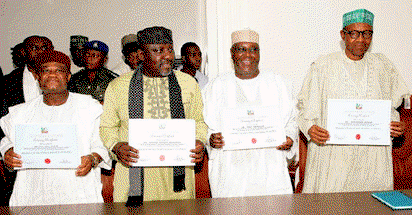
L-R Founder, Leadership Group, Sam Nda-Isaiah, Governor Rochas Okorocha, former Vice President Atiku Abubakar and former head of state, Major General Muhammadu Buhari (rtd) displaying their Certificates of Clearance after receiving same from Chairman, Presidential Screening Committee of APC, Chief Ogbonnaya Onu at the APC National Headquarters in Abuja on Wednesday.
By Ochereome Nnanna
WITH the emergence of the presidential candidates of the People’s Democratic Party (PDP) and the All Progressives Congress (APC), the stage is set for the February 2015 general elections. However, there are certain issues that give reason for grave concern as we get ready to embrace the polls. Of particular interest to me in today’s write-up is the series of threats by the main opposition APC to form a parallel government if the elections are “rigged”.
The first to issue this threat was the National Chairman of the Party, Chief John Oyegun, during the campaigns for the Osun State governorship election earlier in August of this passing year. According to him, APC will no longer recognise “stolen mandate” or any outcome of an election that is not free, fair and credible. Again, in Abuja on November 20th, Governor of Rivers State, Rotimi Amaechi, after a street rally and a barricade of the Police Force headquarters, reissued this warning. The Presidency chided him in a statement, and Oyegun issued a reiteration, saying it is not merely an individual’s opinion but the official stand of the party.
Viewed on its face value, there is nothing wrong or strange in calling for a free and fair election. It is perfectly in order to insist that the outcome of elections must cohere with the wishes of the people. It is very much okay to frown on any attempt to subvert the wishes of the people. But this stance is much deeper than merely calling for a free and fair election. We have to answer these questions: what is a “rigged” election?
Who determines it under our laws? And what is a parallel government? What are the consequences of forming a parallel government? By the time we ruminate through these questions it becomes clear that this issue is far more sinister than it appears on its face value.
What is a rigged election? It is a subversion of the wishes of the people and award of victory to those who do not deserve it. Who rigs elections? Is it the ruling party or the opposition that rigs elections? The answer is simple.
There are a million and one things that can lead to a rigged election. If the Independent National Electoral Commission (INEC) comes late with voting materials to a polling station and this leads to disenfranchisement of voters, it is bound to affect the fortunes of one contestant or party more than the other, and the disadvantaged party will complain of rigging, even if their opponent had no hand in it.
Poor security can affect the outcome of an election. Too much presence of security men can also give room for agents of a contestant to foul the rules of the game to their advantage. It is a very widely acknowledged fact that politicians routinely foul the rules to gain undue advantage for themselves. No politician can claim innocence of this.
It is also a widely acknowledged fact that politicians rig in areas where they already have dominance over their opponents. All the political parties have areas where they are strong and areas where they are weak. While helping themselves to impunities in areas where they are strong, they complain that their opponents are rigging in the (opponents’) stronghold. PDP, APC and others are guilty of this electoral sin.
If we are to apply the APC threat, does it mean that if PDP loses, say, in Lagos where APC-related parties have dominated for sixteen years, PDP is free to accuse APC of “rigging” the election and form a PDP-led “parallel’ or alternative government? If that is allowed, then we are going to have parallel legislators at the state and federal levels, parallel governors and parallel presidents. And since we have more than 30 registered political parties, we are going to have over thirty parallel presidents, 980 parallel governors, do the math for parallel senators, members of the House Reps and the 36 state legislators multiplied by thirty each!
It was this absurdity that drove the framers of our constitution and the concomitant electoral laws to spell out the lawful ways of winning elections, getting certified as holders of the people’s mandates, and seeking redress in court when you have proof that you were cheated. Is it not instructive that the same Chibuike Amaechi, a prime beneficiary of justice through the courts of the land was the one vowing his party will not go to court if elections were rigged?
It is dangerous to allow politicians to determine by themselves that elections have been rigged and thus proceed to take the laws into their own hands. The courts remain the only legally recognised institutions to determine if an election has been rigged, and give justice to the injured. We are fortunate to have a president whose regime has never gone against the wishes of the electorate in any election or the wishes of any court of law, contrary to the situation that obtained during the regime of President Olusegun Obasanjo.
There is no alternative to the rule of law. Supposed the INEC announces APC as the winner of the presidency, how will they like it if President Goodluck Jonathan and his PDP proceed to form a parallel government? Foolishness is not a preserve of anybody. Majority of our people know how to break the law and yet choose to be law-abiding.
Besides, the wages of sin is death, says the Bible. If you form a parallel government, what happened to Chief Moshood Abiola when he made his Epetedo Declaration (in August 1994 before he was taken into custody from which he never came out alive) can happen to anyone. The state does not tolerate acts of treason or those who perpetrate them.
Those who shout “impunity” at the drop of a hat have not seen anything, until someone carries out the threat of forming a parallel government. The real government, with the full paraphernalia of the state, will make its presence known.
Where will the capital be, anyway?
Disclaimer
Comments expressed here do not reflect the opinions of Vanguard newspapers or any employee thereof.