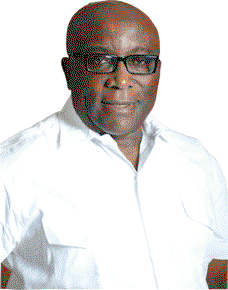
Chidi Amuta is the founding director of the Rural Directorate of Food, Roads and Rural Infrastructure (DFRRI), old Imo State. Currently he is the chairman and CEO, Silson & Weizmann Associates Ltd, a media and information warehousing company, and OUTCOMES, an international public affairs and policy consulting company.
 In this interview with MOSES NOSIKE, he speaks on how lack of reading culture is dragging development in Nigeria into the mud, saying that statistics on development are not in consonant with reality on ground, and that deficiency on record-keeping is a huge setback. Excerpts:
You’ve been writing for many years now as captured in your new book, do you think some of your write-ups had influenced any government policies at any point in time?
I was speaking with some journalists recently, and the question was, you know so many leaders and politicians, why are you not in politics? and I answered “no, that is not my style.” I have been mostly a background person and in that capacity, one has influenced a lot of policies one may not know.
Essentially I prefer functioning at the background and the essays that are in the book billed to be presented a few days from now form part of that engagement with leaders and people who make policies.
So, if you are a good background person, either you’re an adviser to a president, governor etc. the first rule is that you must not ascribe any of their policy or successes to yourself even though you designed the programme for him; once he is the person that announces it, he takes all the accolades. So, those pieces of writings that I brainstormed in aid of specific policies, are deployed to those who are in position to make policies.
I contributed to the decision by Nigeria to go into Liberia during the period. If you go to that book you will see essay on Liberia and that forms the policy bed rock, but I didn’t know. Years later, major actors called me and said you helped us, once you came out with that position we adopted it and made those changes in Liberia.
Again, the restoration of tiers with Israel; normalisation of relations with South Africa; once Mandela was released from prison it was pointless not having ties. Before then, a lot of Nigerians were trading with South Africa, and our policy on Equatorial Guinea at our backyard here.
The reading culture in Nigeria is very low; information deficiency is another challenge, how do these affect leadership and development?
The problem of our reading culture is even more frightening. If you have kept tracks of the utterances of our leaders overtime, they have lost interest in reading. One of them said he doesn’t read newspapers. Even the current ones say there is no need reading newspapers; that the media is predictable. And when you do that, it is not just the newspapers, but everything that is read.
Recently, government reviewed import tariff on books with 50 per cent. How do you encourage reading and writing when you place tariff on intellectual materials in a country that needs ideas. There is no country in the world that has developed that is not rooted in ideals. I was reading something about China, how they established a high level technology where they train their young bureaucrats that would help them project what position China will occupy in the world next 50 years.
They also simulate what China will do in Nigeria, Angola etc. All those things you are seeing; the Chinese here, they are building five airports in Nigeria presently. Do you know the statistics implication of having one country build five airports in most strategic airports, Abuja, Kano, Port Harcourt, Lagos and others – all the gate ways, even the approved plan is made in China and is already with them. And we are living in a country that has a global agenda. For whatever reason, I don’t know why we believe that we can develop without ideas.
Now, we know that books are carriers of ideas. Attitude to reading in Nigeria is very worrisome. How do we change it? It doesn’t matter to us that our kids are scoring very badly in basic expression, basic English and Mathematics. I was looking at recent statistics. We are about the worst in Africa in high school results. We are misplacing emphasis. If we want to declare emergency, it should start from education.
When Obama took over as President of United States, one of the things he did was to approve a special training programme for teachers and ensure that American kids began to do well again in the sciences and mathematics because they found out that American kids were lagging behind the European peers, China and Singapore. But they said “No, if this continues, America will take a back seat in a global development. In our case, for some reason whatever, some people sit somewhere and said, Nigeria will be the greatest country in 2020; others sit down in Abuja and take statistics, saying Nigeria is the greatest economy in Africa – just by sitting around the best computer. The numbers don’t add up. Where is the infrastructure? Where is the access to employment?
How many Nigerians have access to home loans? You are young people, how many of you own houses? How many of you can hope to own his or her own houses in the next fifteen years? How many people have access to decent water or electricity?
There are no roads. All I’m saying is that we have to be very careful how we play with statistics. People wake up and say whatever they like and there is nobody to challenge them because the people who should challenge them either have died or have given up or they are tired.
When Chief Awolowo was alive, once the FG publishes its budget, Awolowo would release his own budget based on facts and figures. In fact, he had superior facts and figures than the government of the day.
Today they are doing APC versus PDP. PDP doesn’t have the fact even though it’s in government presiding. APC doesn’t have the facts, and does not have alternatives. If Jonathan were to close his mouth or stop making mistakes, APC will have nothing to say because they only wait for the man to open his mouth and say something, then they (APC) will counter.
There is nothing they are doing. But, Awolowo had his own budget, timeline, school enrollment, even his facts and figures from the CBN. He was the first person who warned Nigeria that at the rate Nigeria was borrowing we would get into trouble in the next ten years and it happened. Today, what you see is governance without ideas, culture without reading.
There are also other things that make people not to read; how many hours are there in a day? How many hours will a Nigerian need to work in order to earn a livelihood? There are 24 hours; the average Nigerian worker needs about thirty hours of work to even survive. How is he going to read?
When is he going to read. Most of the time, he is unhappy. A sad man can’t read anything, even some journalists don’t read their own papers.
That is the problem. So, this is where we are. I used to operate from the UK. Once you enter a train in the UK, you see everybody reading either newspapers or novels, journals, text books etc., with the result that the newspapers that wanted a lot adverts distributed themselves free and placed their copies at the Metro station. There is a newspaper called Metro.
It is heaped at every train station. When you go there you collect your own and read it free of charge. So advertisers prefer that because people have access. But here I have to buy papers before I can see the advert and if I don’t have the money to buy, that becomes an impediment.
Disclaimer
Comments expressed here do not reflect the opinions of Vanguard newspapers or any employee thereof.