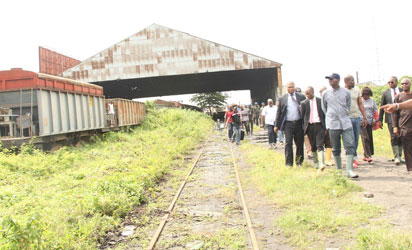
Lagos State Governor, Mr. Babatunde Fashola SAN (2nd left), Commissioner for Transportation, Mr. Kayode Opeifa (2nd right), and the Chairman, Lagos State Task Force on Environment and Special Offences (Enforcement) Unit, Chief Superintendent of Police, Bayo Sulaiman (right) during the Governor’s inspection tour of the abandoned Nigerian Railway Corporation Port Work Yard at Marine Beach Apapa on Sunday, August 31, 2014.
NIGERIA cannot survive on partial implementation of promised policies.The foresights on which planning of the country were based at independence have been jettisoned for measures that sustain impressions that Nigeria exists for the moment. A simple example is the infrastructure used in distributing fuel, when it is available.
The railways distributed fuel for more than 15 years after independence. The facilities for fuel distribution are evident at the ports where the rails criss-crossed into the fuel depots, whether they were imported or blended locally. The same rail system runs through most of the industrial estates that the regional governments established.
At Ikeja Industrial Estate, disused rail lines are still visible in the compounds of most of the industries. The same applied to industrial estates elsewhere. Most of the manufacturing hubs were located by the rails for easy movements of their finished goods to the markets and transportation of raw materials from the ports.
The madness in Lagos, when fuel tankers load from facilities in Apapa, indicates blindness to planning. How does anyone expect that tanks bearing only 33,000 litres of products would cover the country especially now that professional pipeline breakers have defeated that once economic means of moving products?
Daily, fuel tankers block the Apapa-Oshodi Expressway, Nigeria’s main access to her busiest ports, waiting for their turn to load products. Where there is product scarcity, the lines of trucks, heading to the ports, and tankers waiting petroleum products can stretch for kilometres.
The situation exacerbates security issues on the route. Additionally, the pressure from the huge trucks is already damaging the road that is under re-construction. The bridges on the route are at greater risks.
Most of them have become the parking lots of the heavy vehicles. The dangers the practice pose to the health of the bridges are merely discussed. If the rails worked, they would have been evacuating goods from the ports and the fuel terminals with better efficiency. There is also need to improve ports outside Lagos.
Congestions at the Lagos ports make it imperative for government to hasten the re-development of the ports in Calabar, Port Harcourt, Warri, and the inland ports that have been promoted for Onitsha and Lokoja. The neglect visited on them hugely accounts for the chaos at the Lagos ports.
Experts posit that if the other ports were working, Apapa-Oshodi Expressway, Lagos-Ibadan Expressway, Benin-Shagamu Expressway, and the nation’s other highways, which frequently decay from the weight of the imports from Lagos ports, would have longer life spans. The enormous savings could be invested in other infrastructure.
The rails and more ports are the solutions to longer life span of our over-burdened roads.
Disclaimer
Comments expressed here do not reflect the opinions of Vanguard newspapers or any employee thereof.