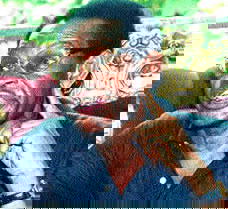
General-Benjamin Adekunle
By Ochereome Nnanna
I NEVER met retired Col. Benjamin Adekunle. But I had an encounter with him, which I will narrate, to give you an insight into the strange man he was.
On March 17th 2006, Mr. Peter Obi, the candidate of the All Progressives Grand Alliance (APGA) for the 2003 election was sworn-in as the duly elected governor of Anambra State.
It was a remarkable triumph of good over evil. The Uba family, who were the appointed political agents of then President Olusegun Obasanjo in Anambra State, had failed conclusively to hijack Anambra, even though Obasanjo used every abominable trick, including the abduction of their non-conformist flunkey, Governor Chris Ngige; and the use of Nigerian security forces to burn down the government house and other public buildings.

General-Benjamin Adekunle
I wrote an article celebrating the shaming of the devil. I described Obasanjo as a man given to cowardly behaviour. He ordered the flattening of Odi in Bayelsa State, the destruction of Zaki-Biam in Benue State and sent an Assistant Inspector General of Police, Raphael Ige, to supervise the abduction of Governor Ngige in Anambra State.
But when Alhaji Sani Yerima, the Governor of Zamfara State, forcefully and illegally declared full sharia and riots swept through Arewa North like a natural disaster, Obasanjo went to Kaduna and decided to weep instead of taking his usual strong arm measures. He made his famous prediction that sharia would “fizzle out”. Obasanjo fears and respects the North but whenever there is a drop of the pin in any part of the South and Middle Belt, he becomes a ten-star army general. That is my own idea of cowardice.
I said so in my write-up. It was a Monday. Later that day, at around 4.00pm, my phone rang. I answered:
“Good afternoon. Whose is on the line?”
“Ezigbo nwanne m. Kedu kwa nu?”(my dear brother, how are you) came a deep, clear voice from the other end. For every word I uttered in English, he answered back in impeccable Anambra dialect of Igbo, which he spoke smoothly without an accent. He introduced himself: “I am Benjamin Adekunle” (no Colonel or General or any military title).
“The Black Scorpion?” I asked.
“By the grace of God”, he answered back.
He went on to tell me that what I wrote Obasanjo was a watered-down “gospel truth”. He used a lot of unprintable words to describe the man who took over from him as the head of the 3rd Marine Commandos that did much to stop the actualisation of the breakaway Republic of Biafra during the civil war. He accused Obasanjo of lying with his biographical stories of the civil war. He went on and on. The journalist in me took over, and I persuaded him to give me a date for a full interview.
“With all pleasure”, he boomed.
He gave me his address in Surulere, Lagos and asked to come three days later, a Thursday. On the appointed day, I was at his gate on schedule. I knocked and no one answered. I called his line. He did not pick it. I waited at the gate for about thirty minutes. Just when I was about to get into my car and go, a rather young man of about 20 years old came out of the gate and introduced himself as Col Adekunle’s son. He told me his dad wanted me to leave. That he did not talk to the Press!
When the news of Adekunle’s passing at 78 was announced recently, it barely gathered traction as a piece of news. However, on resumption of the National Assembly from vacation, the Leader of the House of Representatives, Hon. Mulikat Akande, who represents Ogbomosho, Adekunle’s hometown in Oyo State, officially brought the news to the Green Chamber. Since Adekunle fought for the federal side during the war, the Speaker of the House of Representatives, Aminu Tambuwal, asked his colleagues to stand and honour him with a one-minute silence. As the House rose, some Igbo Reps members refused to comply. Their grouse was that Adekunle was a “war criminal” who allegedly killed a lot of defenceless civilians. In fact, he was quoted in some written works of boasting he would “kill everything that moves” in “Iboland”.
Following this event, a big fight (predictably) ensued across the social media forums between Igbo and Yoruba commentators. These fights are always breaking out whenever a historic figure dies on both sides. It happened when Chief Chukwuemeka Odumegwu Ojukwu and Professor Chinua Achebe joined their Creator. When Obasanjo, Prof. Wole Soyinka, Generals Yakubu Gowon and Theophilus Danjuma eventually go, you can be sure of more fights among these, mainly young people, most of who do not properly understand the full underpinnings of our history and why people played the roles they had to.
What happened in the House of Reps was unfortunate, but I fully understood it. When it comes to the events that culminated in the civil war and their aftermath, we can never feel the same when we remember. Nigeria won independence in 1960, but in 1966, the crises that followed the independence overflowed after the January 1966 military coup. A civil war was fought when the East (Igbos) declared secession. The war was a gang-up of the rest of the country and their foreign backers to force the Igbos back to Nigeria. Those, like Adekunle, who played prominent roles at the war front towards “keeping Nigeria One” qualify as heroes of the Nigerian civil war.
The Igbos who felt the heat of the war will, naturally, not be amused when such people are being celebrated because, for them, one man’s war hero is another man’s war criminal. It is an interplay of democracy that while one side is celebrating their war hero the other side chooses to abstain.
The Benjamin Adekunle story is free for all. If he was your hero, celebrate (or mourn). If he was not, put him where he belongs. Personally, as far as events of those days were concerned, I would rather honour Col. Adekunle Fajuyi as a true hero and man of great example (who chose to go down with his visiting boss, General Aguiyi-Ironsi, rather than join his murderers) than an Benjamin Adekunle who derived demonic pleasure from killing defenceless people.
In any case, look at the One Nigeria they fought for, where everyone is crying tears, sorrow and blood, irrespective of which side they belonged. More than forty years after the war, Nigeria is yet to recover from the rapacity of those who fought to keep it one. They waged a mindless war on its resources and condemned its future. Was this what Adekunle, who returned from the war front to a life of recluse, fought and joyfully killed for?
And I am wondering: if Adekunle hated Igbos so much that he was ready to kill everything that moved during the war, why did he so gleefully go out of his way to impress me with his excellent mastery of the Igbo language, even when he did not know me personally? Why did he call me ezigbo nwanne m (my dear brother)? Perhaps, the devil is not as black as he is painted? Or perhaps, for Adekunle, bygones were bygones? Or normal hypocrisy?
So, if Adekunle was willing to call me a brother in spite of everything, where does that leave those of you killing one another over the social media?Most of you are the youth of this country. Is this how you are going to live in Nigeria after the Ojukwus, Gowons, Obasanjos, Murtalas, Danjumas, Joe Achuzias, Alex Madiebos and the other protagonists of the war, are phased out?
Disclaimer
Comments expressed here do not reflect the opinions of Vanguard newspapers or any employee thereof.