Biafra
By Charles Kumolu
WHEN then Head of State Gen Yakubu Gowon, rtd proclaimed the “No Victor No Vanquished”, slogan at the end of the Nigerian Civil War on January 15, 1970, the general assumption was that the Biafran question would be resolved with the post- war programmes that were expected to come with that proclamation. Although the Igbos were obviously vanquished , the declaration created some level of confidence amid overwhelming doubts and despair.

The arrested Biafra Zionists Federation, BZF, members on parade.
Specifically, the post-war programmes which were captured in the Reconciliation, Reconstruction and Rehabilitation,RRR, policy were initiated to heal the wounds created by the war on both sides.
Whether the Igbos were truly rehabilitated and reconciled with the other parts of the country is still debatable as the generality of opinion points to the argument that the RRR was a failed policy.
Failed policy
The Easterners who were given 20 pounds each by the Federal Government, irrespective of whatever balance or asset they had prior to the war, gradually integrated into the society. Despite having found its feet economically beyond the pre-civil war status, the Biafran spirit has continued to hover across the country, especially in the South East geo-political zone.
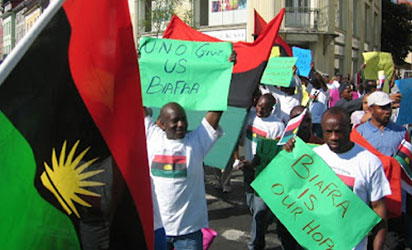
With the 1999 formation of the Movement for the Actualisation of the Sovereign State of Biafra, MASSOB, reawakening the physical agitation for self determination, the nation was taken by the storm, as other pro-Biafran groups have also emerged.
Though initially dismissed as posing no threat to the corporate existence of the country, the gradual spread and modus oparandi of the groups, have raised a lot concern.
Investigations by Vanguard Features, VF showed that while a section of the public finds the resurgence of the issue more than four decades after the war, disturbing, others, especially Igbos, are sympathetic to the pro-Biafran agitations.
Those compassionate with the cause believe that the Igbos were displaced in the Nigerian equation, economically and politically. They maintain that the psyche of Ndigbo was debased for losing the war.
But the question remains: Does the agitations reflect the collective aspiration of Igbos at the moment?
This poser does not ignore Gowon’s declaration outlawing Biafra. VF recalls that Gowon had in his speech titled: “The Dawn of National Reconciliation”, sounded a death knell on the Biafran question
.’’The so-called ‘Rising Sun of Biafra’ is set for ever. It will be a great disservice for anyone to continue to use the word Biafra to refer to any part of the East Central State of Nigeria. The tragic chapter of violence is just ended. We are at the dawn of national reconciliation. Once again, we have an opportunity to build a new nation,’’he noted on the day Gen Philip Effiong of Biafra surrendered to Gowon at Dodan Barracks, Lagos.
Speaking on the matter, a civil war veteran, Col Joe Achuzia told VF that those behind the latest pro-Biafran invasion of a Radio House in Enugu, were on their own. As far as he is concerned, they want to drag Ndigbo into Nigeria’s problems.
’’Those behind the Enugu invasion want to drag Biafra into the current problems in Nigeria. We should not be dragged into Nigeria’s problem. We have nothing to do with them,” he stated.
Asked if the agitations of the major pro-Biafran group, MASSOB, were in line with the present collective aspiration of Ndigbo, Achuzia responded with a question.
”What does the OPC reflect? What about Afenifere?”
Continuing, he said: “What these groups reflect could be likened to what MASSOB is doing. So long as MASSOB serves the interest of the Igbos, we acknowledge it.”
Leader of the All Progressive Congress,APC, in Lagos State, Chief Campbell Umeh agrees that the Biafra cause is still relevant. But he cautiously disowned the activities of pro-Biafran associations that are inimical to the interest of the state.
“Biafra is a child of necessity and today the necessity is still Ojukwu- championed Biafra not because of greed but as a result the extermination of Igbos across the country. In Biafra, Igbos derived an identity,” Umeh argued.
He supported other arguments that failure of the RRR policy is responsible for pro-Biafran demands.
”After the defeat, the terms of re-integration was not followed. And the failure of that indicates that the war is still there. So that keeps Biafra alive,” Umeh added.
Going down memory lane, he remembered the contentious abandoned properties issue, saying: “When the war ended the abandoned properties matter was not properly handled. Today many people are still bitter about that. When you say no victor no vanquished, it should be real. You remember that every Igbo man was given 20 pounds each; that one is still a source of anger.”
The APGA chieftain however added thus: “We agreed on ‘One Nigeria’, but people are entitled to their aspirations. I don’t see myself following the path of war. That does not mean that the Biafran question is no more relevant.”
Despite his affection for the Biafran cause, Umeh disowned the manner in which pro-Biafran groups are going about the matter.
”We can only caution the young boys doing this because their methods of operation are not acceptable. I am only asking the Federal Government to find a way of addressing the issues that triggered the formation of these groups,” he submitted.
Disclaimer
Comments expressed here do not reflect the opinions of Vanguard newspapers or any employee thereof.