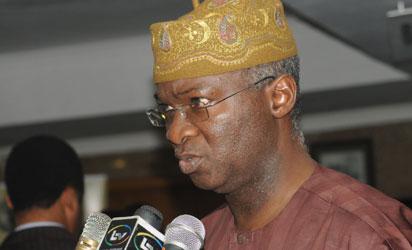
Babatunde Fashola
By GODFREY BIVBERE & IFEYINWA OBI
LAGOS — Lagos State governor, Babatunde Fashola has said his administration will go ahead with the construction of the Lekki link bridge without waiting for Federal Government approval.
Also, he said he will not seek for any approval before embarking on the state ferry service.
Governor Fashola spoke in Lagos, yesterday, during the 13th National Council on Transportation, with the theme ‘Transformation of Transport Infrastructure as a Catalyst for Socio economic Growth.’

Governor Babatunde Fashola of Lagos state
According to Fashola, it was absurd for an agency like the National Inland Waterways Authority, NIWA, to require his administration to apply for a permit to build the Lekki link bridge over the Lagos lagoon or to develop municipal water transportation facilities, which would be beneficial to Lagosians.
He said: “I believe that each state has the capacity to operate and manage its municipal water transport, inside the territory of the state.
“I find it difficult a situation, where NIWA asks me to come and take up a permit before I set up a jetty on my own lagoon; we will not stand for it. I also find it objectionable, where NIWA suggests to me that before we can build the Lekki link bridge, over a lagoon inside Lagos, I should come and take a permit to build a bridge for the citizens of Lagos; we will not apply for it.
…assures of liveable Lagos
Lagos State Governor, Mr. Babatunde Fashola, yesterday, flagged off the Lagos Liveable City Conference 2013, declaring that in grappling with challenges of managing the Mega City that Lagos had become the well-being of the people including the man on the street, who remained the central focus of government.
The Governor, who spoke at the opening of the conference with the theme, ‘Preparing for the Mental and Social Health Needs of the Lagos Megacity,’ explained that the project of governance in a mega city “is first and lastly for the people and about the people including the man on the street who must be able to live in it.
“He must be able to breathe in it. He must be able to dream in it – dream for himself, for his family, for his succeeding generations. He must be safe in it.”
According to the Governor, doing so, however, required that, “he must know the rules of engagement in the defining transactions of his city – including his interactions with the law enforcement agents, his financial institutions, his moral and religious institutions.”
Governor Fashola challenged the participants to come up with ideas and implementable suggestions on the listed matters, noting that he was already thinking about the structures that could be put in place to carry the inter-ministerial, cross-territorial project forward, beyond the deliberations of the conference.
He recalled the experience of a particular person who migrated to Lagos some years ago with no possessions, but just a beautiful voice and who had succeeded in living a respectable life, describing his experience as a symptom of the liveability in Lagos.
“The essence of this conference will be partly how we can multiply these opportunities in such a way that other people’s journeys to Lagos do not end in slavery, destitution, crime, drug abuse, mental illness or sudden and avoidable death”, he said.
The other main objective of the conference, according to the Governor, would be the exposition of the responsibilities that come with rights and opportunities which constitutes responsibilities that emphasise the nature of the commonwealth from which the successes of liveable cities derive.
He identified the responsibilities to include prompt and voluntary payment of taxes by those who earn incomes, compliance with laws, rules and regulations, such as public health laws, sanitation laws, traffic laws, building and planning laws and so much more.
“Indeed they will also be defined by responsibilities driven by codes of morality and compassion for humanity that drives us to support the physically challenged, the elderly, the vulnerable and those with special needs”, he reiterated.
The Governor said he is concerned and sometimes obsessively so, about that man on the street as he is often nameless and faceless, but in reality has a name, a face and a story.
He stated that statistically the man on the street is only one out of the over twenty-one million residents in Lagos and may be forgiven if he gets lost in the crowd just as he may be also be forgiven if he himself does not believe he matters in the scheme of things.
“We may forgive him when he keeps his demands and expectations from the superstructure of the state minimal, with little faith in the likelihood of their fulfilment, and absolutely no sense that he has any power to demand or enforce their actualisation.
“The leader, the city planner, the dreamer of great city concepts, the builder of great iconic monuments may also be forgiven if, in the lofty scale of his vision, he has failed to take the little man on board”, the Governor stated.
Governor Fashola recalled that during the last general elections, he had to request that the physically challenged people be allowed to vote first, adding that though all the people in his polling station agreed, the question he had asked himself is whether the same thing happened in all other polling stations and if it did not what can be done to ensure that it happens at the next election?
“How can we make it a way of life for us to create special queues for people with special needs in our airports, supermarkets and other public places? What must be our common strategy for responding to and supporting people with mental infirmity?”
“How do we evolve a strategy of re-integration for prisoners who have served out their punishment with demonstrable contrition and penitence, so that they can have a new beginning?” he asked.
Governor added that the listed points are some of the main reasons why a conference like Liveable City Conference has become a necessity as the State Government grapples with the challenges of managing the mega city that Lagos has become.
“How healthy is our general environment? How do we deal with our traffic? How caring a society are we? Are there a lot of visibly mentally ill or intellectually challenged persons wandering unattended through our streets?”, the Governor stressed.
Governor Fashola asserted that while it is true that there exists a rich harvest of data about the origins and evolution of cities as centres of human habitation, it is doubtful whether there is an agreeable gold standard that is applicable to all cities about what exactly makes them liveable.
He stressed that this must be so because as long as cities are about human civilization, their sizes, the diversity and complexity of their people, they provide understandable justification for the difference in their liveability needs.
The Governor explained that in many Nigerian cities, Lagos included, the liveability challenges are perhaps more intense at the bottom of the pyramid as dictated by the demands of a large, growing and youthful population while on the contrary, in Japan, the liveability challenges are today defined by how a younger population can generate enough resources to sustain an aging and growing population with over 50,000 people now living over the age of 100 years.
He said recently the liveability challenge in Lagos is being defined by the need to reduce fatalities arising from road traffic accidents, adding that one year after implementing an amended road traffic law, state wide incidents of road traffic accidents from motorcycles dropped from 646 accidents a month to 112 accidents a month.
“Deaths from motorcycle accidents dropped from 15 a month to one in a month, and no deaths at all were recorded in August, September and October this year. But that has not been the only reward”, the Governor stated.
He declared: “We have seen an emergence of more streets jogging by our citizens, more bicycles by our children, and although this was not initially an objective, we seize on the promise of a healthier, fitter and less prone to obesity citizenry. This has led us to a re-assessment of our road infrastructure designs and the first dedicated bicycle lanes are on the way as a pilot scheme to support liveability”.
Governor Fashola said the plurality of the Lagos society, its immigrant population and its commercial appeal define very clearly the responsibility that is upon the government to support all those who call the city their home.
“Whether they are rich or poor, whether they are indigenous or immigrant, whether they are able bodied or disabled, men or women, old or young, Christian, Moslem or atheist, the big question is how can we make this economic and commercial magnet liveable and inclusive for all of them”, he emphasized.
Speaking earlier, the State Commissioner for Health, Dr Jide Idris expressed the optimism that with the opening of the 2013 Liveable City Conference no one will leave the venue asking about what is the connection between security and health and what is the relevance of transportation to health or what is the government’s business.
He explained that cities offer both the best and the worst environment for health as everything is holistically connected to everything else and that the creativity of a society can be significantly enhanced or limited by the mental well being of the generality of its citizenry.
The conference featured presentations on society and crime, environmental psychology on the first day by Ekiti State Governor, Dr Kayode Fayemi, renowned geographer, Dr Andrea Koch- Kraft and Consultant Psychiatrist, Dr Richard Gater among others.
Prominent among those who attended the event were the Ekiti State Governor, Dr Kayode Fayemi, members of the State Executive Council including the Special Adviser on Health, Dr (Mrs) Yewande Adeshina, Attorney General and Commissioner for Justice, Mr Ade Ipaiye, the Secretary to the State Government, Dr (Mrs) Ranti Adebule, the Asoju Oba of Lagos, Sir Molade Okoya-Thomas and Baba Eto of Lagos, Chief Folarin Coker and several other dignitaries.
Disclaimer
Comments expressed here do not reflect the opinions of Vanguard newspapers or any employee thereof.