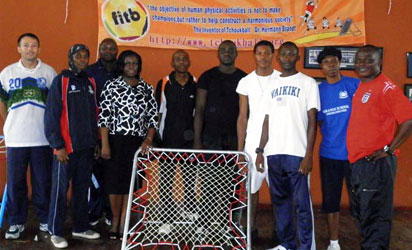
READY TO ROLL . . . Members of the International Tchoukball Federation officials after a media briefing heralding a competition will be held from August 10th to 12th in Togo.
Sports has held an undeniable place in the history of mankind. In spite of the noble ideals of sports, there are some times that the frail human nature tends to bastardise it by violating fair play.
We have witnessed cases of sportsmen taking performance enhancing drugs to win. A common attribute of sports are also injuries. The careers of many have been unceremoniously cut short due to them.
A Swiss biologist, Hermann Brandt was highly disturbed about the evil effects of unhealthy competition and he was so concerned about the numerous injuries on sportsmen that he opined “The objective of all physical activities is not to make champions, but make contributions in the building of a harmonious society.” The product of his thoughts was the development of tchoukball.

READY TO ROLL . . . Members of the International Tchoukball Federation officials after a media briefing heralding a competition will be held from August 10th to 12th in Togo.
The sport is usually played on an outdoor court measuring 27 by 16 metres. At each end there is a frame which measures one metre and a semi-circular D-shaped forbidden zone measuring three metres in radius. Each team can score on both ends on the field, with seven playing at a time. In order to score a point, the ball must be thrown by an attacking player, hit the frame and bounce outside the D without being caught by the defending team. Physical contact is prohibited, and defenders may not attempt to intercept the attacking team’s passes. Players may take three steps with the ball, hold the ball for a maximum of three seconds, and teams may not pass the ball more than three times before shooting at the frame. The ball used weighs between 325 and 475 grams and has a circumference of 54 to 60 centimetres. Two teams of seven players each play at a time with the aim of one of them gaining the most points at the end of the game.
Fouls are also a feature of the game and they come into play when the ball touches the ground during passing, more than three contacts are made, the ball is held for more than three seconds, the ball is touched with any part of the body below the knee, any form of interception is made whether deliberately or accidentally, while the other team is passing or physically preventing another player from catching the ball. Substitution of players during the game is also allowed during the game and is unlimited – all players can be substituted in the course of it.
There is the International Federation for Tchoukball (FITB) which was founded in 1971 and currently based in Geneva. The game is now played in thirty-five countries. The first world championship game was played in China in 1984.
The sport is new in Nigeria and the fact that it is free from injuries which is a bane of most sports is a strong reason why it should be promoted.
Quality Assurance and Research Development Agency, Nigeria, an educational NGO in Nigeria in Lekki, Lagos has been promoting it in Nigeria. It realised the importance of sports in the development of students. Since 2011, it has, in collaboration with the International Federation of Tchoukball (FITB), organised series of trainings for Physical and Health Education Teachers in schools such as British International School, Corona, Crescent, Grange, Meadow Hall, Lagos Preparatory School, Peak Lane, Green Springs, Chrisland, Starling, Clemmy High and Children’s International School.
Qaardan has worked in close collaboration with Julio Calegari, a Brazilian coach of the game. He has been a member of the Brazilian Physical Education Council as a coach and instructor.
The frames used for the sport is made locally by a Nigerian and is the agency’s miniscule way of promoting local content and entrepreneurship.
The tournament in Africa is scheduled to hold in Togo this August between the 10th and 12th with some Nigerian representatives.
Theresa Okafor, Director Qaardan.
Disclaimer
Comments expressed here do not reflect the opinions of Vanguard newspapers or any employee thereof.