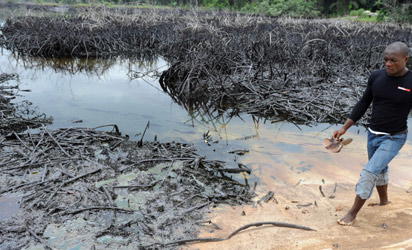
OIl spill
By Oscarline ONWUEMENYI with agency reports
Many industry watchers were shocked by recent pronouncements by the Federal Government and some operators that the nation loses over $1billion monthly to activities of oil thieves in the Niger Delta region.
The financial and environmental impacts of illegal oil bunkering in the country have reached an alarming level, and demands crucial intervention by the government if the life-blood of the nation is not to be drained.
Oil theft siphons the main source of the Nigerian economy for private gains before taxation or crediting to the national account. Various experts have estimated the volume of oil theft at between 100,000 and 250,000 barrels per day or as much as 91 million barrels yearly or billions of dollars in lost revenue.
Individuals benefitting from the sale of stolen oil do not re-invest in oil exploration or production. While some of the revenues may filter down to inhabitants by way of pay-offs, the bulk of earnings are diverted outside the country into the international bank accounts of the beneficiaries.
Environmental damage
Tampering with or sabotage to pipelines and flow-stations and careless handling during the bunkering process cause the greatest environmental damage to the region, according to environmental activists. Vast areas of the Niger Delta have become saturated with oil as a result of the many oil spills associated with illegal bunkering and pipeline sabotage.
Traditional livelihoods, such as fishing and farming, have become increasingly difficult if not impossible to pursue. Alternative jobs, however, have not been created for the largely unskilled and poorly educated residents of the impacted areas.
The Nigerian National Petroleum Corporation, NNPC, ecently warned that the acts of illegal oil bunkering in the Niger Delta could expose the region to the worst environmental disasters ever faced in the history of the country. The Corporation also disclosed that the country presently loses over 180,000 barrels of crude oil per day to oil thieves, warning that if unchecked, such criminal activities could cripple the nation’s oil and gas production.
The Group Managing Director of the NNPC, Mr. Austen Oniwon, stated this when he hosted the House of Representatives Committee on Petroleum Resources (Upstream), led by its Chairman, Hon. Ajibola Muraina, who was visiting the Corporation’s headquarters in Abuja as part of the Committee’s oversight function.
Meanwhile, the Executive Secretary of the Nigeria Extractive Industries Transparency Initiative, NEITI, Mrs. Zainab Ahmed, has also raised an alarm over the increasing rate of oil theft in parts the Niger Delta, and urged government to declare a national emergency to tackle the menace of illegal bunkering in the sector.
Ahmed noted that a recent facility tour of Shell oil exploration activities in the Niger Delta conducted by the NEITI management, had revealed “mind-boggling theft of petroleum products. The increasing rate of stealing of crude through illegal oil bunkering activities in the creeks, the activities of oil thieves,
Oil operations
Multinational oil companies operating in the country have taken a direct hit due to the activities of oil thieves. Shell, which is probably the worst victim due to its vast oil and gas assets in the Niger Delta, has come out with a statement lamenting the impact of illegal oil bunkering on its many pipelines.
“There have been 10 additional oil bunkering incidents in the Eastern Niger Delta since Shell shut down production from Imo River on the August 28, this year, following an upsurge of sabotage activities, which have severely impacted the environment,” the company said in a statement recently.
“Some of the latest incidents are on the Okordia–Rumuekpe trunk line, Imo River–Ogale trunk line and Buguma–Alakiri trunk line. Four separate incidents were reported on sections of the Obigbo North delivery line at Komkom and Ogale,” it added. It noted that an overfly showed unknown persons had drilled holes and installed valves to transfer crude to waiting barges and trucks and, in the process, polluting farm lands and water bodies.
Some 16 oil theft points were discovered in Imo River field in September alone. The unprecedented scale of crude theft in the area forced SPDC to shut the field, resulting in deferment of about 25,000 barrels of oil per day. Production will remain suspended until the crude theft and refining activities have stopped.
More than 75 per cent of all oil spill incidents and more than 70 per cent of all oil spilled from SPDC facilities in the delta between 2006 and 2010 were caused by sabotage, theft and illegal refining. Shell also announced lifting the force majeure which had been declared on Forcados loadings, following completion of repairs on the Trans Forcados Pipeline.
Justifying the illegality
The justification often given for the unfortunate acts is that residents who have no opportunity to earn a legitimate living have more incentive to engage in pipeline sabotage and oil theft. One popular pastime involves demanding monetary compensation for environmental damage.
Villagers are keen to direct oil spills whether accidental or intentional to their communities for the short-term economic benefit of selling the oil on the local market or claiming damages from the International Oil Companies, IOCs.
According to environmentalists, communities vandalise pipelines to claim compensation. A more sophisticated economic model entails communities forming “service companies” which offer either “protection” or “environmental clean-up” services. Local inhabitants on the payrolls of these companies either provide armed guards for installations or conduct environmental “clean-up” after spills, which residents may or may not have caused.
These local environmental clean-up companies, which usually lack training and equipment, often expose their workers to serious health risks. Some village leaders allegedly charge IOCs for operating in their areas with the threat that if they do not get “settled” illegal bunkering or militant attacks would occur.
Fueling insecurity
Many of the arms in circulation in the Niger Delta, including a variety of sophisticated weapons, have been purchased with money derived directly or indirectly from illegal bunkering. Insecurity in some parts of the country results in part, from accessibility of oil-purchased arms with illegal bunkering serving as a major contributor to Nigeria’s violent crime, armed robbery, piracy and kidnapping.
The immense wealth derived from illegal bunkering ensures that those profiting from it have no interest in a well-policed, stable Niger Delta. Many interlocutors have stressed that peace in the Niger Delta will reduce the opportunities for profit from illegal bunkering activities.
They suggest that everyone along the chain, from the president’s inner circle to those “service” companies that profit from “protection money,” will resist finding a permanent solution. These interests will persist beyond amnesty, according to these sources.
It has also been reported that some Joint Task Force, JTF members, in particular, remain reluctant to see an end to the “crisis” in the Niger Delta, according to many sources. Officers and enlisted personnel allegedly pay large premiums for the opportunity to serve in the JTF because the profits derived from protecting or participating in illegal bunkering far outweighs such premiums and the risks of deployment.
Nigerian Navy officers allegedly pay up to $30,000 for the opportunity to serve in the Delta. Some military officers are so successful that they have bought multi-million dollar homes in high-end neighborhoods in Lagos.
Profits from illegal bunkering became high enough in the last several years to enable both JTF members and “militants” to profit and co-exist without seriously interfering with each other’s activities. Some observers compared the relationship between the JTF and major militant groups to arrangements between rival gangs in U.S. urban areas.
Generally, each JTF unit and militant band have its own territory in which they operated and from which they derived their illicit incomes. Fighting only erupted when disputes arose about boundaries or when one group “poached” in the territory of another or did not “settle” the other properly.
Some observers assert that the JTF offensive in May 2010 largely resulted from a misunderstanding between militant leader Tom Polo and a new JTF commander that escalated out of control. Many sources speculate that the impact of the amnesty will be a return to the “status quo ante” before the May offensive in Delta; i.e., relative peace will enable both sides to pursue their business interests without large displays of force on either side and despite the “lip service” about “cracking down” on illegal bunkerers.
Indeed, widespread illegal bunkering has led to control by armed bands over large areas in the oil-producing states. While some armed groups claimed political objectives, others remained openly criminal; all armed groups intimidated and dominated the communities in the territory they controlled thereby undermining traditional leadership and social structures.
Militant presence also made these communities more likely to become targets for military action. Tens of thousands of inhabitants fled their homes and hid in the jungle for weeks during the May offensive against militants in Delta State.
The presence of armed bands also inhibited the delivery of regular government services and infrastructure, rendering the areas dominated by militants ungovernable and isolated from democratic institutions and processes.
Disclaimer
Comments expressed here do not reflect the opinions of Vanguard newspapers or any employee thereof.