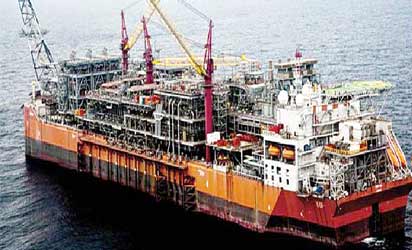
FPSO Vessel
Jim Rex-Lawson MOSES
INTRO:
A FPSO (Floating, Production, Storage and Offloading) system is a converted or custom-built ship-shaped floater, employed to process oil and gas and for temporary storage of the oil prior to transshipment. The FPSO system is used extensively by oil companies for the purpose of storing oil from the oil rigs in the middle of the ocean and in the high seas.
It is one of the best devised systems to have developed in the oil exploration industry for the marine areas. Often a converted tanker, these will sometimes have production facilities onboard, and are normally used in areas where a pipeline to transport oil to shore isn’t available. Typically a shuttle tanker will moor alongside the FPSO and offload the stored oil periodically.
FPSOs have made the greatest inroads and, accounting for 63% of all FPS installations, they remain the dominant force in the global floating production landscape. Thirty years on from their first appearance, FPSO systems still dominate the offshore market, and are unlikely to relinquish their position any time soon.
Innovative technologies, coupled with developments of existing ones, have played a big part in maintaining this standing for so long. The system is foolproof, enables cost efficiency and thus becomes a very major asset when it comes to excavating for oil in the marine areas.
WHAT THEN IS FPSO?
According to Wikipedia, A floating production, storage and offloading (FPSO) unit is a floating vessel used by the offshore industry for the processing of hydrocarbons and for storage of oil. A FPSO vessel is designed to receive hydrocarbons produced from nearby platforms or subsea template, process them, and store oil until it can be offloaded onto a tanker or transported through a pipeline.
FPSOs are preferred in frontier offshore regions as they are easy to install, and do not require a local pipeline infrastructure to export oil. FPSOs can be a conversion of an oil tanker or can be a vessel built specially for the application.
UNDERSTANDING FPSO
Production: The ‘P’ in the FPSO refers to production. And production means evolving the crude oil tapped from the deeper parts of the ocean. The FPSO is enabled and fitted with equipments that acts as a refinery of sort to distil the oil obtained from the ocean along with the gases that are emitted. This is the main feature of a FPSO as only with the help of this feature can a FPSO attain the reliability that it enjoys in today’s times.

FPSO Vessel
Production is usually conducted in 3phases: separation of gas, separation of water, and separation of oil. Gas recovered/separated during production may be used as fuel on Marine energy resource units (MRU) fitted on board. Gas may be flared off in some cases if MRU is not fitted. Water separation may be carried out using Dehydrators or Hydro Cyclones.
STORAGE:
The ‘S’ in the acronym FPSO refers to storage and it is the second most important feature in this system. It is the second-most important because just as it is important to filter the excavated oil from its oceanic reservoirs, it is equally important to store it properly.
For this purpose, the FPSO is built in such a way that the tubes, pipes, and the tanks are perfect for storing the distilled product from the crude raw-material to resist any chances of unwanted oil spillage and thus contamination of the marine life-forms and the environment.
OFFLOADING:
Letter ‘O’, in the concept of a FPSO stands for offloading. The offloading aspect is equally important when the FPSO has to transfer its content into ships designed for carrying oil or to pipelines that act as transfer agents.
In simple terms, offloading refers to removing the cargo in a FPSO and transferring it to another cargo-carrying vessel or equipment. The offloading part is very technical as the process is carried out in the middle of the sea and thus requires a lot of concentration and focus in order to avoid any sort of spillage.
MECHANISM:
There are two main types of FPSOs today; those built converting an existing oil tanker, and those that are purpose-built. The FPSO design will depend on the area of operation. In benign waters, the FPSO may have a simple box shape or may be a converted tanker.
Generally (though not always) the production lines otherwise known as risers are connected to a major component of the vessel, called a Turret, which allows the vessel to rotate in order to head into the wind and reduce environmental forces on the moorings. In relatively calm waters, such as in West Africa, turrets can be located externally to the ship structure, hanging off the bow of the FPSO. For harsher environments like the North Sea, the turret is generally located internally.
The turrets and the mooring systems can also be designed to be disconnectible or to remain permanently moored. While most FPSOs are ship-shaped, some FPSOs have a semi-submersible type hull with storage (very rare), or have a cylindrical hull. The inherent symmetry of these FPSO configurations makes turrets unnecessary, so the platforms remain in a fixed orientation.
An FPSO has the capability to carry out some form of separation process. If the unit does not have such facilities, it is generally referred to as a Floating Storage and Offloading unit, and would be operated in conjunction with a production platform. Process plant on FPSO is a core component on facility and forms a key part of the production process.
BENEFITS:
Technology advancements since the inception of FPSOs have seen the arrival of a host of features, from geostationary turrets to allow the vessel to turn and ride prevailing weather, to the wider inclusion of water or gas injection and gas-lifts.
Also, its simplicity as an offshore production facility, capable of accumulating and storing oil before periodically offloading it to tankers for transport to the mainland – gives it an obvious logistic and economic appeal. Not only does this directly permit the rationalisation of shuttle tanker movements but, more fundamentally, it can also allow marginal oil fields, or those in deepwater areas at some physical distance from existing pipelines, to be developed.
The system is foolproof, enables cost efficiency and thus becomes a very major asset when it comes to excavating for oil in the marine areas: it does not require the laying of pipelines and can be moved to new locations.
Finally, FPSOs eliminate the need for costly and expansive underwater infrastructure, they are more environmentally friendly than rigs, and their abandonment costs are less than for fixed platforms.
Disclaimer
Comments expressed here do not reflect the opinions of Vanguard newspapers or any employee thereof.