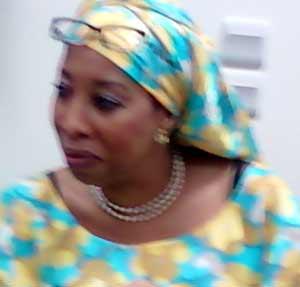
Hon. Nnenna Elendu-Ukeje
By Victoria Ojeme
…‘Why it was difficult to evacuate citizens from Libya’
In this interview, the chairman of the House of Representatives Committee on Foreign Affairs, Hon. Nnenna Elendu-Ukeje unveils the plan to make Nigerians the focal point of the nation’s foreign policy. She also gives reasons why it was difficult to evacuate citizens from Libya Excerpts:
What’s the legislative agenda on foreign affairs?
I, as a Representative, have seven items on my agenda – but what I have and the agenda of the House of Representatives are replicated in most of our committees. We have stringent oversight measures on ministries, departments and agencies in the areas of appropriations, policies and laws. This is where the oversight of our legislative agenda comes in. Basically, whatever we do in foreign affairs committee will be to take a critical look at the recently reformed foreign policy thrust and agenda of Nigeria. Just recently, new ambassadors were inaugurated.
One of the things the committee on foreign affairs intends to do is to take Nigeria back to where it used to be in the comity of nations. Now this committee intends to, as a matter of policy, bring back ethics and codes of diplomacy in Nigeria. Because we want the citizens to be the focal point of our nation’s foreign policy, the Diaspora Desk of our foreign missions is being strengthened so that it can engage fully with our citizens abroad.
Furthermore, in the fallout of the Nigeria-Libya crisis, we found out that one of the problems that we had as a country was that we didn’t have a total inventory of the number of Nigerians that reside outside this country. Now, what we are doing is to see that these missions have a roll of Nigerians so that we can track them should the need arise for, say evacuation.
On the roll of Nigerians, how far has the missions abroad gone in compliance with this?
It is work in progress and it is something everybody understands its importance. The United States, for example, would insist that once its citizens gets into Nigeria, they must register with the embassy. Unfortunately, some of our citizens do not even register with our foreign missions because many of them go there out of status. We intend to find out how far the compliance has gone. This was one of the reasons it was difficult to evacuate our citizens from Libya; the problem was that we did not know the exact number of Nigerians in that country.
Have you been able to also take the roll of Nigerians in prisons abroad?
As at two weeks ago, we got a report about 800 Nigerians in prisons in Togo. In the case of China, the details are scanty. But one country that we have a clear inventory is the United Kingdom and we are working on a bill that will aid prisoner exchange. Of course the National Assembly in the last session discussed how Nigerians in prisons in other countries can come back to Nigeria.
What is the thrust of Nigeria’s foreign policy? Is it investment-driven or democracy-driven?
Nigeria has reviewed its foreign policy 11 times in 50 years. The reason there was a need for the review of our foreign policy is that, right now, the world is getting smaller and smaller and we are beginning to have countries without borders and, because of our interactions, most of these countries are joined at the Hague by our destiny at the time.
We had all sorts of bilateral and multilateral agreements with a lot of countries. We had bi-national commission with countries like the UK, the USA, we just signed one with Germany, we have one with South Africa, etc. So we cannot have a single foreign policy thrust, we cannot say its only citizen-based. So our new foreign policy thrust is one that is alive to our responsibilities. What are the things we want in Nigeria?

Hon. Nnenna Elendu-Ukeje
We want greater patriotism which supports what John F Kennedy said when he asked Americans not to think of what their country could do for them but what they could do for their country; we have also come to realize that unless people have faith in the country, they will not give back to the country; so citizen-based diplomacy is another thing. Like I said earlier, we are looking at strengthening our Diaspora Desk. One of the ways to do that is to actually know the number of Nigerians out there.
So that in itself is a thrust. We also believe in Nigeria, that the greatest right of a human being is the right to choose the people that govern them. And we believe that unless the entire region is safe, we are not safe in Nigeria because there is proliferation of small fire arms and there is movement around our borders. We are becoming one large entity, so there is movement of arms everywhere. So, we are exporting peace around Africa, to ensure that Nigeria is peaceful.
Another thing we have found because of our present recent reality of terrorism in Nigeria is that a lot of these arms are imported both in ideal and small quantities. So, basically another thing that we are looking at is being strong in the region so that there will be relative peace in the region as far as it affects our country.
Concerning our agreements on trading partnership around the world, it’s economic-driven. So we are also strengthening our friendship with countries that are our trade partners. We are also interested in being the world leader, to be able to give leadership as we did in the Libyan crisis, take charge of the region, promote peace and democracy around the world and, increase our trading partnership. And of course, we want to give back integrity to the people under the entity called Nigeria, carrying the green passport.
Talking about economic diplomacy, when you look at Nigeria being the giant of Africa and our contribution to peace and development in this region, you will discover that what Nigeria does at times is that we don’t reap from our efforts in other countries. We have cases like Liberia, Sierra Leone where other countries are benefiting from what they did not contribute. When you look at the
Directorate of Technical Aid Corps, you will see that we have contributed so much in that aspect but Nigeria has not been given anything. What is your take?
We have had to review our foreign policy a good number of times and it is because everybody has come to the realization that even though we play the big brother role, it is not reciprocated in a lot of ways, that we have come back to a place where we are looking at profitable engagements.
We all feel that we have been short changed, to a large extent; of course leadership in the region is not only about economic profit to the country, we are after all the giant of Africa. We are the one everybody looks up to, but that has worked in our favour.
But in line with the new foreign policy thrust on trade and reciprocity, we are probably going to do good things in a better way. We have looked at those issues and learnt from them. We will continue to engage. We will continue to drive the process, we will continue to export peace everywhere and we will start to export with the doctrine of reciprocity.
What is the House doing to assist the ministry in funding our missions abroad?
I believe our missions are grossly underfunded. Now, of course Nigeria has a very ambitious foreign policy. We are trying to sell our Nigerianness around the world, we are trying to gain respect around the world, we are trying for people to take us seriously, we are trying for us to interact on trade, but I think that our missions abroad are seriously under-funded, grossly under-funded.
Mr. President, while visiting Sao Tome and Principle, stated that more money was going to be sent to our missions,he made the same pledge in London, about two weeks ago. The President of the Senate said the same thing at the inauguration of parliament. The Speaker of the House of Representatives said it; the chairman of the Senate committee said it.
However, the reality on ground is that the funding of these missions remains less than one percent of the nation’s budget. Which means that, if we want to actually drive our foreign policy thrust, it takes money? The bone of contention with the ministry at the time during the budget defense was that we felt the ministry exists because of the missions. We felt the missions were under-funded; we had issues with certain sub-heads in the ministry.
Which sub heads?
There was ambiguity on security, there is something called security vote, we thought there was funding for overseas trips. We thought that that was not the money we needed. But we felt that in line with the president’s directive of 25 percent over head, that we are going to do a bit of house keeping which is what we’ve promised in the committee in the House to take some money from their over heads and move it to the missions.Those were the issues we had.
We are all in agreement that the missions are under-funded and one of the goals of this committee for the 7th assembly is that we are going to take a critical look at our missions and ensure that our missions actually are able to drive the country’s foreign policy. Many people have stated that we have to trim down our missions in line with the nation’s budget. I do not feel, for instance, that, that would work. For instance, Cameroon has three missions. I think we can shut down some of those missions and move them down to the east coast.
I think that if you shut down missions in certain areas, you might be giving the impression that you are shutting down diplomatic relations in those countries. Now, the fallout of that is not a good thing. Basically, what we are going to be looking at is what I call redistribution of our missions. I think for a country as strong, big and visible as Nigeria, we must be coming up with a foreign policy that will work; I think we must put our money where our aspirations are.
And if our aspiration is to become one of the greatest and largest economy by the year 2020, and we need credibility everywhere in the world, we must put our money there. I think the missions are grossly under-funded and I think that anybody who has anything to do that is listening and with the hope that we can actually drive our foreign policy.
Nigerians are badly treated by foreign missions in Nigeria when they seek travel visa. Do you think the recent visa and immigration review should go beyond South Africa?
In the spirit of reciprocity, we have engaged the ministry and I know that they are going to check on these embassies. For instance, the United States, I think, has started giving 5 years visa to Nigerian business men. So, basically, for us, its reciprocity. Now a lot of the issues that we have, we are sitting down and we are taking inventory. We are doing a lot of house keeping on the countries that we engage regularly and finding out how they treat our citizens with regards to visa requirements.
I get quite a few complaints as well from people who have been asked to come back a couple of times by our missions over visa requirements. So I understand that everybody is tightening immigration laws around the world including Nigeria. The House of Representatives just had a review of our immigration laws to tighten our borders and strengthen our consulate. So I know that it is a trend that is going on around the world and I am very quick to say that Nigeria is not a over.
The posting of non-career diplomats to Nigeria’s foreign missions has been identified as a major challenge in our foreign policy initiative. What is your opinion on this?
There are career diplomats and political appointees who become ambassadors. Now, a lot of people, especially career diplomats, keep things to the ratio. This year, they were 88 and 58 were career diplomats. Basically, it is skewed in favour of career diplomats, as indeed it should be.
But I know that, with time, it’s going to get better and we are going to start to have a more balanced ratio. I am probably thinking 80-20 because it is a specialized area and I am very careful considering that I may want to be an ambassador one day.
Disclaimer
Comments expressed here do not reflect the opinions of Vanguard newspapers or any employee thereof.