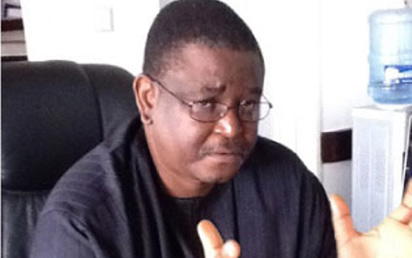
*Omadachi Oklobia…“I will not start a project and abandon it.”
BY PETER DURU, MAKURDI
Mr. Omadachi Oklobia is the Benue State Commissioner for Finance. In this interview, he spoke on various economic issues including policies and programmes of the Suswam-led administration in the state.
The Benue State Governor recently presented the 2012 Appropriation Bill to the State House of Assembly. Can you give us a general overview of that budget?
You would recall that His Excellency presented the budget recently to the Benue State House of Assembly. You would also recall that in his presentation, he made clear what was the basis of the 2012 budget.
The first thing he said which constitutes the theme of the budget is to ensure actualisation of further development in our dear state. The second thing that he clearly stated is the completion of all ongoing projects especially critical infrastructure which are critical to the development of the state.
In that, he mentioned the completion of the Benue State University Teaching Hospital which is now at an advanced stage. He also talked about additional kilometers of urban and rural roads across the three geo-political zones of the state.
He also talked about initiating one or two urban and semi-urban water schemes. Central to this are the Otukpa Water Works, the Ayiin Water Works and the fact that he intends to also start one in Guma Local Government area. He also talked about revitalization our ailing industries but in this case, through private-public partnership.
We have received a couple of investors in the state who have been interested in some of our ailing industries and we are talking with them and discussions between these investors and the Ministry of Commerce is at an advanced stage.
These industries are already up for investors to fund. One of such is the Benue Fruit Juice Factory here in Makurdi. A Memorandum of Understanding has been signed in respect of that; also, the Orange and Juice Factory in Yandev, Gboko. Discussions are at an advanced stage and we hope to sign an MoU on that soon.
And you are also aware that we signed an MoU for the revitalization and management of Taraku Mills last year, and the investors have injected money into it and they are working on reviving it. Then, we also have one or two people interested in the plastic plant. These and many more are on track.
The other thing that he also talked about is the renovation of primary and secondary schools across the state. We are partnering with the Universal Basic Education Board in Abuja to raise some funds. As I speak to you, we have raised about N4.2 billion which we will be putting into renovation of schools across the state.

*Omadachi Oklobia...“I will not start a project and abandon it.”
We have advertised through due process and we have been receiving a lot of interests from contractors who are interested in participating in that process. Also, we are doing a lot in the area of health especially in the renovation of General hospitals across the state.
We have released some money to contractors and we are setting up a process of monitoring and ensuring that all of these are done to specification.
The governor also clearly stated in the 2012 Budget speech that he intends to improve on social and economic wellbeing of the citizens of the state; including the issue of security. As we got into 2012, the governor purchased additional vehicles for ‘Operation Zenda,’ the police outfit that helps secure our streets across the state. My understanding is that these vehicles will be commissioned within the next one or two weeks from now. So, a lot is going on.
The governor has implemented the new minimum wage. In fact, in Benue State, we pay more than N18,000 as minimum wage. We are paying N19,200 as minimum wage. It is the governor’s gesture of showing appreciation to civil servants in the state.
He intends to continue to maintain that and ensure that we pay minimum wage as approved following the negotiations that we had between the state government and the Nigerian Labour Congress (NLC).
There is a general conception especially from the opposition parties that the budget as presented by the Governor has several contradictions or overlaps. Can you clarify the issue?
Well, I’ve heard this issue of overlapping expenditure items. Now, if you understand the way the budget is and if you also understand the position of the Governor of Benue State, from day one, he said: “I will not start a project and abandon it.” That is what he said.
Therefore, what that means is that if he started a project in 2008 and if he does not complete that project, are you telling me that he should remove it from the budget and therefore not complete it? The other thing again that we fail to understand about the budget process is, you could start a road that also has a bridge and the completion period is 21 months, that therefore means that the project will cut across two different budgets.
Then you also factor in the starting date of the project. Remember a lot of the construction that requires earth work, there is a period during which you can’t do maximum work on the field because of our weather. Therefore, during that period, the contractors will demobilise and work will slow down, meaning that the work that started say, in March, 2010 with a 12-month duration will finish in 2011.
Now, if it does, because this government is responsible and is transparent, we have to account for that project in the new fiscal year and so, we must put it in the budget for the balance of the project. So, if a project started in say year one at N100 million and the total project is N130 million, it means that in year two, the N30 million will be provided for.
However, if in the event that in year one, you were not able to deploy the whole N100 million, it means that you are going to carry over the remaining balance plus the additional N30 million of the subsequent year. That is the way it works.
Now, if a project is supposed to be started in year one and you only expended a particular amount, not all of the amount and then that project is not repeated for the balance of payment in year two, what that means is that you abandoned it. The governor said from day one that he is not the governor that will abandon projects.
Recently, Governor Suswam said the 2012 Budget was prepared in anticipation that fuel subsidy would be removed. He said with the subsidy still there, Benue State has lost N7.6 billion. Can you clarify this issue?
What happened was that when we were preparing the 2012 Budget, the issue of subsidy removal was on the table and from the information we got from the Federal Ministry of Finance, Benue State Government was going to get N7.6 billion as refund on the removal of subsidy.
If you look at the SURE document, that information is there. However, when negotiations between Labour and the Federal Government went the way it did and the issue of total removal of subsidy was reversed, and we now have increase in the price of PMS from N65 to N97, what that meant was that there is no guarantee that the N7.6 billion that we are anticipating was going to come again.
However, we are in dialogue with the Federation Account Committee and the Federal Ministry of Finance to see what happens now as we go forward in this fiscal year. But if in the event like the governor said, that does not come, that amounts to a short fall in our anticipated revenue for 2012.
Now, what that means is that we will have to adjust along the line because that is no longer going to come. One or two projects will suffer but the priority projects will not suffer.
Would that also mean that the governor might either down-size the workforce or reduce the minimum wage?
The governor has not said that he is going to retrench or downsize. He has not said so. What he has said is that he has directed the Civil Service Commission to prepare vacancies and the Civil Service Commission and the Office of the Head of Service are already working day and night preparing vacancies.
He has also directed that those who are due for retirement should be encouraged to leave and to ensure that monies are paid to them for their gratuity. He has also directed all local government chairmen to begin to register all unemployed youths in all the 23 local government areas of the state for purposes of employment.
He is also creating situations in public works to make sure he can employ young people in the Ministry of Water and Environment where we can employ people. So, the argument that he is going to retrench is absolutely wrong.
The governor is committed to the agreement between government and Labour on the minimum wage. He is not going to go back on that and he is going to continue on that and infact, like I said, we are paying more than N18,000 minimum wage; we are paying N19,200.
We have paid in December, we have paid in January and we are going to continue to pay it. The non-removal of fuel subsidy will not cause us to say that we are going to retrench.
Another issue that has attracted so much criticism to the budget is that of IGR. In the budget presentation, the governor told the people of Benue State that the state generated N1.6 billion last year. But from information gathered from the BIRS, the chairman actually said he generates N500 million monthly. Summed together, that gives us about N6 billion. So, one begins to wonder about the discrepancies.
They are not discrepancies. Now, this is the intrigue, when the governor read his 2012 Budget, he said what has come into treasury is N1.6 billion. Now, the chairman of the Benue Internal Revenue Board (BIRS) would have captured that of all other revenues that agencies collect.
Now, some of the revenues, because of the law establishing these agencies, they collect and utilise directly; whether it’s school fees in primary schools or water rates at the Water Board and so on. So, if you add up all of that, it would give you what the BIRS chairman is saying as total IGR collected.
And that is different from what came into treasury. But because for accountability sake, we have to account for everything, that is the point of the BIRS chairman. So, they are no conflicting issues at all.
Now, on the issue of bond, the general belief is that the state collected N13 billion bond last year for some specific projects and these same projects are still being given allocation in the 2012 Budget. What is your take on this?
When the bond came in,of course you have to account for it. So, it came in and we tagged it as part and parcel of revenues that came into the state. If the money came in and we didn’t account for it, it means we are not being responsible.
And the best way to account for any revenue coming to the state is the budget. So, we accounted for it in the budget like you rightly said. Then two, if you account for something, you also indicate where it is going to. So, the actual bond money is going to the projects that you find in the budget.
They are not additional money. What is important is to know that the specific items that we went to the Security and Exchange Commission (SEC) with to get the bond are still being funded and we have not completed them. The other thing that you also need to know is that we did not say that the bond is 100% funding of these projects.
The bond was additional funding to fast-track the projects. And because of the way the bond was going to come in, it was not going to come in like traditional account that is in a sense unpredictable in terms of size and when.
The bond was predictable, we have access to all of the money and therefore it would fast-track these projects. And if you go round, you would see that these projects are actually being fast-tracked; whether it’s the water works, the road construction or some of the jobs in the education and health sectors, or the repayment of some loans that we inherited or the renovations that we’ve taken up in the area of the bond.
So, the bond is being utilised as prescribed and as passed by the House of Assembly. So, we are on track in terms of what the law says.
There are basically four areas but principally, three areas that the bond was utilised in. One is road construction, the second is water projects and the third is education/health. In the area of water works, the first is the Makurdi Water Works.
Some portion of the bond was spent there and you are aware that the project is ready for commissioning. We also took part of it to fund Katsina-Ala Water Works and Otobi-Otukpo Water Works. We also took part of the bond to fund the Ayiin Water Scheme and then the Otukpa water supply scheme.
All of these water works were ready for commissioning before the end of June except for the Otukpa water scheme that had slight delay because they had to adjust the original design. That will be commissioned, I’m sure by July. What we said when we took it was that we plan to complete as much as we can, the construction and completion of the Benue State University Teaching Hospital.
And you know that the teaching hospital is the only state teaching hospital in the whole of northern Nigeria. And so, it’s something that we pride ourselves in and we want to ensure that we complete it. And it’s going to serve as a platform for the teaching of medical science students at the Benue State University and deliver quality secondary and tertiary health care services to the people of the state.
This is what we seek to achieve and that is why we took part of the bond for it and I’m happy to tell you that a lot of work has been done there.
In the area of roads, when we took the bond, we itemized seven major roads that lead to the three senatorial districts of the state including telecommunication and greatly enhancing access for rural communities to markets, health centers and other government services.
This is the basis on which we took the money we had from the bond and put on the seven major roads.
And if you go and check on these major roads, they cut across the three senatorial districts. The bond was taken on specific projects which are being funded. Then, there are other reasons why we took the bond which is not obvious in the sense that it is not a list of projects.
And that is when you go to the bond market, you are required to comply with certain rules and regulations in terms of how you maintain your account. It’s a very stringent regulation. The state government decided to put the state through that process so that we standardize our account, our procedures and processes to make sure that we are up to date.
And we are. We are releasing all our accounts from 2007 to date in a short while to the public to look at. The accounts are ready and we are going to publish them and make them public. And then, we keep quarterly reports on all our utilisation of public funds.
These are some of the things that you are required to do when you take the bond. Bond is not like you go into the market and buy tomao at your will. It’s much more than that. It’s a very rigorous process. Basically, you open your account and ensure that your account is straight and in compliance with the rules and regulations prescribed by the SEC.
To that extent, I can say that we’ve become due process compliant, we are transparent and we have a standard accounting system in the state. So, apart from accessing money to fund projects, we also wanted to take ourselves through the rigours of getting the bond to sort of testing the strength of our system.
And the fact that we were able to go through it and get N13 billion meant that our system was good enough because if our system was not good enough, we wouldn’t have been able to access the bond.
In terms of implementation, how much percentage was achieved in last year’s budget?
Again, if you look at the governor’s speech on the 2012 Budget, he was very clear as to the performance of the 2011 Budget. In the area of recurrent expenditure, we did extremely well whereas in the area of capital expenditure, we slightly did not do as much as we expected largely because some of the funds did not come as we expected.
But on the whole, I can say that we did well. The 2011 Budget certainly performed much more than the 2010 Budget. In 2011, the total realised was N63.6 billion. So, if you juxtapose that figure against the 2010 figure, you would find that we are short 100 per cent by about 11 per cent of total budget. On the whole, we can argue that the 2011 Budget performed about 89 per cent of total budget. However, I’ll like you to know that the final figure for November and December are still being worked out and I hope that by next week, I will get the report of the figures of November and December. So, we have projected November and December and it is on the basis of that projection that w
e say that the 2011 Budget performed 89 per cent.
Disclaimer
Comments expressed here do not reflect the opinions of Vanguard newspapers or any employee thereof.