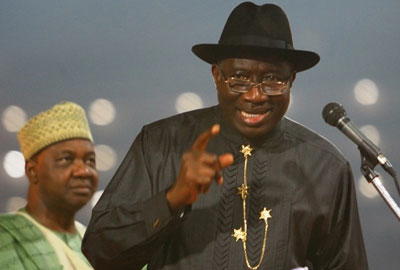
President Goodluck Jonathan
By Emmanuel Aziken, Political Editor
After the most prolonged strike in recent Nigerian history, submissions on the effect on the Jonathan presidency are at opposite ends.
THe strike action has not in any way diminished the President, but rather made him stronger,” Barrister John Chijena, national coordinator of Youths Ask for Goodluck, an offshoot of Youths Ask for Good Governance said yesterday afternoon moments after the strike action called by the coalition of organised labour and civil society was called off.
A learned colleague of his, Barrister Bamidele Aturu, one of the country’s leading civil rights advocates agreed but only to the extent of demonstration of strength by the President.
In mobilizing soldiers on the last day of the strike yesterday, Aturu who was himself leading demonstrators along Ikorodu Road, Lagos, said President Jonathan had made his administration the most unpopular in the history of the country.
“The government has unfortunately become the most unpopular government in the history of this country. This would be in my recent recollection the only civilian government that would unleash the military on protesters, it is a very sad day for our democracy,” Aturu said in a telephone interview yesterday.
Earlier that yesterday, President Jonathan had given his readiness to combat the irritations caused by the strike in an early morning broadcast to the nation.
“Government will not condone brazen acts of criminality and subversion. As President, I have sworn to uphold the unity, peace and order of the Nigerian State and by the grace of God, I intend to fully and effectively discharge that responsibility. Let me add that we are desirous of further engagements with Labour. I urge our Labour leaders to call off their strike, and go back to work,” the President said.
His stern mien was according to many a reflection of his determination to forcibly stop the daily gatherings that turned the whole country into an ungovernable state for most of the six days that the strike lasted.
Embarrassingly for the presidency, the strike action was seen as one of the most successful strike actions ever called by organised labour in the country.
Nigerians across tribe and religion were united in their denunciation of the administration’s increase in the price of petrol from N65 per litre to N138 or more under the policy of deregulation. The claimed deregulation was quickly faulted by many Nigerians who said that the administration by continuing to fix prices through the Petroleum Products Pricing Regulatory Agency, PPPRA had lost the basic principles of deregulation.

President Goodluck Jonathan
The unanimity of Nigerians was clearly demonstrated on one of the striking days when Christians in the Occupy Nigeria centre in Abuja encircled their Muslim colleagues as the latter had their afternoon prayers.
Remarkably, many Nigerians were especially vexed by the timing of the price increase. It was done when many citizens had travelled causing a number of the travelers to be stranded at their destinations. It was also done just seven days after the Christmas Day bombing and other killings in mostly the Northeastern part of the country.
Security threats
While the administration laid feeble in resolving the security threats against citizens, many were perplexed that the government could mobilize its energies into confronting the populace during the strike action.
As Aturu said yesterday, “so for me, this government cannot be taken seriously by any serious democrat, because the man has shifted himself from one who allegedly got a pan-Nigerian mandate only a few months ago to the President of a village, President of Otueke, by sponsoring ethnic jingoists to support his illegal and controversial deregulation policy. And that shows that the man does not have the capacity to see things in broad ways.”
Irrespective of Aturu’s criticisms, many cite the perceived hijacking of the protests by other political interests for the President’s tough stance. The Lagos protests showed Pastor Tunde Bakare, the running mate of the Congress for Progressive Change, CPC presidential candidate, Gen. Muhammadu Buhari, and Buhari’s spokesman, Yinka Odumakin mount the stage to repeatedly denounce the President, sometimes using acerbic languages against the President.
In Abuja a confidant of the CPC leader, Mallam Nasir El-Rufai was a central mobiliser of the protest at the federal capital. Besides leading the protests, El-Rufai also was on television giving facts and figures to counter the administration’s position. With the country almost grinding to a halt, it was as such not surprising that fears of a major threat to the nation’s security, if not a threat to the democratic form of government, became a major concern for the administration.
As labour leaders concluded the last negotiations with the government team yesterday morning at the presidential villa, word was reportedly passed around the delegation that labour had been infiltrated by fifth columnists who were aiming to overthrow the administration.
It was a take it or leave it scenario that labour was as such faced with. Indeed, before the last negotiations that began on Sunday night, there were suggestions of the readiness of government to revert to the N65 per litre regime on the condition that labour would accede to full deregulation by March or April.
The alleged security threats, however, changed all such permutations causing the hardening of government’s position. As Chijena, who remains unwavering in his support of the President said yesterday evening: “The luck we have is that the NLC and TUC called it off because other people almost hijacked it, it turned a political strike, people were not reading between the lines.”
Chijena is nevertheless minded that the President must “tackle corruption, tackle wasteful expenditure and other negative vices that put distrust between the people and past governments. The problem we have is that we are dwelling in the past and the people have had other governments promise heaven on earth and at the end of the day they don’t deliver,” he said as he called for more support for the Jonathan administration.
Asked if the strike has diminished the President, Chijena said: “This strike has not diminished, what the strike will do is that it is going to make him become stronger. You know when a man discovers loopholes in the structure, he then tightens the structure, so the President is going to look at those working with him and find out whether those people are useful or not.”
Aturu is, however, of the contrary view saying that the Jonathan administration has become a lame duck.
“I think that the truth of the matter is that the Jonathan presidency is now a lame duck administration. As from the 9th of this month when the strike became full blown it became lame duck and it is now a descent to barbarism under a purportedly democratic administration.”
Whatever are the conclusions the fact is that the Jonathan presidency would never be the same again!
Disclaimer
Comments expressed here do not reflect the opinions of Vanguard newspapers or any employee thereof.