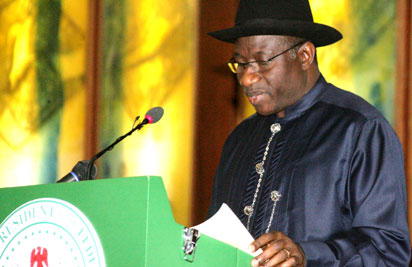
President Jonathan.
PRESIDENT Goodluck Jonathan is providing leadership by words. His prescriptions for surviving the plain and plentiful pain that increasing the price of petrol will cause are examples of how he leads us. Our President is out of touch with Nigerians – it shows.
How did he know the outrageous price of diesel was not affecting the economy? Did he speak to manufacturers? Does he know many companies are moving their operations to Ghana because of regular electricity? Is he aware of how many companies that have shut down because of high cost of diesel?
His explanation that most mass transit buses and trailers conveying goods use diesel and the impact of the increase in fuel price would be minimal is typical and clearly shows how distant government is from the people. Where are the buses that would replace private vehicles?
Should a government that talks about savings not be concerned about wastes in the economy beyond fuel imports? Why do the refineries not work? When will the refineries work? What has happened to the billions of Naira spent on turn around maintenance of refineries? Why do the rails not work? Does government not know the roads would last longer if the bulk of goods from the seaports were moved by rail? Does government know how the death of the rails has hurt economic activities in many rural communities that depended on rail transportation? Are these not concerns to address, to stimulate growth in the economy, particularly in rural Nigeria?
Government cannot provide electricity. Every Nigerian generates his own electricity. Anyone operating a business, even the small barber, generates electricity, using fuel or diesel. Government has failed to address electricity. Government ignores the consequences of this waste, and its complications for health (noise and carbon monoxide pollutions). Will increase in price of fuel improve electricity?
President Jonathan is still focused on oil. “The professionals are making predictions that the oil reserve that we have, will dry up in 35 to 40 years. So even now that we have oil, we are borrowing and we are not expanding the economy, in the next 35 to 40 years, assuming we do not discover more oil reserves, what will happen to our children and grandchildren?,” Jonathan asks ordinary Nigerians who expect him to tell us.
There is no problem with borrowing, except that government borrows not for capital projects but for the constant expansion of its unproductive bureaucracy. Capital projects, in the 2012 budget euphorically called “Budget of Fiscal Consolidation,” is only 28 per cent, a slight improvement on 26 per cent in 2011. How will the country develop when its leaders spend its resources on themselves?
“I know the pains Nigerians are passing through, yes I am here in the State House and being fed by government, but that does not keep me so far from the people,” Jonathan said. Doubtlessly, he is not unemployed, does not go for days without a meal, does not pay house rents, does not generate his own electricity, and is not uncertain whether he can send his children to school.
Jonathan’s consistent comparison of global price of fuel with Nigeria is provocative. Why does he not compare electricity, public transportation and the level of infrastructure in those places with Nigeria? He should simply tell Nigeria he does not care what pain they will feel with the increase. It is a better position.
He cannot feel the pains of Nigerians. In his circumstances, he is hardly the Nigerian who will suffer the consequences of a mismanaged economy, though he trusted his leaders to have made decisions that would serve Nigerians.
Disclaimer
Comments expressed here do not reflect the opinions of Vanguard newspapers or any employee thereof.