BY BASHIR ADEFAKA
Dim Emeka Odumegwu Ojukwu’s death, last Saturday, has continued to generate comments from eminent Nigerians, especially those who were with him from the time of the Civil War till his death.
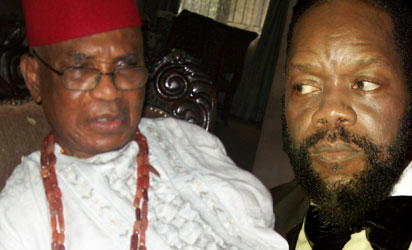
Igwe Alex Nwokedi, a veteran journalist and Igbo monarch who served in the war as head of counter intelligence under Ojukwu’s Republic of Biafra gives graphic details of Ojukwu’s health in London hospital.

Your Majesty was very close to the late Ikemba of Nnewi, Dim Emeka Odumegwu Ojukwu so much that you visited him at his London hospital before he died. What is your account of his life in London hospital?
When I visited London, I went to the hospital where he was admitted. His chief- of- staff was with him and I was told upon entering the ward that I should just hold his hand and speak; that he could hear but he could not talk. I held his hand and greeted him, “Gburugburu,” that is Igwe of Igbo Land. He was a very good Catholic. I told him that he had suffered for the Igbo and that our mother, the Blessed Virgin Mary would take very good care of him.
I spoke to him, encouraged him but to tell you the truth, I was not happy at all with his situation. There was a Philipino nurse taking care of him, and his daughter was also there with him. They were the only two people with him in that ward. I told the daughter that as she was taking care of her father, that our Lord would bless her and that her own children would pay her back by taking good care of her. Then, I left the hospital and since then, I have been saying Novena Mass for him so that our good Lord would take good care of him.
Also, during my visit to him in London, I was told how General Gowon used to call every day to ask after his health. That really touched me. I was the one who suggested to his General Practitioner, GP, Dr. Koyi Ugboma, who recommended him to specialists in London that they should put the ailing Ojukwu in a wheel chair and move him around because to lie in that position without being moved around could be very tormenting. I told him also that after taking him around and he became normal, that they should bring him back to Enugu where his people would be coming to visit him and that itself would make him fine because he was very lonesome.
How did your relationship with him start?
I knew Ojukwu in the early 60s through my late brother, the Igwe I took over from, Igwe Charles Nwokedi. He was a very good friend of Ojukwu. When I was with the Daily Times as a reporter. I was on leave sometime and I went to my brother in Aba. He and Ojukwu lived together when Ojukwu was the District Officer. Ojukwu came to the airport in Enugu to pick me in ‘calm and gear’ vehicle. That was what they called the car that time, and he drove me from Enugu to my brother’s house in Aba. And all along, we chatted very well. He was telling me about his days in King’s College and I was telling him too about my days in St. Gregory’s College. We were chatting that way until we got home.
Since then, we were meeting quite regularly in my brother’s place till the (civil) war started.
Was there anything about Ojukwu’s character then that suggested he could lead a war in the magnitude of Biafra Civil War?
Ojukwu was a very kind hearted man. With the war, he became the man of the century. He sacrificed a lot to take the Igbo out of slavery. His father was a very rich man and he had all the money of his father but still, he sacrificed everything he had and volunteered to wage the war, which was imposed on him.
You said the war was imposed on him. How?
That war was imposed him because he didn’t start it. He was not in the (first) coup. In fact, he was among those to be killed but he narrowly escaped, and after the coup, they went for Ahiara Declaration, which Vanguard is serializing. And you know what happened? After the Aburi Accord in Ghana and they all came back, the then ‘Super’ Permanent Secretaries went to convince the Head of State, General Yakubu Gowon and they reneged from what they all agreed on in Ghana.
Nobody would say that the killing of Igbos at that time was a good thing but Nigerians kept quiet. Ojukwu did not start the war. Nigerians started the war, they attacked us and we defended ourselves.
I must say that somebody like the then, Lt. Col. Theophilus Danjuma, being a very disciplined officer, made sure that he was fighting a war and not personality. But for the discipline he instilled in the One Division of the Nigerian Army that he commanded at that time, the war would have lingered on and probably Biafrans could have gone into guerrilla warfare.
Well, I don’t agree with him for his coup and I don’t agree with his remarks, which he wrote about General Aguiyi Ironsi. But when you talk about the Civil War, the truth there is that General Danjuma, who was then a lieutenant colonel, was a very disciplined commander and he disciplined his division very well, which played a role in how the war ended. We also have to thank General Gowon for his declaration of ‘no victor, no vanquished’.
Another person who is very important on how the war really ended was a deputy inspector-general of police then, Chief Theo Fagbola. As a matter of fact, Fagbola could be said to be the architect of the end of the Civil War in Nigeria.
Chief Awolowo has always been mentioned in this regard. How did Fagbola come into it?
I am coming to that. When the Owelle of Onitsha and former President, late Dr. Nnamdi Azikiwe, was in the plane travelling to Liberia, Fagbola was in the plane. He delayed the flight and took Dr. Azikiwe to Dodan Barracks and that was the beginning of the end of the Civil War because it was as a result of that action that the Igbo became divided as to whether to surrender or continue with the war or not.
We all respected Dr. Nnamdi Azikiwe and for him to be seen in Dodan Barracks at that time talking with the Nigerian side caused the division of opinions among the Igbos and that was the end of the war, though General Obasanjo ended it physically and General Gowon sealed it up with his might and magnanimity.
I’m therefore using this medium to call on the government to give a post-humous award to the late DIG, Chief Theo Fagbola for his noble role in how the move for the end of the Civil War started. His taking Dr. Azikiwe to Dodan Barracks was the beginning of the dialogues and negotiations that eventually ended the war.
Igbo without Ojukwu
First and foremost, we the Igbo shall immortalize him. As a matter of fact, I’m calling on the Anambra State House of Assembly to pass a resolution that Anambra State should be called Biafra State to immortalize Ojukwu.
Does that not sound inciting considering the issue on ground regarding MASSOB?
We are not doing it with war again. It should be done constitutionally because Ojukwu was and he is still a great man in death as you can see. And as a matter of fact, for the seven days declared for mourning, I urge all traditional rulers not to wear beads; any Igbo man who is a traditional ruler should not wear beads as a sign of mourning our late great leader.
The chief mourner is the Governor of Anambra State, Dr. Peter Obi. You have linked his recent return of schools to missionaries as part of the signs that the Civil War has finally ended. Could you throw more light on this?
I don’t know about the political aspect of it but all I know is that our governor, Peter Obi, returned schools to their original owners and that, again, is a landmark of the end of the Civil War. By handing over those schools to the voluntary organizations who have the will to run them, he has virtually told the Igbos not only in Anambra State but elsewhere that the Civil War has ended.
How do I mean? Yes, because taking schools away in the first place from voluntary agencies was an attempt to destroy the educational power that was the pride of the Igbo and to tell you the fact, it was the reason the Igbo did not like Anthony Ukpabi Asika, the former governor of East Central State. He was the one who took over the schools. I think he said he was forced to do it because at that time,what they were talking about in the country was educational imbalance and the North was always talking of imbalance in education in Nigeria and taking schools away from the missions in the East at that time was a calculated attempt to destroy the pride of the Igbo which was the education.
When you look at it, while Hausas were talking about education imbalance, the Igbo, instead of complaining, didn’t but rather they strived to catch up with the Yoruba so much that today there are more lawyers, doctors and engineers in Igboland than they are in Yorubaland.
And this happened because, instead of shouting education imbalance, we started to build schools all over Igboland. At that time, there were only Christ the King College, Government College Umuahia and about two others. But when the missionaries came, they started building schools and so we had many schools all over the place.
I must say that as Igbo, we should be proud of ourselves. And when again they wanted to destroy us, Ojukwu resisted it and led us during the war that was imposed on us. We fought that war to defend ourselves. We did not start it.
We did not fight that war to break Nigeria. The Igbo were foremost in nationalist struggle in this country. Most Nigerians who went to jail were Igbo and some Northerners, of course, like Mallam Abdullahi and Tanbo Gawaba. We had Okoye, Abuna, Peter Osugo, many Igbo who went to jail fighting for this country. Does it then make sense to say the Igbo would want to destroy what they built? I’m asking you: do you think we should destroy what we built? The Igbo did not fight the war to break Nigeria but we fought the war to defend ourselves; we fought the war to defend our faith and knowledge.
There are people who were very close to Ojukwu and only they can talk about him, not the kind of talks that I have been hearing or reading by some people who don’t know him. There are people like Uche Chukwumerije, Dr. Benard Odogwu, who was the head of the Directorate of Military Intelligence under Ojukwu’s Biafra and under whom I served during the war as the head of counter intelligence. So those who know Ojukwu should speak. I will always remain proud of him and as far as I am concerned. Ojukwu will always remain a hero, who saved the Igbo from slavery.
Is it still a case that the Igbo will never forget Awolowo for the role he played in their loss of secession?
It was what he said that caused it. He said everything we had was just N20 and it was too hard on us but that will not stop me from recognizing him as a great man who, as Federal Commissioner for Finance, fought the war without borrowing money. The truth must be said.
I have very high regards for Papa Awolowo and I have a very, very high regard for General Yakubu Gowon; he has a big heart, he’s a brother and an uncle to the Igbo. Similarly, somebody like Danjuma must be acknowledged here as a great man. While the Third Marine Commando in the West was just busy killing people any how, Lt. Col. Danjuma instilled discipline in his own division and that helped a lot in stopping the war from escalating beyond what it was.
Disclaimer
Comments expressed here do not reflect the opinions of Vanguard newspapers or any employee thereof.