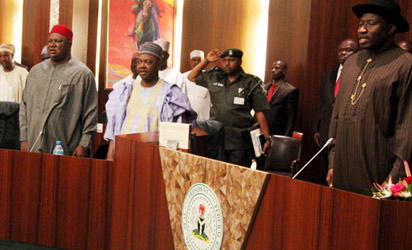
From the right, President Goodluck Jonathan; Vice President Namadi Sambo; SGF, Senator Pius Anyim; Head of Service, sinning the National Anthem at the opening of the periodic meeting of the Federal Executive Council at the State House, Abuja. Photo by Abayomi Adeshida 19/10/2011
MY apprehension that the Arab revolutions might trigger unbridled reign of terrorism after the fashion of Afghanistan, Iraq and Somalia is receding, somewhat.
The situation is still fluid, tensile. But the ways the revolutionaries have packaged the transition to democracy (not civil rule, as in our case) have been methodical and liable to result in success.
The revolutions in Tunisia and Egypt could not remove the powerful military establishments that bolstered the President Zine El Abidine Ben Ali and Hosni Mubarak regimes. They were entrusted with the responsibility of supervising the election of transitional regimes that would draw up new people’s constitutions as prelude to general elections, which will usher in full-blown democracy. In Libya, the Muamar Gaddafi army was defeated in war by the revolutionaries. On-going arrangements point in the direction of the election of an interim government that would supervise the transition to democracy.
At the end, it will not be the military that will dictate the shape of the constitutional order. That would have been the case if Mubarak and Ben Ali had been allowed to conduct the transition programmes. They would simply have manipulated the process and handed over to “safe hands”, as the Yemeni dictator, Ali Abdullah Saleh, would put it. And that would have left these countries in pretty much the same situation as we in Nigeria have found ourselves.
We have had two completed transitions from military to civilian regimes in 1979 and 1999. Both were written by panels appointed by the military, which put the constitutional documents in the shape the military wanted before handing over to the civilians. The 1999 Constitution of the Federal Republic of Nigeria (which is merely an amendment of the 1979 document) is generally seen as anything but the people’s constitution. Many legal opinions have dismissed its preamble of “We, the People of the Federal Republic of Nigeria: HAVING firmly and solemnly resolved….” as a lie.
The military thus handed over to Nigerians a constitution that favoured the interests of the dominant section of the military establishment, which favoured a strong centre and weak peripheries. The section of the country that dominated the military also imposed a fake majority status upon themselves, ensuring that their part of the country would continue to have the upper hand in terms of representation in the National Assembly and revenue allocation.
Constitutional order
The North, having taken the lion’s share, gave the second spot to the West in gratitude for their role in stopping the East from seceding with their oil resources. They left a constitutional order that would be almost impossible to change through democratic, peaceful means, since those favoured by it would always be there to use their “majority” votes in the National Assembly to block any attempt to bring about democratic change.
The current financial crisis facing many states in the federation owes to the dependency syndrome which the constitution we operate has foisted on the federating units. The states depend on the monthly federal allocations for (in most cases) up to 95 per cent of funds to run their governments. Many states have ground to a halt after the Federation Accounts Allocation Committee, FAAC, was unable to share money for the current month.
When the civil war ended in 1970, the new ruling class, in their celebration of victory, started a consumption binge built upon the oil wealth of the country. It soon became a national trend and today, recurrent expenditure takes about 75 per cent of the annual budget of the federation and most of the states. Outside the monthly federal allocations, only Lagos State might be able to continue to function. The cost of governance has gone through the roof. There is little left to develop the country. In other words, the military class left us with a legacy of a Federal Government unable to develop the country, states economically unviable and local councils totally irrelevant in the lives of the citizens.
It is my considered opinion that Nigeria will never move forward unless we, the genuine people of Nigeria, restructure our federalism order. Many perspectives have been proffered as the way toward achieving a more workable arrangement.
The Obafemi Awolowo school of thought wants a federation based on ethnic groups or nationalities, a framework that the late Anthony Enahoro’s Movement for National Reformation, MNR, tried to work out. Their failure to satisfactorily classify the ethnic configurations only confirmed it as a mere academic exercise, since most ethnic groups in the country are not what they seem.
Another perspective was brought forward by the General Ibrahim Babangida regime, which tried to make the local government tier of government autonomous from the states. That arrangement has also been proved a failure after 12 years of experimentation.
The joint state/local government accounts put the latter in the pocket of the state governors. Also, no election into that “tier” of governance has produced a credible, democratic outcome. Governors routinely ignore constitutional provisions and dissolve local administrations at will (elected ones inclusive) and most local councils are run by sole administrators appointed by the governors. The local councils are unable to provide the people the most basic of needs.
Professor Jibril Aminu’s own idea of a perfect federation is one in which the centre is made even more powerful that it currently obtains in Nigeria. In his many papers on the subject, he calls for the abolition of the states, leaving only two tiers of government: the federal and local councils.
Alternatively, as many states as possible should be created because, according to him, the more states are created the weaker they are and the stronger the centre is. In his view, Nigeria requires a super-powerful centre to protect the citizens from their greedy and oppressive local elite and to ensure the no part of the country is strong enough to break up the federation.
Constitutional conference
I tend to gravitate more towards the Dr Alex Ekwueme formula which he tendered at the Constitutional Conference convened by the late General Sani Abacha in 1994-1995. It was that argument that led to the approval of the six geopolitical zones which, however, have never been reflected in any of our constitutions. I, however, differ from the Ekwueme blueprint in that I would like the states and local councils to be phased out. Let us have two tiers of government: the federal and six regional governments. It will be up to the various regions to decide how they take government closer to the people.
The Arewa North regions (North East, North West) may opt for emirates/districts/villages structure. The West might want to retain the local government system. The South East and South/South are likely to opt for county or community councils. These suggestions are based on what is already obtainable in these respective areas.
The current state and local government system can never produce good results. The Igbo nation is cheated under this arrangement, while the North and West have more than their share. This was an arrangement that came after the civil war was lost and won and the booties of war shared. The Constitution was created by the military to consecrate this arrangement as a permanent feature of the Nigerian federation to perpetuate injustice, indolence, parasitism, sectional arrogance and corruption.
And these are the reasons that Nigeria is a backward, poverty-stricken, violence-wracked and unmanageable civic entity. It cannot be cured through creation of more states or local governments. This will further increase the cost of governance and promote stagnation.
The way forward is radical, even revolutionary. But it is the only peaceful and viable way forward.
LASU fee hike
OVER the past one week, students
of the Lagos State University, LASU, have been staging series of demonstrations in rejection of the recent increase in school fees imposed by the authorities of the institution. The students are now to cough out N200,000 instead of the old N25,000 as tuition fees.
The students have been careening from pillar to post, storming the offices of the Governor, Deputy Governor and the State House of Assembly to demonstrate their dissatisfaction over this astronomical hike. That is understandable. What is not understandable, however, is the insensitivity of the authorities, who have now decided to engage the private universities in a school fees “arms race”. This 800% increase effectively means that workers who are to receive the N18,000 minimum wage are to lose the ability to give their children university education.
Coming from a generation of teachers, university administrators and political leaders who were educated free of charge by the Obafemi Awolowo and Lateef Jakande regimes, this is an unfortunate irony. Some people have climbed to the top and decided to kick away the ladder! Coming from Governor Babatunde Fashola whose regime has enjoyed fine reputation around the country as one of the most performing state governors, this is simply out of sync.
This issue must be looked into again. Increases in the financial burden of education, when necessary, must be gradual and mild enough to allow as many young people as are able and willing to acquire education. An uneducated citizen is a devalued citizen and often a dangerous citizen. Our leaders must think of the consequences of their decisions before taking them.
I thumb down this hike.
Disclaimer
Comments expressed here do not reflect the opinions of Vanguard newspapers or any employee thereof.