Acknowledgements and gratitude (1)
This Christmas season I had intended to engage in a critical investigation of religion given the powerful theological significance of the controversial purported birth of Jesus on December 25.







Will agonising fuel queues ever end?
It is, inexplicable, that despite Nigeria’s ranking as a major oil producer, our economy is still literally in shambles with a tattered currency and a crushing unemployment rate above 25%; we still unfortunately presently expend almost 50% of our total export revenue on fuel imported from some of those refineries which buy our crude oil. Regrettably, despite the regular recurrence of fuel scarcity, with its severe public discomfort, and ravaging economic dislocation, there is still no assurance that this tortuous cycle will ever end. However, if the inefficient, and wasteful sporadic operation of existing government refineries is anything to go by, any serious proposal for government to build and operate more refineries may just be a death wish.

Devaluation: IMF vs BUHARI
A Team from IMF, recently consulted with relevant government Agencies and officials to assess the economic impact of the crash in oil revenue and the proposed responses to address the ‘’near-term vulnerabilities’’ and those fundamental reforms which are required to promote sustained economic growth and reduce poverty.
Latent wealth with debt seeking mindset
The 2016 Appropriation Bill, has probably generated wider public interest and debate than any other annual budget in recent memory. The projected spending of over N6Tn is by far the highest ever, but will also require an exceptionally heavy loan of almost N2Tn to fund this budget, in which capital expenditure is allocated an unusually high, though still modest provision, of 30% of government’s total spending this year.
Dollar racketeering and enemies from within
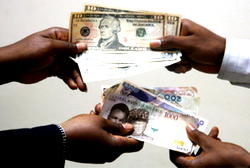
‘’There is nowhere in the world where Monetary Authorities fund Bureaus De Change (BDCs) directly with foreign exchange. The predominant patrons of Nigeria’s BDCs are predominantly, smugglers of unauthorised items, treasury looters, and others who cannot process formal documentation to access official foreign exchange. Curiously, the CBN’s formal policy to sell $400,000 weekly to each BDC translates to $1.6bn, for 1000 BDCs monthly.

To borrow or not to borrow
President Muhammed Buhari’s is proposing to spend over N6trillion in the 2016 Appropriation bill, even though government ‘reasonably’ expects to earn about N3.8trillion as revenue. Indeed, according to the budget proposals, N984bn will be borrowed in Naira from personal and corporate holders of surplus cash to fund the shortfall, while $4.5b (N900bn) will also be borrowed from the international market at the current exchange rate of about N200= $1 and prevailing commercial interest rates will apply.

Sensible path to stronger Naira, economic prosperity
Hereafter, we will discuss the related ADVERSE consequences of the Current Payments Model (CPM) against the positive attributes of the Advocated Payments Model (APM) for the allocation, for example, of $1bn export revenue in the following explanatory steps. Thus, in CPM: -1 The CBN unilaterally determines the naira exchange rate and thereafter unconstitutionally captures the distributable $1bn revenue and prints/creates in replacement (read as monetizes) N200bn as statutory allocations, which are then domiciled in the bank accounts of beneficiaries.
Can CBN save the Naira and Nigerians?
Historically, the CBN has compulsively devalued the Naira to bridge increasingly widening gaps between official and parallel exchange rates, even when these gaps were caused by the obtusely contrived monopolistic market dynamics of demand and supply. It would undoubtedly create much discomfort for CBN Management if unrestrained dollar demand further pushes parallel market rates well above N300=$1; in such event, CBN may again unwittingly, jerk up the official rate above N300 and remove the embedded ‘subsidy’ from the official Naira exchange rate so as to raise the dollar price and discourage demand and hopefully also minimise the inherent rent seeking market opportunities.

Wobbling, fumbling with fuel prices
The PPPRA Executive Secretary, Farouk Ahmed reportedly announced, at a press briefing on December 29th 2015 in Abuja, that a revised template for fuel pricing had been approved by the Agency; the announcement was evidently the formal manifestation of the ‘modulated pricing’ model earlier canvassed by Ibe Kachikwu, the NNPC CEO and current Minister of State for Petroleum. Thus, with the application of the new template, petrol price will be reduced from N87 to N86 in NNPC filling stations, while other marketers would sell at a pump price of N86.50/litre.

Is lagarde a fairy godmother or economic imperialist?
Christine Lagarde, the Managing Director of IMF, held strategic meetings last week with President Muhammad Buhari and some key members of Parliament and the federal executive. Godwin Emefiele the CBN Governor, also joined in the consultations with the IMF boss, who quickly dispelled the trending perception that her visit was programmed to initiate discussions on an imminent IMF Loan.

An unusual austerity budget for 2016
Ironically, despite his well attested frugal administrative style, President Buhari has unexpectedly, pumped up recurrent budget from N3.97Tn in 2015 to N4.28Tn in 2016. The downside of this expansion is that the additional borrowing will certainly increase government activity in the capital market, so that government will invariably continue to outbid and crowd out the real sector from access to cheap loans.