
By Osa Mbonu-Amadi
Madunacho Onyedikachi Wisdom is a UK-based Nigerian artist from the Igbo ethnic group. Both his Igbo ethnic origin and his training in Surveying and Geo-Informatics have profoundly influenced his work. For instance, his “Umu Ada” (Igbo daughters) series, featured in 2026 exhibitions, presented Igbo daughters as custodians of Igbo culture.
On the other hand, the precision observable in his work, and the sense of space one gets viewing them, are all results of influences from his training in Surveying and Geo-Informatics. His work revolves around the themes of identity and migration. Using landscapes and human forms, he explores memory, belonging, and continuity.
Before transitioning to art, where he fuses smart designs with in-depth feelings, Madunacho spent over ten years in land surveying. He also plays the guitar, which has further influenced his conceptual photography art practice.
His artistic efforts at heritage preservation, visible in his series such as “Nkwu (palm tree, 2025)”, “Njirimara” (cultural identity, 2026), and “Umu Ada” (Igbo daughters, 2026), helps to connect past experiences of ndigbo with the present state of things. His recent exhibitions like “Held in Common: Between Us” at Cista Art and “Horizons” at Allora Gallery, are testimonies to his growing presence on the international stage.
But amongst all those works mentioned above, the “Umu Ada” series is probably the most profound and impactful for two significant reasons.
First, in a society that has traditionally relegated the girl child to the background, the artist, perhaps through keen research, is able to unearth an important aspect of the same culture which recognises female children as guardians of the lineage and embodiment of morality. Second, the artist also discovered an aspect of the Igbo culture that recognises and venerates girl children as important instruments of communal continuity. Those two reasons are by virtue of women being the mothers and the first teachers of children who are the future of the community. It must have been these thoughts that gave birth to the series, “Umu Ada”.
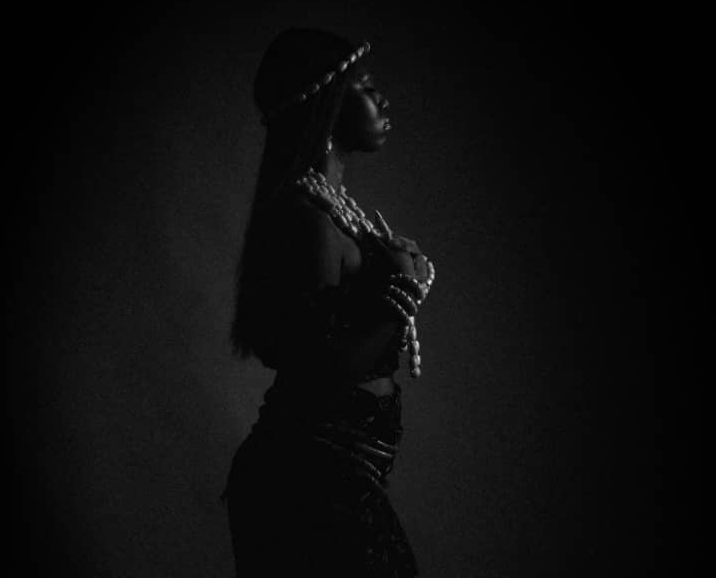
Through different types of coral beads (including the ones won on the waist called ‘ngbaji’) and cowries, Madunacho communicates the strength and dignity the “Umu Ada” posses in the Igbo culture, and at the same time, tell the cultural history of the people.
The “Ụmụ Ada” series fits perfectly into “Fragments of Her”, an exhibition organised in March 2026 by Espacio Gallery in London, and in which Madunacho participated. “Fragments of Her” celebrated female portraiture in all cultures, and showcased womanhood’s complexity through identity, strength, and vulnerability. As such, the “Umu Ada” series contributes an Igbo aspect of the theme to the exhibition.
In the “Umu Ada” series, as in all his works, we see how Madunacho Onyedikachi Wisdom is able to carry his technical surveying skills over to photographic art, using it to tell interesting stories that resonate beyond his Igbo culture. His masterful use of light and darkness in an almost one-colour (black) photo (save for a tiny sprinkle of white on the beads) to achieve breathtaking contrast is quite impressive. It is that near-total blackness that makes the work subtle, inviting us to reflect on the impact of migration and other themes of the work.
The “Umu Ada”, solidly rooted in tradition, and showcased in contemporary exhibitions, positions Madunacho as a strong voice in global conceptual photography.
Disclaimer
Comments expressed here do not reflect the opinions of Vanguard newspapers or any employee thereof.