
•.Seeks Otti’s urgent intervention
By Steve Oko
Ntalakwu, a quiet agrarian settlement in Bende Local Government Area of Abia State, is a land of abundance – rich soil, thriving farms, and resilient people. Yet, beneath this natural prosperity lies a deep, lingering neglect that has left the community stranded and miserable for decades.
Renowned as one of the food baskets of Abia, Ntalakwu produces cocoa, cassava, palm oil, okro , and corn in impressive quantities. Ironically, while food is plentiful, the access road is not. A custard bucket of garri sells for between N600 and N800 in the community, almost half the price in Umuahia, where it goes for about N1,500. A bottle of red oil, sold locally for N800-N1,000, fetches as much as N1,500 in urban markets.
The reason is painfully simple: there is no road.
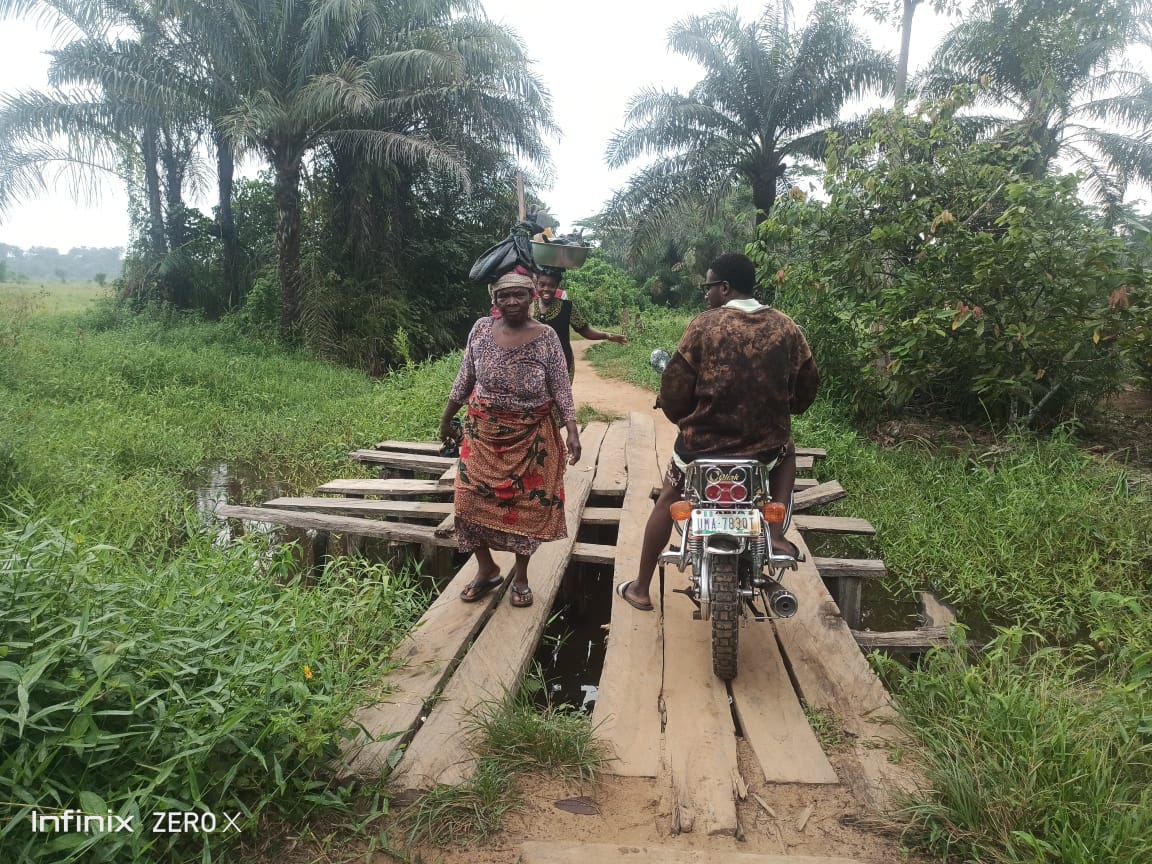
Located about 25 minutes from Bende town, beyond Itumbauzo and Okopedi, and sharing a boundary with Akwa Ibom State, Ntalakwu remains largely cut off due to a severely dilapidated access road. Once constructed during the era of the late Sam Mbakwe, the road has since deteriorated into a near-impassable stretch after decades of abandonment.
Today, tarred motorable access ends at Itumbauzo. Although the Abia State Government has begun intervention work between Itumbauzo and Okopedi, the remaining seven-kilometre stretch to Ntalakwu-especially the path leading to Utughetu Village-remains a nightmare of mud and despair.
A visit to the community reveals not just poor infrastructure, but human suffering etched into daily life. It was a tale of woes by the locals who were so excited to see someone they could tell their stories to.
“We have food. We have a peaceful environment. But we have no road and no light,” lamented the village head of Utughetu, Ezeogo Chimezie Nnaji Okoronkwo Otti. He added that the community lives in darkness – physically and developmentally.
Tracing the village’s origin to one Mazi Uwanta, a migrant farmer from Arochukwu, the Ezeogo described a painful history of neglect.
“We are only Igbo by language, but we feel abandoned. Our Akwa Ibom neighbours are even trying to claim us, but we have refused. Yet, we get nothing from our own state.”
In a deeply emotional recollection, he narrated how his late father, who died in 1989, celebrated the rare sight of a vehicle entering the village.
“He said he would tell our ancestors that he saw a car before he died. That tells you how long we have suffered.”
The absence of a functional road has crippled the local economy. Farmers are forced to sell raw palm produce to merchants across the border in Akwa Ibom, who process and reap the real profits. Building materials cost nearly three times their original price due to exorbitant transportation challenges-sometimes requiring manual carriage over long distances.
For women, the hardship is even more severe. Chief (Mrs) Jannie Ogbonnaya, a 95-year-old woman leader and traditional birth attendant, spoke with visible anguish about the plight of expectant mothers.
“During labour, getting to the Primary Health Centre at Ahaba is a nightmare. Some women suffer unnecessarily because of this road,” she said. “We farm, we produce food, but buyers cannot reach us. Our efforts are wasted.”
She also made a heartfelt plea to Governor Otti to extend the electricity project – one she helped initiate decades ago- which currently stopped at Okopedi.
“I want to see light in my village before I die,” she said quietly.
At the palace, the wife of the traditional ruler, Lolo Grace Uche Ifegwu, echoed the same sorrow, describing the Ugwukwuezi Hill as a death trap during the rainy season.
“Our farms are productive, but we have no road to evacuate our produce. Our markets are dying. Our women are losing hope. We beg the government to come to our rescue.
The Ugoeze, who said the traditional ruler travelled to a neighbouring Akwa Ibom community, regretted that pleas to past governments fell on deaf ears.
The impact of the road extends beyond commerce; it is also crippling education in the agrarian community. Technical School Ntalakwu now stands in dead silence, overrun by weeds. At exactly 9:15 am, as our Correspondent passed by, not a single academic activity was observed. There was nobody in sight to even inquire from. Local sources said parents had withdrawn their children, frustrated by the absence of teachers unwilling to accept postings to such an inaccessible area.
“The school is almost dead,” lamented a resident, Isaac Onwubuiko. “Even our primary school is suffering the same fate.”
For transporters like 25-year-old commercial motorcyclist, Chima Anyaso, every journey is a gamble.
After charging our Correspondent N3,000 for a risky trip from Bende, he warned that getting a return ride might depend on sheer luck.
“I was born to meet our community on a bad road. During the rainy season, movement becomes nearly impossible. Politicians only remember us during elections. After that, we are forgotten,” he lamented.
Another resident, Mr Maduabuchi Chimezie, described the frustration of transporting building materials as hellish. He narrated his recent experience and called for government intervention.
“We drop materials in nearby villages and use motorcycles to shuttle them. It is exhausting and expensive. We have suffered enough.”
Despite their pain, the people acknowledged ongoing infrastructural efforts by the present Gov. Alex Otti-led administration. They blamed past governments for gross neglect. Yet, they remain hopeful and desperate that their plight will not be overlooked.
According to the locals, Ntalakwu is not asking for miracles. It is only asking for a road – a road that will unlock its vast agricultural potential. A road that will save lives, and a road that will restore dignity. Above all, a road that will reconnect a forgotten people to the rest of Abia State.
Disclaimer
Comments expressed here do not reflect the opinions of Vanguard newspapers or any employee thereof.