
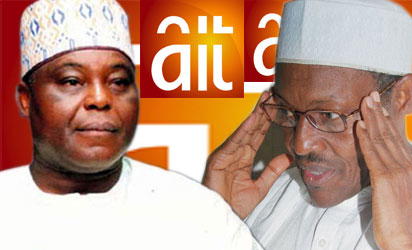
Chief Raymond Dokpesi and President-elect Buhari
By Douglas Anele
A musket, according to Chambers Twentieth Century Dictionary, is a military hand firearm, particularly of an antiquated smoothbore kind. A musketeer, therefore, is someone, a soldier most likely, armed with a musket. Somehow, the President-elect, Maj. Gen. Muhammadu Buhari (rtd) and his party, the All Progressives Congress (APC), may be likened to musketeers using revenge mentality and threats of probe as muskets against opponents, especially members of the outgoing administration and African Independent Television (AIT).
As is well known, Buhari’s biggest selling point in the last Presidential election is his reputation as a disciplined incorruptible leader with the iron will to fight corruption mercilessly. However, I have always maintained that the President-elect is not as squeaky clean as his ardent supporters claim. Moreover, the showy strong-arm anti-corruption strategy he deployed as a military dictator is at odds with sound democratic practice and unsuitable for the sophisticated mutations which corruption have undergone since he was deposed by a military coup about thirty years ago.
During the electioneering campaigns, Gen. Buhari was in a dilemma. His electoral appeal and electability, as already indicated, depended heavily on his anti-corruption reputation. As a result, his brief campaign speeches were dominated by allegations of graft and impunity against President Goodluck Jonathan’s government, together with the promise to deal with the problem decisively if elected President. Yet, in order not to scare away dodgy chieftains of APC with stinking antecedents who financed his campaigns, Buhari announced that as President he would not waste precious time probing those who embezzled public funds before May 29, 2015. His position was reinforced by the chairman of APC, John Odigie Oyegun, who declared that the future of Nigerians is too important for the in-coming government to spend valuable time digging into the past.

Chief Raymond Dokpesi and President-elect Buhari
Now that Buhari has won, he no longer feels obligated to abide by his earlier promise not to probe past governments. In fact, there are indications that revenge mentality might compel the President-elect and some potential key players in his incoming administration to move against individuals, groups and organisations that did not support the APC in the last elections. In other words, the new government that would start functioning in less than three weeks from now may embark on mudslinging probe of Jonathan and his lieutenants, clamp down on media organisations it considers anti-APC, and discriminate against those states that voted massively for the Peoples Democratic Party (PDP).
For example, Gen. Buhari, after a courtesy visit by a former governor of the Central Bank of Nigeria and Emir of Kano, Mallam Sanusi Lamido Sanusi, pledged to probe the $20 billion which, according to Sanusi, the Nigerian National Petroleum Corporation (NNPC) did not remit to the federation account as required by law. I have written about this and other allegations against the minister of petroleum and first female President of the Organisation of Petroleum Exporting Countries (OPEC), Mrs. Diezani Alison-Madueke, in a two-part essay entitled “The NNPC and its enemies.” Consequently, there is nothing really new to add now, except to note that Buhari’s promise to revisit the matter despite President Jonathan’s order that the findings of the investigative review of NNPC’s activities carried out by PricewaterhouseCoopers be made public is indicative of his deep distrust of the out-going President. Even so, there is a new argument that the PwC probe which exploded Sanusi’s allegations is just a “report or review,” not a forensic audit.
But I have a copy of the document PwC sent to the Auditor-General of the Federation, and it is captioned “Investigative Forensic Audit into the Allegations of Unremitted Funds into the Federation Accounts by the NNPC.” On page 8 of the document, in the section labelled “1.1 Introduction,” the last paragraph says, “As this is our definitive report on this forensic work/exercise, all previous positions taken or views expressed are henceforth invalid…” Furthermore, the words “forensic” and “audit” were used in several pages to describe the work done by PricewaterhouseCoopers. Hence, the claim that the document is a mere report is inaccurate. I suspect that if its contents had vindicated Sanusi’s claim of missing $20 billion, Mrs. Alison-Madueke’s pharisaic critics would hail it as a paragon of professionalism in auditing.
Meanwhile, with the benefit of hindsight, the timing and unprofessional manner Sanusi orchestrated his allegations strongly suggests that he might be acting out a script intended to denigrate Jonathan’s government for the benefit of APC. Sanusi relentlessly raised the issue of unremitted funds in the middle of presidential electioneering campaigns so that the aura of corruption would hang around PDP and President Jonathan, the intention behind which is to reinforce APC’s argument that his government is corrupt. In addition, extremely malicious rumours in the social media about financial recklessness by Mrs. Alison-Madueke, her intended asylum to avoid being prosecuted for yet-to-be identified offenses, and her efforts to secure a soft landing through the intervention of former military ruler, Gen. Abdulsalami Abubakar (rtd), bear the unmistakable signature of a grand design to malign and discredit her.
Of course, the minister has consistently denied all the damaging allegations, blaming her travails on agents of international oil cabals who can no longer use their local agents to steal from Nigeria because of the reforms she introduced in the oil sector. But how many of Mrs. Alison-Madueke’s traducers are willing to listen to her own side of the story or give her the benefit of doubt until adequate evidence to support the allegations against her becomes available? Given the “Crucify her, crucify her!” chorus in both conventional and social media, it appears that an accused is no longer presumed innocent until proved guilty in a competent court.
For decades, bulimic embezzlement of public funds is the defining characteristic of Nigeria’s ruling elite, to the extent that it has become the single most devastating cause of our arrested development. Thus, it is understandable if Nigerians are incensed and revolted by reports of corruption against public officials ahead of solid evidence, and are too eager to see them punished severely. Nevertheless, they should not get things twisted: people must avoid the mistake of allowing their disgust towards rampaging corruption metamorphose and harden into lynch mentality against government officials based solely on hearsay and uncorroborated allegations of graft. In this connection, it is unfortunate that many Nigerians, including well-educated people with high-sounding academic and professional titles who should know better, tend to believe without question outlandish stories of corruption connected to Mr. President and members of his cabinet without sufficient evidence.
Of course if Gen. Buhari, after he takes over from Jonathan, decides to probe any former public office holder, NNPC and other federal institutions, that is up to him.
Disclaimer
Comments expressed here do not reflect the opinions of Vanguard newspapers or any employee thereof.