
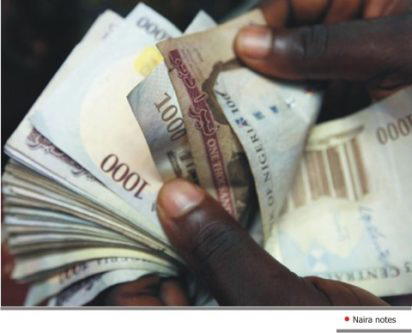
Money
By Henry Boyo
The contradictions in our failed economy are probably best captured by the stark reality of deepening poverty and unbridled rate of unemployment despite the celebrated recent increase in the Gross Domestic Product, with increasing revenue and bountiful reserves to boot for over two decades!
We may recall that despite of the paltry $4bn national reserves during the Abacha years, when Nigeria also remained a pariah nation, our country and our people continued to enjoy credible ratings as a developing country with great promise.
Ironically, Nigeria became a regular contender in the list of the world’s poorest nations only in recent years when our dollar reserves hardly fell below US30bn with the related, favourable, extended cover for our import bills.
Indeed, a closer examination of prevailing fiscal and monetary strategies may suggest that the seeming relative social sanity is not only superficial, but probably also belies the deeply rooted causes of deepening poverty.

Okonjo-Iweala
For example, it is inexplicable that a country with acute infrastructural deprivation will progressively tilt annual budgets in favour of recurrent expenses, such that the 2015 Appropriation Bill presently allocates barely 20% for the provision of supportive Social infrastructure.
Similarly, despite the UNESCO’s best practice recommendation for 26% of budget allocation to education, we have barely attained half of this ratio in recent years!
In the rest of this article we will briefly discuss the difference between public perception and the actual reality of the impact of CBN’s monetary strategies. Ardent media followers will already be familiar with the regular reports of CBN’s unchanging response to what is generally branded as excess liquidity. These Media reports generally describe the process with which the Central Bank borrows billions of Naira monthly, by selling Treasury bills to the banks, as a supportive strategy “to enable commercial banks manage their surplus cash holdings profitably.”
Sadly, the positive media undertone induces the public’s perception of CBN as a supportive, attentive and proactive government Agency, which is relentless in its efforts to empower the banks to perform their roles as strategic mediators between investible funds and the real sector in order to grow the economy.
The Media, both print and electronic which re-echo such positive undertone of CBN’s surplus cash management, have indeed become in-advertent collaborators with the Apex bank to mischievously misrepresent the economic and social utility of this instrument of monetary strategy.
Conversely, if the Public and the media had carefully evaluated the content of CBN’s press releases in relation to its borrowings with Treasury bills, the regularity of alleged Naira surplus, and the frequency of government borrowing to restrain bank lending would appear as a bizarre strategy which required urgent interrogation; for example, it would be sensible to ask why the ever present burden of surplus Naira exists alongside serious shortage of cheap funds which are required to ignite and sustain increasing productivity of the real sector of our economy.
Furthermore, it is inexplicable that inspite of eternally surplus Naira in the system, cost of funds should remain oppressively high and a deterrent to real sector growth and creation of more jobs; certainly, there is probably nothing that rises in price when its supply is excess, so why does the CBN, wilfully, borrow allegedly surplus funds at exceedingly high rates of interest (between 9-16%) for what are clearly risk free sovereign loans!; it should also be pertinent to determine how much it cost Nigerians to service such oppressive loans annually?
The CBN’s usually terse defence that its strategy is designed to restrain inflation from spiralling out of control as a result of surplus Naira chasing few goods, is generally accepted as sufficient explanation for the contradictory social and economic impact of CBN’s method of reducing surplus cash from the economy.
It is worrisome that the public also assumes that the trillions of Naira borrowed over the years with such high costs are actually applied to the improvement of our social infrastructure. This, however, is far from the truth; we must remember that since the funds were mopped up because they were adjudged to be excess and antagonistic to the promotion of a stable market, it would be counterproductive to re-introduce the same funds into the system, by re spending it for any purpose whatsoever!
In other words, despite the heavy collateral of increasing national debt and the attendant exorbitant service charges, the Apex bank actually also consciously crowds out the real sector from the available funds in the market by liberally borrowing money that will simply be sterilised (kept idle), inspite of the clearly inappropriate and oppressive double digit interest rates for such risk free sovereign debts.
Expectedly, the attendant profit bonanza for doing nothing is sufficient attraction for commercial banks to shun lending to the real sector. Clearly, therefore, CBN’s Treasury bills borrowings remain the actual enemy of real sector growth as well as a major threat to job creation, thus probably making CBN, Nigeria’s number one public enemy!
If the impact of CBN’s failed monetary strategy is understood from the preceding narrative, the media will certainly be more circumspect in their evaluation and unfortunate tacit endorsement of the impact of the current strategy for mopping up excess liquidity. Indeed, despite clearly desperate monetary controls, such as 75% cash reserves requirement for public sector deposits and 20% for the private sector, with MPR also at the industrially disenabling rate of 13%, excess liquidity still remains uncaged. Sadly, the body language and monetary measures recently rolled out to checkmate inflation by CBN suggest that it is more of the same strategies that have deepened poverty in the midst of plenty!
Consequently, the social and economic excess baggage that pulls us back will be here for sometime; for example on the 19th of December 2014, the CBN borrowed N195bn with Treasury bills to mop up unyielding surplus spending power from the system; soon after, the Apex bank also gave notice of its intention to additionally borrow about N1.2trn between January –March 2015.
Thus, in less than 14 weeks, the debt service charge attendant to these loans, which incidentally will simply be kept idle, may exceed N150bn; indeed if this reflects CBN’s liquidity strategy for the rest of 2015, we may require close to N600bn to service loans which will not be applied for any social or economic improvement; furthermore, the CBN’s crushing monetary policy rate of 13% will continue to deter economic growth and stunt the development of SMES. Ultimately the army of unemployed Nigerians will continue to expand.
Who will save Nigerians?
Save the Naira, Save Nigerians!!
Disclaimer
Comments expressed here do not reflect the opinions of Vanguard newspapers or any employee thereof.