
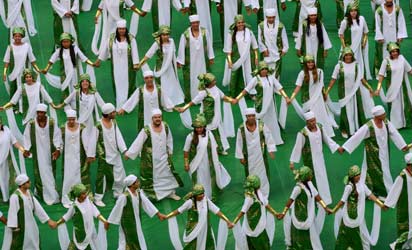
Artists representing Nigeria perform during the opening ceremony of the FIFA Confederations Cup Brazil 2013, held before the Group A football match between Brazil and Japan, at the National Stadium in Brasilia on June 15, 2013. AFP PHOTO /
By Douglas Anele
The sporadic violent uprisings between 1945 up to the eve of independence in which Southern Nigerians resident in the North, especially the Igbo, were attacked by their Northern compatriots, the lopsided colonial political arrangement which favoured the North despite its educational backwardness and economic dependence on the South, pernicious inter-ethnic suspicion and political rivalry among politicians from different parts of the country, indicated that the Nigerian federation which emerged on October I, 1960 was far from being a unified colonial amalgam.
The history of Nigeria from independence to the outbreak of the civil war in July 1967 has been well documented. The key point that emerges from it is that the traditional form of parliamentary democracy bequeathed the country by Britain was inappropriate for welding the ethnic nationalities together into a single cohesive geopolitical unit, and did not take into account the peculiarities of indigenous systems of governance and lifestyles.
Moreover, despite its merits, the system worked out in Whitehall was impracticable in a country where primordial ethnic cleavages, far from being obliterated or at least reduced by the colonial government, was exploited by that very government as a useful expedient for indirect rule. Hence, it was not surprising that the government of Tafawa Balewa could not deal effectively with the political upheavals in Western region and combat mind-bending corruption among the political class. For Ndigbo and, ultimately, Nigerians, the most significant event in inter-ethnic relations before the civil war was the pogroms of 1966. We have already alluded to the pre-independence violence against the Igbo in different parts of Northern Nigeria.
The pogroms of 1966 constitute one of the most unfortunate events in Nigeria’s history because, aside from the massive scale of destruction of lives and property, Northerners, incited by members of the Northern establishment, used the January 15, 1966 coup, the so-called Igbo coup, as a pretext to launch the most savage attacks of genocidal proportion on Ndigbo living in various parts of Northern Nigeria.
It must be pointed out that the purported arrogance and occasional noisy exhibitionism by the “uppity Igbo,” though annoying and provocative to others, cannot justify the pogrom. The most sensible response to it would have been for Northern leaders to implement strategies that would both gradually abolish servility among Northern youths while at the same time encouraging them to embrace Western education and entrepreneurship. That did not happen. The pogrom crossed the Rubicon when Yakubu Gowon, Murtala Mohammed and Theophilus Danjuma successfully executed their bloody revenge coup that culminated in the brutal murder of J.T.U. Aguiyi-Ironsi. With Ironsi’s death, it became obvious that Nigeria would fall apart unless centrifugal forces tending to tear her apart were checkmated expeditiously.
The political and military leaders at the centre stage before the first shots were fired against the Republic of Biafra on July 1967 failed woefully to rise to the challenge. With the benefit of hindsight, one can justifiably claim that Chukwuemeka Odumegwu-Ojukwu and prominent Igbo leaders who supported secession of Eastern region grossly underestimated the resolve of Gowon and his cohorts to maintain the geopolitical status quo left behind by British colonial administrators. The remote and proximate causes of the devastating civil war are well known. What most people do not realise is the seemingly insignificant but critical role animosity between the two principal actors, namely, Gowon and Odumegwu-Ojukwu, played in precipitating and prolonging the war. It also explains why both men did not compromise on time to save Nigeria from disaster.
I believe that Gowon saw the Eastern region’s choice of secession as an opportunity to get even with Ojukwu. Consider this: Gowon is the son of a Methodist clergyman and mission-trained evangelist from one of the smallest tribes in the North. As a young boy, he had a missionary education, and later proceeded to grammar school. Gowon joined the army at nineteen, and underwent military training in England.
Ojukwu, on the other hand, was the son of a multimillionaire business tycoon. He had a first class British education, beginning with Epsom College, Surrey, and ended up with a Masters degree in Modern History from Lincoln College, Oxford University. Because of his academic achievement, Ojukwu, the first Nigerian graduate to enlist in the army, was promoted higher than Gowon, despite having entered the army two years after the former head of state. Someone told me in confidence that Njideka, Ojukwu’s first wife, was formerly Gowon’s girlfriend, but that the latter lost out in the romantic contest perhaps because Ojukwu was better educated and richer than Gowon. On the other hand, it is clear that Ojukwu considered Gowon unqualified to become head of state after the killing of Aguiyi-Ironsi, because he and Brigadier Ogundipe were senior in rank to Gowon. All this could have generated intense jealousy and hatred in Gowon towards Ojukwu.
But before the Biafran war actually started, some efforts were made to save Nigeria from descending into existential black hole. For instance, on September 12 1966, an Ad Hoc Constitutional Conference was convened to work out an acceptable constitution, following the atmosphere of ethnic suspicion and hate occasioned by the araba (or secession) riots of May and the coups of January July 1966. Keep in mind that under the leadership of Nnamdi Azikiwe, Eastern Nigeria had been the foremost advocate of One Nigeria. The region had put more effort into concrete realisation of the concept than any other group, and continuously supported its cause at both the political and economic levels.
However, after the bloody revenge coup of July, the East made a complete turnaround. At the conference mentioned a moment ago, instead of supporting a tightly knit federation, with a structure similar to that envisaged by the Unification Decree 34, 1966 promulgated by Aguiyi-Ironsi, Eastern leaders proposed a loose federation of states with a high degree of internal autonomy. The Eastern position was in accord with decades of tradition in the North, whose leaders had always insisted that the best political structure for Nigeria is a relatively weak centre and strong regions. In their initial recommendation to the same conference, for example, the Northern delegation argued that “recent events have shown that for Nigerian leaders to try and build a future for the country on rigid political ideology will be unrealistic and disastrous.
We have pretended for too long that there are no differences between the peoples of this country. The hard fact which we must honestly accept as of paramount importance in the Nigerian experiment especially for the future is that we are different peoples brought together by recent accidents of history.
To be continued.
Disclaimer
Comments expressed here do not reflect the opinions of Vanguard newspapers or any employee thereof.