
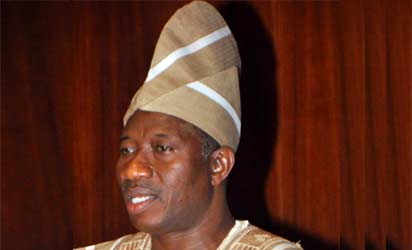
*Jonathan
By Josef Omorotionmwan
WHAT is happening? At the end of last year, President Goodluck Jonathan finally robbed himself of the immense benefits of appearing before the National Assembly to present his Appropriation Bill, thus further whittling down the glamour of his exalted office. This is quite a negative development.
By the time the leadership of the National Assembly has enough time to think it over, we shall not be surprised if they one day decide to delegate the chairman of an obscure subcommittee to receive the Bill from the Finance Minister. Or, better still, it could just be submitted to the Sergeant-At-Arms.
Before now, the moment a Nigerian President was sworn in, he looked forward, with enthusiasm, to the opportunity to appear before the National Assembly, in just the same way as an American President looks forward to the opportunity to appear before Congress to deliver his State of the Union Address. Even in times of ill-health, we have never heard of the Queen of England delegating the delivery of the Message from the Throne to anyone.
We had reckoned that this is one year that President Jonathan must reinvent a zero-tolerance to policy somersaults and inconsistencies. He must be steadfast and refuse to be pushed around by self-serving aides. Right now, the echoes coming from around him are not encouraging. Two of his aides are dancing naked in the market place over the issue of whether to sell the refineries or not.
Listen to the Petroleum Minister, Mrs. Deziani Alison, in an interview with Bloomberg TV Africa, London: “The refineries would be sold. We would like to see major infrastructure, such as refineries, moving out of government’s hands into the private sector. Government does not want to be in the business of running major entities and we haven’t done a very good job at it over the years.”
Mr. Reuben Abati has since over-ruled her: “Government is not going to sell any refineries. There is no such plan, and there is no presidential approval for such. Nobody, not even the Minister of Petroleum, has powers to sell government’s property.”
This rumble in the jungle is certainly a bad way to begin a new year, for a good administration, that is.
Apparently, that important policy had not been duly considered and properly consummated by the Federal Executive Council, FEC, before Madam rushed it to the world market. To that extent, it lacked due process and, therefore, voidable.
Reuben Abati is doing well but it also depends on what is doing. He is doing well in the business of exposing the porous nature of the Jonathan administration. True, he wants to avert a strike. But that is hardly a good reason to be crying more than the bereaved. No matter how good his intentions are, he is still a personal staff to the President.
By whatever designation he now parades himself, he is still the Public Relations Officer, PRO, to the President. We know of no better definition of a PRO than that offered by late Emmanuel Obahiagbon, years ago, when Abati was perhaps yet pinning his ABC together that, the PRO is a glorified messenger.
It is only in an administration like Jonathan’s that a personal staff of the President can over-rule a Senior Cabinet Minister in her area of administrative coverage. There are clear limits to the audacity of power. In the policy domain, the official spokesman of government is the Minister of Information.
Understandably, NUPENG insists it must proceed on the planned strike, except it hears from the real person, the Petroleum Minister who kicked the first ball.
It is easy to accept that Abati was merely echoing the master’s voice. That aggravates the situation as it immediately promotes the public disagreement to one between Jonathan and his Minister.
Incidentally, the President on whose table the buck stops and who should whip his appointees on line is busy swimming in his own pool of confusion. For a very long time, the administration’s stand on the prohibition and gradual phase-out of imported used vehicles into the country had become a settled issue.
This also presupposes that a full cost-benefit analysis had been done before the issue was brought to the public domain. And the implementation of the new policy was billed to start this March. Elsewhere, the President would hold tenaciously to such policy and be prepared to defend it even at the edge of doom. But not under Jonathan, where anything that would not translate to votes in 2015 must be destroyed and thrown into the lake of fire.
He is beginning to double-talk on the issue of the importation of used vehicles.Listen to his speech to members of the Road Transport Employers Association of Nigeria, RTEAN, this last Friday: “I will abort the new policy on Tokunbo vehicles if it inflicts pains on Nigerians. If that comes up, I will abort it even midway because we cannot come up with a policy that will make Nigerians suffer or pay higher prices for vehicles… Attempting to be your enemy is suicidal because you can prevent people from voting.” This is looking increasingly like one administration at war with itself!
Policy somersault is one thing that this administration has lived with all along.Examples are legion but we will take just one.We wonder how many people have forgotten the imbroglio between the Executive and the Legislature on the question of the ill-fated N5,000 notes. While the Information Minister, Labaran Maku, was busy announcing that there was no going back on the proposal, the President was busy announcing its suspension. A good administrator would have announced two suspensions – the Minister and the proposal!
This macabre dance is becoming uninteresting. Just imagine how three successive administrations of the same party have dubiously vacillated on a single issue: The Obasanjo administration sold the refineries; The Yar’ Adua administration revoked the sale; and now, President Jonathan is playing hide and seek, wanting to sell! What greater disincentive do investors need than this bundle of inconsistencies?
Disclaimer
Comments expressed here do not reflect the opinions of Vanguard newspapers or any employee thereof.