
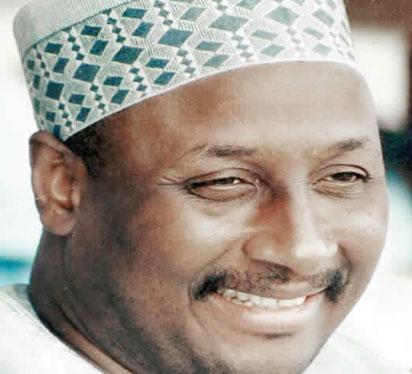
Adamu-Mu’azu
By Is’haq Modibbo Kawu
THE online news medium, PREMIUM TIMES, was spot on in the title of its report: “How PDP disgraced six of its seven chairmen in 15 years; in the wake of Alhaji Bamanga Tukur’s forced resignation as party chairman, after months of a most destructive in-fighting in the PDP. It had been constructed by founding fathers like the late Chief Sunday Awoniyi, with lofty nationalist intentions to build a post military dictatorship Nigeria, with the best ruling class sense responsibility.
Before long, the party sidelined idealists and expelled delusions about nation building, having been captured by the most anti-democratic tendency within the party with roots in the dictatorial traditions of military rule. The PDP, despite the idealism of people like Chief Awoniyi or Audu Ogbeh, has always been a rally of disparate tendencies of the Nigerian bourgeoisie, with the weakness that it was much easier for the anti-democratic wing, to achieve hegemonic control.
That wing has cunning, ruthlessness and experience plus a lot of money; the right mix of ingredients to consolidate power. President Olusegun Obasanjo masterminded the original sin. From the beginning, he was never going to allow a party leadership in the mould of Chief Awolowo to institute an idealistic ethos as dominant paradigm. So he perfected a most suffocating grab of the reigns of party leadership and in the process, as PREMIUM TIMES noted, things within PDP began to conform “to a grim tradition that has haunted the party since 1999: one that has seen all but one of its seven chairmen forced out of power in controversial circumstances”.
Only Amadu Ali served out his tenure and was able to step down without being disgraced from his perch atop the PDP, which never ceases to describe itself as the largest political party in Africa! Obasanjo literally booted out Chief Solomon Lar, one of the party’s founding fathers; barely a year in position, Lar was replaced by Barnabas Gemade preferred to the principled Chief Sunday Awoniyi. Gemade was a willing tool for Obasanjo’s battles against opponents, especially in the National Assembly. But being a willing tool in dirty political fights did not save Gemade; he was kicked out in the charged political atmosphere which led to the 2003 elections and was replaced by the cerebral Chief Audu Ogbeh, who came from the more principled and idealistic tendency within the party. Ogbeh was forced out by Obasanjo, for daring him to behave with decorum to prevent political anarchy in Anambra state. The Uba brothers were members of the Obasanjo inner circle and Ogbeh was sacrificed in a most vicious manner. In his place came Amadu Ali, an old soldier who had been minister of education during Obasanjo’s reign as military ruler. He was the only one who completed his tenure. It was under Ali that Obasanjo’s Third Term Agenda was spectacularly defeated by the Nigerian people.
Obasanjo’s Third term Agenda
Obasanjo hurriedly left office with tail between his legs in the aftermath of Third Term Agenda failure. Vincent Ogbulafor was then elected as PDP Chairman in 2008 but was to be caught up in the controversy following in the wake of President Yar’adua’s illness and death. Ogbulafor was pushed by ambitious governors to reiterate that power was to remain in the North, as agreed within the party.
The statement endangered President Goodluck Jonathan’s ambition. Ogbulafor was not only kicked out but was handed to the EFCC, to answer corruption allegations from six years earlier. He was then succeeded by an initially gung-ho Dr. Nwodo, who was sacked on the basis of a court ruling that he was not even a party member! An interregnum of acting leaderships followed before Bamanga Tukur’s fortuitous emergence as national Chairman. It was significant that Tukur came very experienced, highly successful and rich; he had been rejected from his zone but was President Goodluck Jonathan’s preferred candidate.
Bamanga Tukur took himself too seriously and was particularly determined to reign-in all opposition to President Goodluck Jonathan’s re-election in 2015. State governors represent one of the most powerful tendencies within the PDP.
They control votes needed to become candidates and are suzerains in the states. They have increasingly consolidated their power within the PDP since 2003 and have largely determined the electoral fortunes of party members. Many of the governors and former governors have 2015 presidential ambitions too. It was this group that Bamanga Tukur took on, at the president’s behest.
His authoritarian approach suited Jonathan’s purposes but it opened PDP to dangers it hasn’t confronted since 1999. The bruising intra-party rivalry was at a time when the opposition, for the first time, cobbled together a merger as a formidable platform against the PDP in 2015. Those at the receiving end of Bamanga Tukur’s pro-Jonathan wrath chose to call the PDP’s bluff by moving enmass into the newly registered APC. The portents for Jonathan’s re-election in 2015 were becoming ominous. Something had to give!
For President Goodluck Jonathan, it became clear that he must find a way to dam the river. The loss of members to the opposition is a veritable danger. Other individuals and tendencies within the party leadership as well as the governors who remained in the PDP, plus elements in control of various levels of power knew that Bamanga Tukur’s continued retention might endanger them all.
Tukur’s overzealousness
He needed to be sacrificed in the long run. The old man owed his authority to defense of President Jonathan’s interest but in the long run, Jonathan reckoned that Tukur’s over-zealousness had become an albatross. If he persisted with the old man, he would undermine his own long-term position. Bamanga Tukur just had to go. A letter of resignation was contrived as a face saving device of exit. The old man had his full portion of the poisoned chalice and in the past few days, the hemlock-filled chalice passed on to Adamu Muazu.
Muazu arrived as party chairman with the “little baggage” of having allegedly stolen N19 billion from Bauchi state. He is already hostage even before resuming office. That PDP chairmanship position is the ultimate poisoned chalice indeed!
The more you see, the less incomprehensible the ways of govt
EARLY this week, the Rule of Law Collective (TRLC), described as “a civic platform comprising Nigerians from all walks of life who through debate, discourse and civic action seek to advance public service and accountable governance in Nigeria, through the fair, non-discriminatry and effective application of laws”, issued an analysis of the 2014 federal budget proposal, presented to the National Assembly, by Finance Minister, Ngozi Okonjo-Iweala, on December 19, last year.
The budget’s estimated expenditure for 2014 totals a sum of N4.6 trillion. The recurrent component amounts to N2.4 trillion while capital spending will amount to N1.1 trillion. Debt servicing will take N.7trillion and SURE-P spending will come to N.3trillion. Recurrent spending amount to 76.3% of the budget while capital expenditure amounts to only 23.7%.
But, as they say, with these budgets, the devil is always in the detail. The Rule of Law Collective discovered these incredible selected estimates in health care:
a.Construction of a VIP Wing at the State House Clinic: N705million
b.Total Capital Budget for Obafemi Awolowo University Teaching Hospital: N328million
c.Total Capital Budget for University of Ilorin Teaching Hospital: N310million
d.Total Capital Budget for NPMA Children Hospital, Sokoto: N89million
e.Total Capital Budget for the Institute of Child Health, University of Benin Teaching Hospital: NIL
In the words of TRLC, “to the formulators of the budget, the VIP Wing of the State House Clinic is superior in terms of cost, priority and efficient allocation of resources to 2 teaching hospitals. A Nation Children’s Hospital and a Paediatric Research Institute”.
In the area of Defence and National Security, comparative allocations are even more frightening:
a. Stipend and Allowances to 30, 000 Niger Delta Militants under the Presidential Amnesty Programme: N23.6 billion
b.Reintegration of Transformed Ex Militants: N35.4b illion. So the Niger Delta Militants take a total of N59billion.
c.Total Capital Expenditure for the Nigerian Army: N4.8 billion
d.Total Capital Expenditure for the Ministry of Defence HQ: N34.2 Billion
e.Total Capital Expenditure for ALL police formations and Commands: N6 billion. “(TRLC) finds it incomprehensible that the stipends for 30, 000 ex-militants exceeds by more than double the cost of providing facilities and procuring kit and equipment as well as weapons and ammunition for the Nigerian Army and the Nigeria Police Force combined”.
Deepening the absurdity
Similarly, the body expressed deep worry that “the cost of reintegrating ex-Niger Delta militants exceeds the combined capital expenditure of the three arms of the Nigerian Armed Forces (Army, Navy and Air Force)”.
And to deepen the absurdity, the Jonathan administration budgeted only N2billion to rebuild the North East of Nigeria where, in the words of TRLC “damage to property and lives remains inestimable”.
The Collective exposed other absurdities, from monies earmarked for a new presidential jet through to expenditure to feed animals in the Aso Villa zoo. What seems clear is that the present administration, like all the PDP administrations since 1999, has employed a tunnel vision approach to the governance process. These PDP regimes have pursued ruling class centred projects that consolidate the wealth of a tiny minority of the rich, while denying a meaningful social net for the mass of the poor.
There is a more worrisome element from the Yar’adua administration to the Jonathan administration. They are very provincial in nature. Yar’adua’s government was dominated and propped up by a crop from his native Katsina state. It narrowed the base of the administration’s already questionable legitimacy; but Yar’adua’s provincialism has been taken to an even more dangerous level by Goodluck Jonathan. His has been built on a basis of appropriating huge sums of money to projects that shore up his ethnic constituency, including even outsourcing the nation’s maritime security to some of the Niger Delta militants. The newer element of the provincialism of the Jonathan administration is the politics by threats, abuses and intimidation of other Nigerians, by elements from the Niger Delta.
As we approach the 2015 elections, the ethnic base that Jonathan has carefully cultivated and empowered economically will become even bolder in its excesses as it realises that only the retention of power by their man, will assure continuity of the access they have secured to huge resources from the Nigerian state. It is therefore not accidental, that the 2014 budget, just a year before the 2015 elections, has allocated obscene sums to the Niger Delta, even to the detriment of the nation’s security architecture. The ways of government, when they don’t possess sufficiently nationalist and patriotic perspectives, tend to endanger the national weal.
Disclaimer
Comments expressed here do not reflect the opinions of Vanguard newspapers or any employee thereof.