
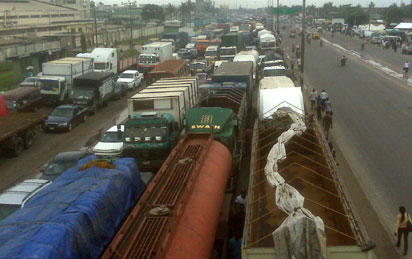
The traffic on Apapa-Oshodi Expressway, Friday. Photo: Adekunle Aliyu.
By Nnamdi Ojiego & Foluso Ajibulu
For more than seven months now, motorists and commuters plying Lagos – Badagry and Oshodi/Apapa expressways have been subjected to untold hardship following regular traffic gridlock on the roads. The situation worsened when the construction works on the Lagos-Badagry expressway reached Mile 2.
Since the commencement of the construction works which targets a 10-lane road on the Lagos-Badagry axis with light rail in the middle, no portion of the road has posed more problems to vehicular movements than that of Mile 2. As a result, Mile 2 has become a chaotic place of a sort.
This may not be unconnected with the peculiar nature of the area being that it has a dual carriage bridge, which serves as a connecting point to the two major expressways. It is an intersection / linking point for vehicles plying routes around Orile, Oshodi, Badagry, Apapa, Festac, etc.
Again, due to the construction works, some links to or from the bridge are either closed or narrowed by the construction company to enable it do its work. This makes vehicular movement difficult thereby culminating in long lines of vehicles.
Apart from the construction works, there are other causes of traffic in the area like flooding, indiscriminate parking of petrol tankers, container trucks, mostly along Oshodi/Apapa expressway, reckless driving by some motorists and, sometimes, poor traffic control by law enforcement agents. It is no longer news that whenever it rains, most parts of Lagos are flooded and Jakande bus stop on the approach to Mile 2 on the Oshodi – Apapa expressway is one of the worst hit areas. So, when this happens, vehicular movement is always at a standstill as vehicles pile up leading to traffic jam.
On unlawful parking of trailers and lorries, the federal and Lagos State governments seem helpless and lacking in political will to enforce the law against the challenge.
Though hopes are high that the ugly development will not last forever, particularly as construction works are nearing completion around Mile 2, motorists continue to count their losses. Our reporters spoke to motorists and hawkers on how the situation has affected them and their businesses.
A commercial bus driver, who identified himself as Kazeem, exclaimed: “Ah bros, we dey suffer well well for this road.” According to him, before the development, commercial vehicle drivers plying the Mile 2 route used to do up to eight trips a day but, following the road construction and its attendant problems, they only manage to do four. Kazeem said they also burn excess fuel and that their vehicles engines often break down due to overheating. This, he said, makes them to spend more money in maintaining their vehicles.”
Another motorist, Mr Peter Uzor, who works in Apapa but lives in Ikotun in Alimosho Local Government Area, described the experience as horrible. He said the experience on the route could shorten the life span of motorists. “Tell me, what will you do in your work place after spending half of the day in the hold-up or how productive will you be in your work place if you always get to your house around 1 a.m. after being held in the traffic for hours?”
Uzor said traffic hold-up has multiple negative effects on the well-being of the people which include loss of man-hours and health hazards from carbon dioxide emission from vehicles. He explained that the situation has added to the sufferings of people who live in Ikotun/Ejigbo axis and have their places of work in Apapa area.
According to him, these areas (Ejigbo, Ikotun and Apapa) are notorious for traffic congestion. “What we pass through on Lagos roads every day is horrible. Only God can save us”, he lamented.
For commercial motorcyclists under Mile 2 bridge, their worry is not really that of road congestion. Ordinarily, Okada operators benefit from such situation. This is because they can meander their way in-between vehicles and narrow paths. In fact, this singular advantage has made Okada a thriving business in Lagos State. In times of unending hold-ups, commuters take solace in commercial motorcyclists who cash in on the situation to charge exorbitant fares.
However, the reverse is the case in Mile 2 as the Okada operators in the area said people prefer trekking to boarding the bike, a situation they attributed to the hard economic situation in the country. One of the operators, Mr Ojo, agreed that Okada riders make more money during hold-ups but stressed that the situation in Mile 2 area has changed. He said: “As you can see, people are trekking to their destinations instead of taking the bikes. Everything hard, I no go lie to you.”
Meanwhile, it was not all ugly tales and complaints as traders and hawkers around Mile 2 continue to thank God for the wonderful opportunities provided by the snarl movement of vehicles in the area and wish it lasts forever. While commuters are groaning in the traffic, hawkers are busy making brisk sales and counting gains.
Many of the hawkers, who our reporters approached, could not speak as they were busy trying to outsell one another. But one of them who managed to speak while attending to his ‘clients’ stuttered: “If hold-up no dey, we no go sell. Na for hold-up we for dey sell”. He gave some insight into why people buy more while in the traffic. According to him, when people stay too long in a place, they become tired, thirsty and hungry.
However, the question now is: Does prolonged stay in traffic has any health implications? Sunday Vanguard sought the opinions of medical professionals who confirmed that there are many health problems associated with traffic congestion.
According to Dr. Fela Oridota of Dept of Community Health and Primary Care, College of Medicine, University of Lagos, most common health problems arising from long stay in traffic is stress. “When people stay long in traffic, get to their homes very late in the night, don’t get enough rest or sleep, then there will be serious health implications and one of them is strain, which occurs when the muscles are overstretched. Again, the fumes emitted by vehicles are dangerous to health and can lead to respiratory problems”, he explained.
Speaking in the same vein, the Chief Medical Director, Consulting Obstetrician/ Gynecologist of Maitama Hospital, Dr Francis Alu, said prolonged stay in traffic could lead to death. According to him, pregnant women in labour and sick persons can even die as a result of not getting to the hospital on time. “It also aggravates heart attack for those who are hypertensive. It aggravates asthma for those who already have it because of carbon monoxide. Carbon monoxide is poisonous and can cause shortage of oxygen.”
Meanwhile, Lagosians have called on government to do something urgently to alleviate their sufferings by implementing all traffic laws in Lagos State, fixing of the bad roads and the deployment of law enforcement agents to traffic prone areas to ensure strict adherence to traffic laws.
They also called on the firm handling the Lagos-Badagry road project to speed up the pace of the construction works around Mile 2 to alleviate their plight.
Disclaimer
Comments expressed here do not reflect the opinions of Vanguard newspapers or any employee thereof.