
By Osa Mbonu-Amadi, Arts Editor
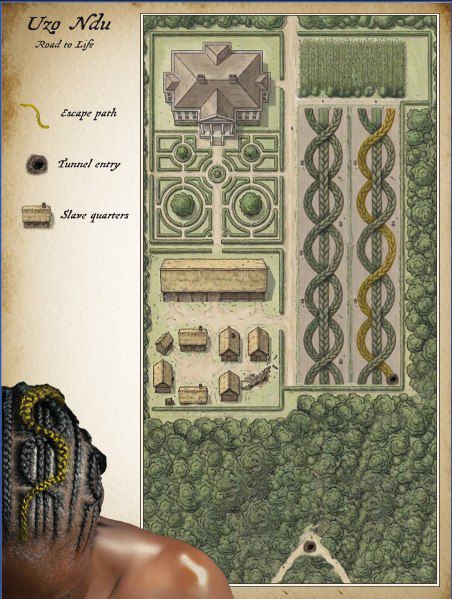
Of all of his other works, the two artworks, “Uzo Ndu” created by Raphael Olabode Demehin in 2026 and “Ona Ola” created in 2025 are remarkable. “Uzo Ndu” and “Ona Ola” epitomize the essence of Demehin’s artistic expression which centers on the themes of ancestral resistance, coded memories, and body as the map towards liberation. Through these works, we see the clear visions of an African artist in diaspora who has used minimalist and cinematographic imagery to retell stories about the resistance of enslaved black people.
For quite some time now, Raphael Demehin, a multi-disciplinary artist, has been using photography to explore themes such as ancestry, resistance, coded memory, and identity of black Africans in the diaspora through storytelling and the common environmental material objects as the symbolic representation.
In “Uzo Ndu” and “Ona Ola”, the artist has converted the environment, the land, and the human body into a text or a map. The land, hair, and the skin have taken new dimensions. With the help of the artist’s creativity, Yoruba braiding, Igbo territorial knowledge, charcoal, herbal thorns have been employed as the means of liberation.
From another angle, Uzo Ndu can be viewed as both poisonous path and tunnel towards the life.
Although imagined by the artist, the story of “Uzo Ndu” could also be plausible in history. For instance, there is historical evidence of how 35 members of Igbo ethnic group managed to turn the trails of the tobacco plantation where they were enslaved into living escape paths. Reading Alex Harley’s novel “Roots” will remind us of the story of Uzo Ndu.
A number of elements are key to the image of Uzo Ndu. These include Golden Blight, which is described by the artist as the trail of crops that have been poisoned with caustic substances to look like a natural blight, but serve as the “Uzo ndu” for the enslaved community of Igbo ethnic group. In this artwork, the artist has captured the landscape in different perspectives. One can see the usual straight plantation rows, the twisting organic Uzo ndu leading towards a man-made tunnel dug underground to end up in the Great Dismal Swamp.
Uzo Ndu contains several themes that give it strength. Firstly, the artist employs the land to capture memories of enslaving and as a source of weapon against the oppressors. It should be pointed out that the soil was filled with the knowledge passed down through generations, but put to good use by the enslaved to navigate the plantation.
Another important theme that the artist has developed in this work is the resistance of enslavement becoming intergenerational. The decision by the enslaved to flee was provoked by their women being pregnant. Thus, reproductive ability has been presented as both weakness and a boundary never to be crossed by the enslaved into intergenerational enslavement.
Another interesting theme present in the work is the translation of the oral history into the visual language to convey messages of the past. For example, the artist asks viewers to read the “Blights” as texts, tunnel as an object of assurance, and the forest as a safe destination.
“Ona Ola” can be translated as “the path to the future”. In the second picture, we see Olaoba’s body becoming a map that guides through the future. Actually, “Ona Ola” has been inspired by the true histories of black women in the diaspora weaving the routes of escape in their braided hairstyles.
Ona Ola is named after the two people. The artist has merged first three letters of Onajimi and Olaoba’s names to come up with the latter. According to the African tradition, the parents often choose names that reflect the desires and expectations in relation to their children. As noted by Demehin in his artist statement, the red lines symbolize blood, memory, and pulse of the living tracing the path of killing of Onajimi to birth of the possible child.
Thematic wise, as seen in “Uzo Ndu”, the body, particularly hair and skin, becomes a carrier of information that the oppressor cannot understand. There is also the theme of maternal courage and future. The flight made by Olaoba is not only intended to save her life, but also the life of their unborn child. The choice corresponds to the nature of motherhood as a powerful force of sacrifice.
Viewed together, “Uzo Ndu” and “Ona Ola” can be treated as the two pieces of clandestine resistance. While the map in “Uzo Ndu” represents the Earth, the body becomes the map in “Ona Ola”.
Undoubtedly, Demehin’s training as a psychologist enhanced his visual storytelling skills, focused around the themes of identity and memories. The artist’s platform, DemzArt has been described as “digital archive and presentation space” for the conceptual and fine-art photography that explores movement, mapping and “psychological architecture of transition”. Perhaps, this has inspired his ancestral resistance thesis, which includes artworks like “Transit Atlas” and “Sovereign of the Void”. However, “Uzo Ndu” and “Ona Ola” seem to have become Demehin’s major accomplishments in this area.
Thanks to these two works, Demehin has managed to show that freedom is not only won through rebellion, but also by codes, patterns, and ancestral knowledge preserved in the land and body. Hair and braids that have been used by the artist in these works should be understood beyond the aesthetic level and regarded as tools of resistance.
Undoubtedly, as Raphael Demehin continues creating more artworks, “Uzo Ndu” and “Ona Ola” are likely to become two key landmarks of his artistic style.
Disclaimer
Comments expressed here do not reflect the opinions of Vanguard newspapers or any employee thereof.