
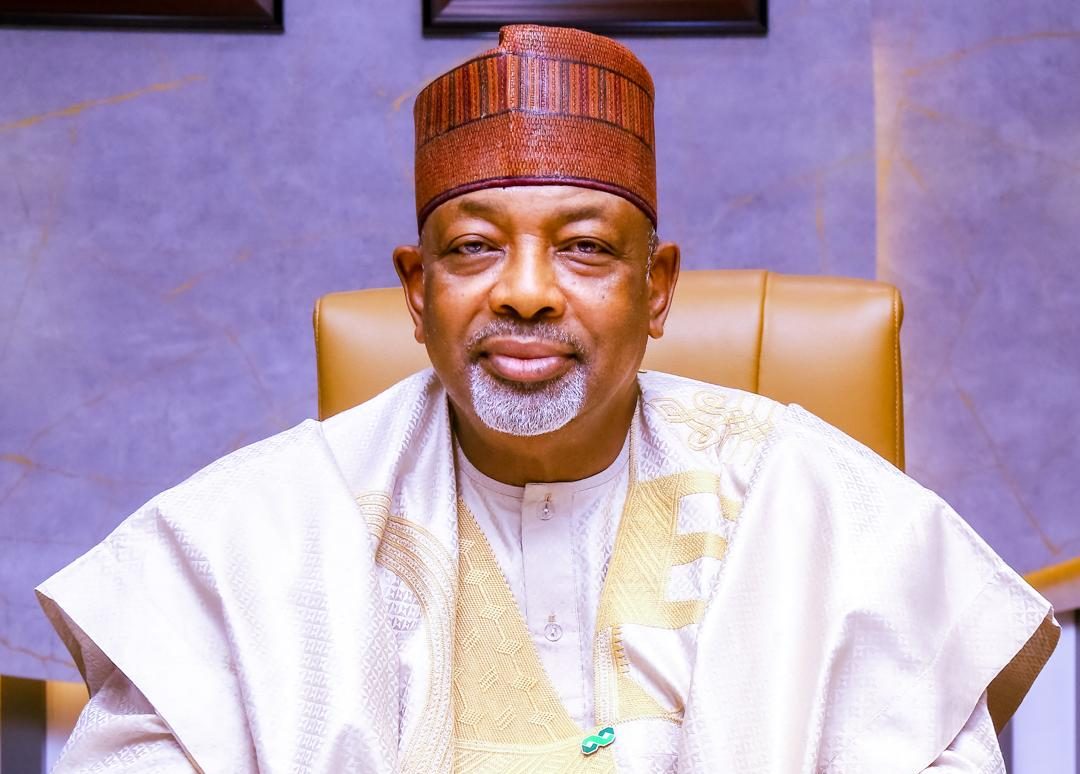
Kyari
By Gabriel Ewepu
ABUJA – AS President Bola Tinubu marked third year in office on Thursday May 29, 2026, and also Nigeria commemorating 27 years of uninterrupted democracy, the Minister of Agriculture and Food Security, Senator Abubakar Kyari, maintained that the Tinubu-led administration has cut down food prices by 50% and also boosted various agricultural value chains.
Kyari said the Federal Government through the Federal Ministry of Agriculture and Food Security had ensured that Nigerians access food at affordable prices, and many Nigerians are now eating food at a lower cost as “Food prices of essential commodities have dropped by up to 50% nationwide, reversing the sharp increases witnessed in previous years.
“Since assuming office, this administration has made food security a top priority. Our efforts are starting to pay off, with a notable impact on food prices.”
“On boosting production and value chains, the Ministry has focused on developing strategic value chains including rice, maize, wheat, millet, sorghum, yam, cocoa, cassava, soybeans, cotton, and oil palm, among others. These efforts have created opportunities for millions of smallholder farmers.”
According to him key interventions in 2024 and 2025 included the distribution of high-quality seeds, agrochemicals, safety kits, and pest management packs, alongside extensive capacity-building programmes, saying, “These measures have helped many farmers transition from subsistence farming to viable agribusinesses.
“A 2025 Agricultural Performance Survey conducted by the National Agricultural Extension and Research Liaison Services (NAERLS) in collaboration with the Ministry confirmed higher outputs in major crops such as rice, maize, sorghum, millet, cowpea, yam, and cassava compared to 2024.”
Meanwhile, he said as part of the strategic planning and execution of critical policies, the Ministry focused on fertilizer supply and soil management, which he said, “The government distributed over 1.9 million bags of fertilizers to nearly one million farmers.
“Additional achievements include the promotion of organic fertilizers (12,000 litres distributed), training of 109 fertilizer inspectors, and the training of over 329 industry stakeholders on regulatory compliance.
“The Ministry also established a National Reference Laboratory and upgraded the National Fertilizer Management Platform to improve quality control and curb the circulation of fake fertilizers. Over 3,500 farmers were trained on sustainable soil management practices.
On infrastructure and rural development, the Minister said significant investments were made in rural infrastructure: Construction of approximately 170km of asphalt roads and 57km of earth roads; Provision of 296 motorized and solar-powered boreholes with water treatment plants; Installation of 3,596 solar street lights; Construction of 69 rural housing and market facilities; Mechanization and Processing.
He (Kyari) also referred to 2025, a year of major push for agricultural mechanization with the launch of the ‘Renewed Hope Agricultural Mechanization Programme’, which President Tinubu launched and deployed 2,000 tractors and other agricultural equipment through the Federal Ministry of Agriculture and Food Security.
Following the quest for self-sufficiency in food and nutrition, 10 large-scale integrated processing plants were established across the six geopolitical zones and set up seven composite flour milling factories, and two agribusiness incubation centres were established at Federal University Lokoja and Michael Okpara University of Agriculture, Umudike.
Speaking on special initiatives and programmes, the Minister said, “The Special Agro-Industrial Processing Zones (SAPZ), supported by the African Development Bank, have recorded notable early successes, including the profiling of 7,398 farmers, cultivation of 409 hectares under climate-resilient practices, and improved rice yields averaging 5 metric tons per hectare.
“The National Agricultural Growth Scheme – Agro-Pocket (NAGS-AP) registered over 647,500 farmers and supported 622,818 with subsidized inputs, contributing to a 30% increase in crop production in participating states.
“Under the Nigerian Farmers Soil Health Scheme, pilot soil assessment laboratories were installed in four states, and farmers recorded up to 20% yield increases through better soil testing and fertilizer recommendations.”
On tackling access to finance and insurance by farmers, the Minister said the Nigerian Agricultural Insurance Corporation, NAIC, provided N700 billion risk cover to 199,275 farmers.
Also, the Bank of Agriculture received a N250 billion facility to provide single-digit interest loans to smallholder farmers. The National Agricultural Development Fund supported various value chains and flood-affected farmers.
The Ministry also strengthened cooperatives by registering 40 National Cooperative Apexes and training their leaders, while enhancing export readiness through the Nigerian Agricultural Quarantine Service for 30 key agro-commodities.
Meanwhile, the maintained and stressed on the Ministry’s focus on inclusivity and sustainability, where he said special attention were given to women and youth through gender-responsive extension services, access to credit, and training in climate-smart agriculture. The Ministry adopted the First Lady’s “Every Home a Garden” initiative to promote household food production.
The Minister also acknowledged collaboration with sister Ministries – Livestock Development, Marine and Blue Economy, and Water Resources, and stressed the importance of continued stakeholder engagement.
However, he acknowledge challenges in the sector, but expressed optimism that sustained collaboration, innovation, and investment will further strengthen Nigeria’s agricultural sector and achieve lasting food security.
Disclaimer
Comments expressed here do not reflect the opinions of Vanguard newspapers or any employee thereof.