
By Osa Mbonu-Amadi
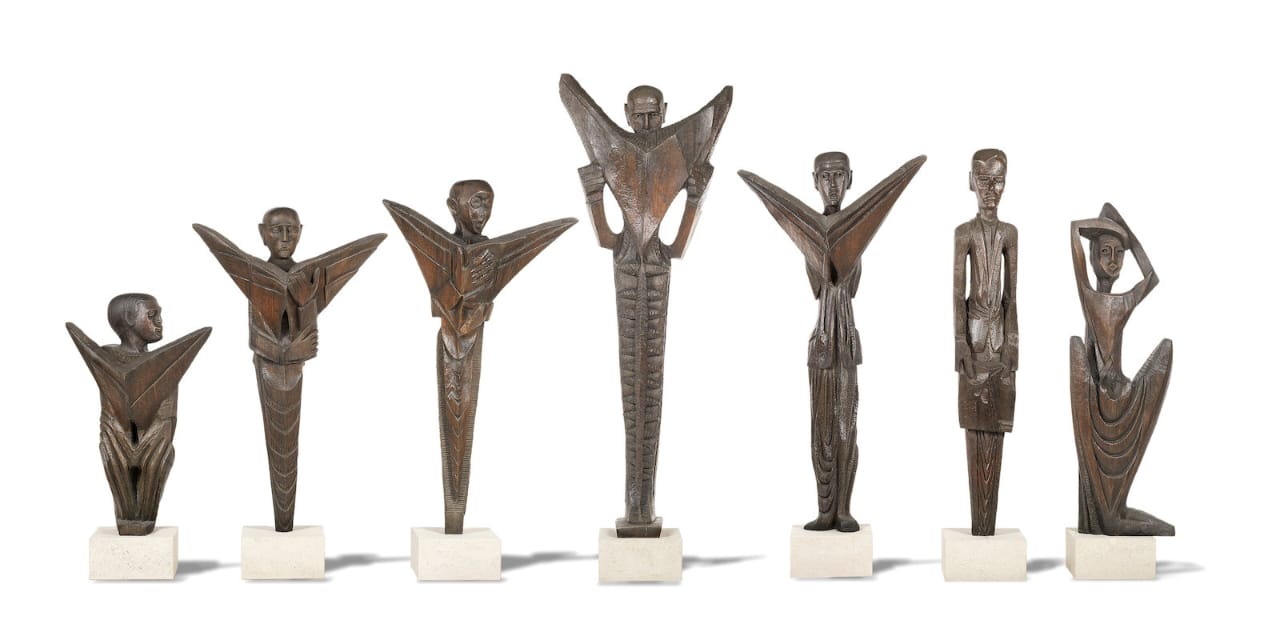
In 1961, Ben Enwonwu crafted seven striking wooden sculptures for the Daily Mirror’s new headquarters at Holborn Circus in London.
Positioned in the forecourt, these figures, each clutching a broadsheet newspaper, embody Enwonwu’s bold sculptural style, blending uplift, sharp angles, and a rhythmic sense of unity. During a 1961 interview, he called them “the wings of the Daily Mirror, flying news all over the world,” likening the ensemble to a harmonious chorus with an almost sacred vibe.


The Daily Mirror spotlighted them on September 6, 1961, with the headline “When News Takes Wings.” Missing for decades after their debut, the sculptures resurfaced in London in 2013 and fetched £361,250 (including buyer’s premium) at Bonhams auction that year—a record price for Enwonwu at the time. This iconic work fuses modernist abstraction, symbolic figures, and the dynamic idea of news soaring worldwide, highlighting his mastery in public art.
Now those seven striking wooden sculptures by Enwonwu are being showcased at ‘Nigerian Modernism’, the first major UK exhibition to trace the development of modern art in Nigeria from the 1940s to the 1990s, which opened 8 October 2025, at Tate Modern, and runs till 10 May 2026.
The exhibition, which features over 250 works by more than 50 artists, is curated by Osei Bonsu and Bilal Akkouche. In this interview, Oliver Enwonwu, the son of Ben Enwonwu spoke in details with Dr. Osa Mbonu-Amadi, Deputy Editorial Board Chairman of Vanguard Newspapers:
Tell us about these 7 wooden sculptures by Ben Enwonwu, your father, commissioned by Daily Mirror in 1960
The 7 wooden sculptures are very significant in Enwonwu’s career in the sense that first, it was commissioned by a major institution, the Daily Mirror, and at a time that it was one of the few public commissioned work given to an African artist. By that time, Enwonwu had already achieved fame for the Queen sitting for him for that famous sculpture he did in 1956. So it came on the back of that.
These sculptures were installed at the Daily Mirror head office in London, and they were there for many years. It was testimony to the man’s skill and fame at that time, and the recognition he had already achieved. You can imagine at that time what it was for a black artist to gain such prominence. If you look at what was happening in Nigeria at the same time, he was receiving a lot of public commissions. “Songo” came soon after that time in 1964 for the Nigerian Electric Board’s building in Marina, and the “Drummer Boy” came in 1978 for Nigeria Telecommunications Headquarters (he served as Art Consultant in 1977 for the FESTAC event).
These were all major commissions. He is one artist who has been able to enter into our national consciousness. When you even think about the work like “Anyawu” at the National Museum that defined the Nigerian people and our aspirations away from the colonial times.
And when you also think about the works themselves being one of his highest contributions to art in the sense that he was able to blend indigenous traditions, the geometric forms and shapes of African art in the near abstraction of the forms of the wood, especially in the lower part of the sculptures, and then you imagine that that abstraction is what gave influence to the creation of modern art itself at the turn of the 19th century when artists like Picasso and the rest were influenced by African forms, our traditional forms.
So you can see how this artist was able to blend the Western techniques with our own indigenous aesthetics together to create works like the Daily Mirror sculptures, the “Anyanwu”, etc. And so that’s what gave those works the sheer power. And also because it was installed in London, a very prominent place, you can imagine the impact it must have had in the consciousness of the people around there. And the Daily Mirror being such a powerful newspaper, a means of communication; at that time we didn’t have the Internet, nothing like the social media like we do today, so that became very symbolic. That’s what gave it the power.
And it got missing
Yes, it got missing when the newspaper had financial problems. They moved from that place. I think it was used to offset some debt. So it was taken away from public glare for such a long time. Now, coming back and appearing is what gave it that sensationalism. For such a work that was in such prominent place and consciousness to disappear and suddenly appear again, I think that was what has given it that beautiful story. You know that sometimes the narrative behind an artwork gives it extraordinary power as well. You can have a piece of furniture, which is beautiful. But because it was owned by a particular person, the value and interest in it is raised. You know that we artists and writers are storytellers… These are some of what gave credence to those sculptures. Today it is part of the works at the Tate Exhibition of Modern Nigerian art (‘Nigerian Modernism’ at Tate Modern). It’s a testament to the man’s great skills. The seven forms are holding newspapers in their hands. The newspapers are not separate from the entities holding them. It’s done in such a way that the newspapers are part of the figures, telling you that we’re all linked together by a common spirit; the 7 continents, 7 sculptures. It also emphasises the need for communication amongst us. You can see the man’s vision in all of that. The fact that the newspapers are also shaped like wings tell you that when you’re informed you can fly. Information is key.
Why does this matter for Nigeria today?
It matters for Nigeria today because it reminds us that cultural achievement has long been one of the country’s strongest forms of international presence. At a time when Nigeria was newly independent, Ben Enwonwu was already occupying important symbolic space within British public life through art. That history should encourage us to take cultural production seriously as part of how a nation defines itself and how it is understood beyond its borders.
Why is the Tate Modern showing especially important now?
Their presence at Tate Modern matters because it restores historical perspective: Nigerian artists were already shaping international modernism at a very high level decades ago. It reminds younger generations that artistic excellence from Nigeria has a deeper international history that deserves fuller understanding and study.
Is Ben Enwonwu fully understood in Nigeria today?
Ben Enwonwu is recognised in Nigeria, but not yet fully understood. His name is widely known, but the full intellectual range of his practice — as artist, writer, thinker and international cultural figure — still requires deeper study. Recognition and understanding are not the same thing.
Why does Ben Enwonwu matter internationally now more than ever?
He matters internationally because the history of modern art is being reconsidered in broader and more accurate terms. For a long time, African modern artists were acknowledged selectively, often without being fully integrated into the main narratives of twentieth-century art. What is increasingly clear today is that artists such as Ben Enwonwu were not working at the margins of modernism, but were shaping its language from their own intellectual and cultural positions.
What does the later acquisition by Access Bank mean?
Their acquisition by Access Bank added an important Nigerian chapter to the story of the Daily Mirror sculptures. What matters most is not simply where the works are held, but that pieces of such historical significance entered institutional care rather than disappearing once more into private circulation. Nigeria increasingly needs institutions — public and private — that understand art not only as asset, but as historical inheritance.
What wider lesson does this story reveal about preservation in Nigeria?
This renewed attention to the Daily Mirror sculptures comes at a moment when questions of preservation within Nigeria remain urgent. Some of Ben Enwonwu’s major public works have suffered alteration, while others have disappeared entirely from public view. The sculptures at Murtala Muhammed International Airport, for example, were conceived as serious public works, yet later repainting in gold altered their original sculptural character. Equally troubling is the disappearance of The Drummer, created in 1978 for the façade of the then NITEL headquarters. What is celebrated internationally should also be carefully protected at home.
Disclaimer
Comments expressed here do not reflect the opinions of Vanguard newspapers or any employee thereof.