
By Gabriel Ewepu
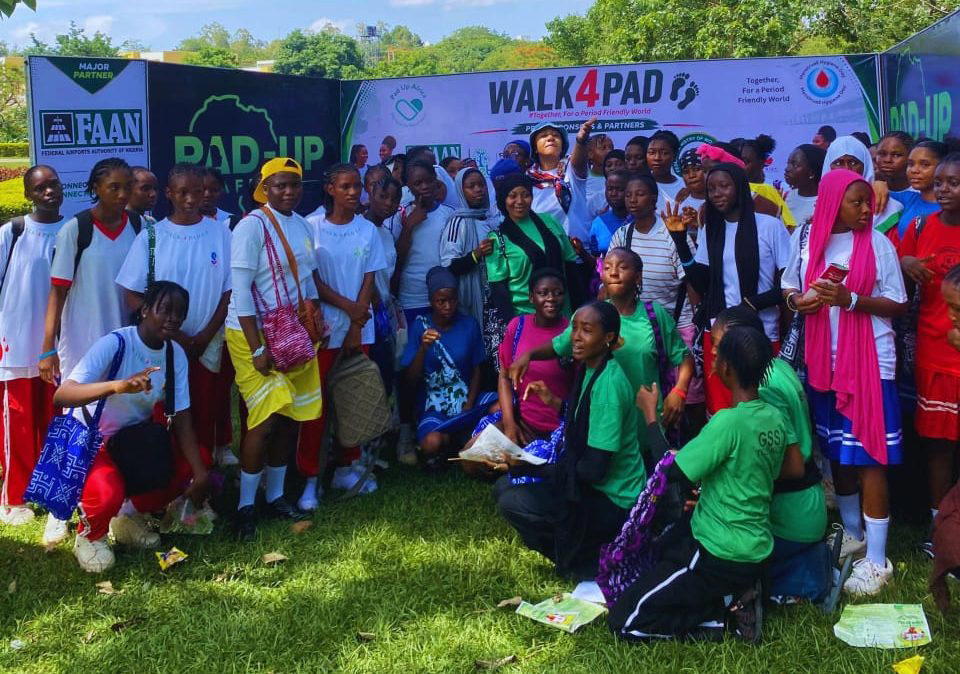
ABUJA – AS Nigeria joins the rest of the world to mark 2026 Menstrual Hygiene Day, Shamies Unusual Heart Foundation partnered with Pad-Up Africa to host the Walk4Pad 2026 advocacy walk and donate one-year menstrual hygiene kits and dignity packs to 100 disadvantaged girls and women in the Federal Capital Territory, FCT, Abuja.
The donations were part of activities lined up to mark the 2026 Menstrual Hygiene Day, during which an advocacy walk was held on Saturday at Millennium Park under the global movement theme, “#PeriodFriendlyWorld.”
The one-year menstrual hygiene support packages include sanitary products and dignity materials, and both organisations also sensitised the girls and women on menstrual hygiene management and period poverty, while they addressed issues on gender inclusion and the need to create safer and more supportive environments for girls and women.
The Executive Director and Founder, Shamies Unusual Heart Foundation, Sara Abdul, represented by the Acting Executive Director, Shamies Unusual Heart Foundation, John Olugbemi, explained that the partnership was aimed at increasing awareness about menstrual hygiene challenges girls and women grapple with.
According to Abdul, the advocacy walk was organised to educate the public and encourage support for menstrual hygiene initiatives.
He said: “We are proud to partner with Pads of Africa as part of activities marking Menstrual Hygiene Day. We realise there is still a lot of misinformation surrounding menstrual hygiene and sensitisation, especially regarding how it affects girls and women.
“We want the public to better understand the challenges faced by girls and women regarding menstrual hygiene. The walk is part of activities marking Global Menstrual Hygiene Day. It is aimed at promoting awareness, education, and sensitisation about the challenges women and girls face.”
He also urged relevant government authorities to be more committed to the issue of period poverty as disadvantaged girls cannot afford sanitary products, “It is sad that many disadvantaged girls suffer from period poverty and cannot afford sanitary products. What we are doing today is to raise awareness so that measures can be put in place to ensure that every girl can afford sanitary pads and properly care for herself.”
Meanwhile, in her remarks, the Executive Director, Pad-Up Africa, Ashley Olachi Lori, pointed out the importance of menstrual hygiene education and gender-sensitive facilities in schools, saying that menstruation should never be treated as a source of shame, urging girls to maintain confidence and dignity at all times.
Lori also made it known that her organisation has taken it upon itself to debunk myths and stigma surrounding menstruation while promoting menstrual health education in schools and communities.
According to her, about 1,000 girls across four rural schools would benefit from this year’s programme through the distribution of sanitary pads and training on reusable sanitary pad production and maintenance.
“We are going to continue to advocate for adequate menstrual hygiene information in schools, as well as proper menstrual hygiene facilities and gender-sensitive toilets.
“We want every young girl to understand that menstruation is a natural phenomenon and should never be a source of shame. Every girl should carry herself with dignity anywhere she finds herself”, Lori said.
She noted that the organisation was working to debunk myths and stigma surrounding menstruation while promoting menstrual health education in schools and communities.
According to her, about 1,000 girls across four rural schools would benefit from this year’s programme through the distribution of sanitary pads and training on reusable sanitary pad production and maintenance.
She further dismissed misconceptions discouraging girls from participating in sports while menstruating, noting that exercise could help relieve cramps and regulate menstrual flow.
One of the beneficiaries, Faleye Eniola, described the programme as empowering and called for reduced prices of sanitary pads following the high cost of sanitary products, which many disavanged girls was making access difficult for many girls and women, said: “I feel refreshed, energized, and more valued as a female growing up in Nigeria. I think sanitary pads should be made cheaper because many people cannot afford them.”
Also speaking, the founder of Lokas Intercontinental Sons of Tomorrow Initiative, Chieloka Iloputaife, stressed the need for boys and young men to support girls and help end period stigma.
“The Lokas Initiative focuses on the boy child. The boy child is here to support the girl child. We want boys to get involved in supporting girls, helping to end period poverty, and assisting girls with sanitary pads when needed”, Iloputaife said.
The Walk4Pad 2026 campaign formed part of broader efforts by advocacy groups and development partners to promote menstrual dignity, improve access to menstrual hygiene products, and eliminate stigma associated with menstruation in Nigeria.
Disclaimer
Comments expressed here do not reflect the opinions of Vanguard newspapers or any employee thereof.