
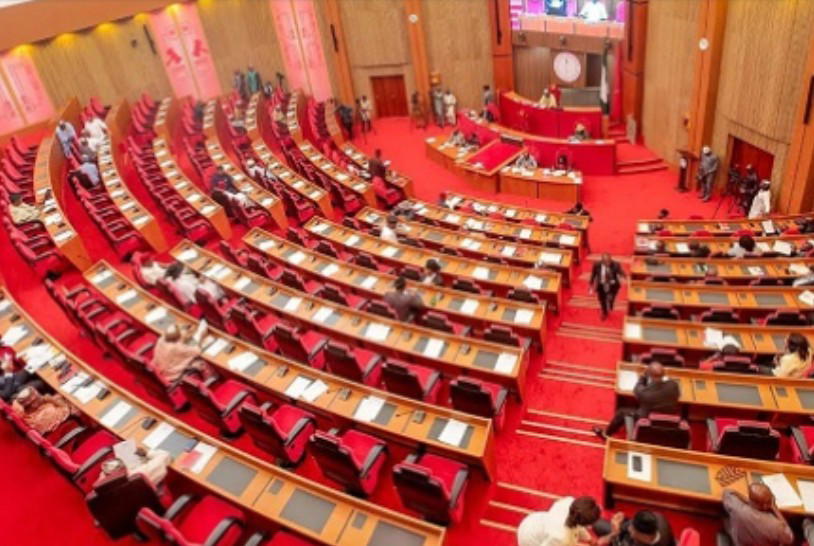
Senate
By Henry Umoru
ABUJA -MOVE by the Senate to establish the Chartered Institute of Revenue and Fiscal Management has got to almost the last stage of legislative process as the Senate has held a public hearing for it.
The bill titled, ” Chattered Institute of Revenue and Fiscal Management of Nigeria ( Establishment) Bill 2025 was sponsored by Senator Adamu Aliero, APC, Kebbi Central.
At the public hearing, there were however divergent views from critical stakeholders in the taxation , revenue generating , collecting and regulating sector, just as some were in support for the establishment of the Institute, there were those who were opposed to it.
The public hearing on the establishment bill for the proposed Institute organised by its joint committee on Finance, Establishment and Public Service chaired by Senator Sani Musa, APC, Niger East.
Declaring open the public hearing , the President of the Senate , Godswill Akpabio represented by the Senate Minority Whip, Senator Tony Nwoye, ADC, Anambra North said that the legislation was designed to institutionalize professionalism, strengthen ethical standards, promote continuous capacity development, and provide policy advisory support in the vital sector.
Akpabio said, “The subject of today’s Public Hearing is both timely and strategic because it directly relates to the economic stability, fiscal sustainability, and institutional strength of our nation.
“Nigeria, like many developing economies, faces increasing demands for improved revenue mobilization, stronger fiscal discipline, greater accountability, and enhanced transparency in public financial management. As government continues to pursue economic reforms and strengthen national development planning, the need for professionalism in revenue administration and fiscal governance becomes even mere critical.
“This Bill seeks to establish the Chartered Institute of Revenue and Fiscal Management of Nigeria as a professional body responsible for regulating, promoting, and advancing standards in revenue and fiscal management practice across the country. It is designed to institutionalize professionalism, strengthen ethical standards, promote continuous capacity development, and provide policy advisory support in this vital sector.
“This initiative is not simply about creating another professional institution; it is about building national capacity and strengthening the systems that support governance and development. It is about ensuring that those entrusted with responsibilities relating to revenue generation, fiscal planning, resource mobilization, and financial | accountability operate within clear professional standards that promote efficiency, integrity, and public trust.
“The National Assembly recognizes that sustainable development is not determined solely by how much revenue is generated, but also by how effectively that revenue is managed, safeguarded, and deployed for the benefit of the Nigerian people.
This is why stakeholder participation in this legislative process is extremely important. Public Hearings remain one of the strongest instruments of participatory democracy. They provide a credible platform for experts, practitioners, institutions, and citizens to contribute meaningfully to the lawmaking process. We value your presence here today because strong laws emerge from
broad consultation, shared experience, and collective wisdom.
“Let me assure you that the 10th National Assembly remains fully committed to enacting laws that promote economic growth, strengthen institutions, improve governance, and deepen public confidence in democratic leadership.”
Also in his remarks at the beginning of the session , the Chairman of the joint committee , Senator Sani Musa, APC, Niger East who was represented by Senator Adamu Aliero, explained that the Bill seeks to establish the Chartered Institute of Revenue and Fiscal Management of Nigeria as a professional body responsible for regulating, promoting, and advancing standards in revenue and fiscal management practice across the country.
Organisations and agencies that were in support of the bill was first the Fiscal Responsibility Commission, but wants the commission to be represented in the Council.
Also in Support where Association of Revenue Practitioners; the institute of Revenue Management and Research ( IRMR); Revenue and Fiscal Management Working Group; Society of Women in Revenue; Advocacy group for Taxation and Revenue; Professional women in taxation and revenue and Association of Tax Practitioners of Lagos.
First to kick against the bill was the Auditor General of the Federation, Shaakaa Kenyitor Chira who urged the Senate to come up with legislation that will strengthen the regulatory powers of existing professional bodies rathan than creating new ones .
He said, “Emphasis should be on strengthening existing Institutes and not establishing new ones to avoid Institutional duplication.”
Similarly, the President – Elect of Institute of Chartered Accountants of Nigeria ( ICAN) , Queensley Sofuratu Seghosime who noted that the proposed institute would create institutional rivalry in the sector and regulatory fragmentation, said, ” ICAN has gone through the proposed legislation and strongly sees it to be unnecessary because proliferation of professional bodies weakens standardization.”
Also contributing, the representative of Chartered Institute of Treasury Management ( CITM) , Titilayo Fowokan also kicked against the bill.
Also in his submission at the public hearing , Dr Yemi Sani of Network of Maletax Practitioners of Nigeria , told the Senate to step down the establishment for the proposed institute.
In his presentation, President of institute of Revenue Management and Research, Professor Ofiafoh Eiya said,
“The name of the Institute takes cognizance of both the Nigerian private and public Sectors. While revenue management refers to the private sector where we have sales and other revenues accruing to companies from goods and services, the fiscal management refers to the public sector which has the instruments of revenue, debt and expenditure management.
“CIRFMAN sets out to regulates and establishes uniform standards of its members in revenue and fiscal management practices in both private and public sectors
“The Bill has been analysed and evaluated and does not conflict with any existing laws but complements other laws with a view to ensuring an efficient and effective fiscal ecosystem. 4. CIRFMAN Bill wishes to fill knowledge gap and weak revenue management as well as the challenges of low government revenue relative to rising debt servicing at both the private and public sector respectively. 5. CIRMAN College of Postgraduate Studies in Revenue and Fiscal Management shall be designed to build capacity not only for Africa, but globally. The College shall be affiliated with a University in line with the requirements of the Nigerian Universities Commission (NUC).
” The Institute of Revenue Management and Research (IRMR) is incorporated as a company limited by guarantee under the Companies and Allied Matters Act 2020, with the Corporate Affair Commission in Nigeria. Introduction
“Today represents a significant milestone in our collective efforts to strengthen revenue advancement, fiscal management, and economic governance in our great nation.
“During our research-driven pursuit of knowledge, we identified a specialised field known as Revenue Management, an area already established at both undergraduate and postgraduate levels in several advanced economies. American Airlines is widely credited as the pioneer of its practical application, and the discipline has since expanded across multiple industries.
“Recognizing its relevance and transformative potential for Nigeria, we initiated the registration of the Institute of Revenue Management and Research (IRMR) with the Corporate Affairs Commission (CAC) in 2021. This required extensive engagements with and approval from the Federal Ministries of Finance and Justice. In 2024, IRMR was formally incorporated as a company limited by guarantee.
“Building on this achievement, we resolved to expand the knowledge, professional standards, and the practice of revenue management across a wider community of practitioners. This led to the birth of the Chartered Institute of Revenue and Fiscal Management of Nigeria (CIRFMAN) Establishment Bill, 2025. The National Institute for Legislative and Democratic Studies (NILDS) carried out the analysis and evaluation of the Bill.
“We are happy to report that our membership strength stands at 1736, spread across Nigeria Revenue Service, State Internal Revenue Services, Tertiary institutions, private sector and other Ministries, Departments and Agencies of government. We are convinced that within a week after this Bill is passed, this number would increase to over 5000. This is not only an indication of Nigerians interest in the institute; it also speak volume of their desire to learn and upskill for future revenue and fiscal management relevance.
Disclaimer
Comments expressed here do not reflect the opinions of Vanguard newspapers or any employee thereof.