
By Kingsley Adegboye
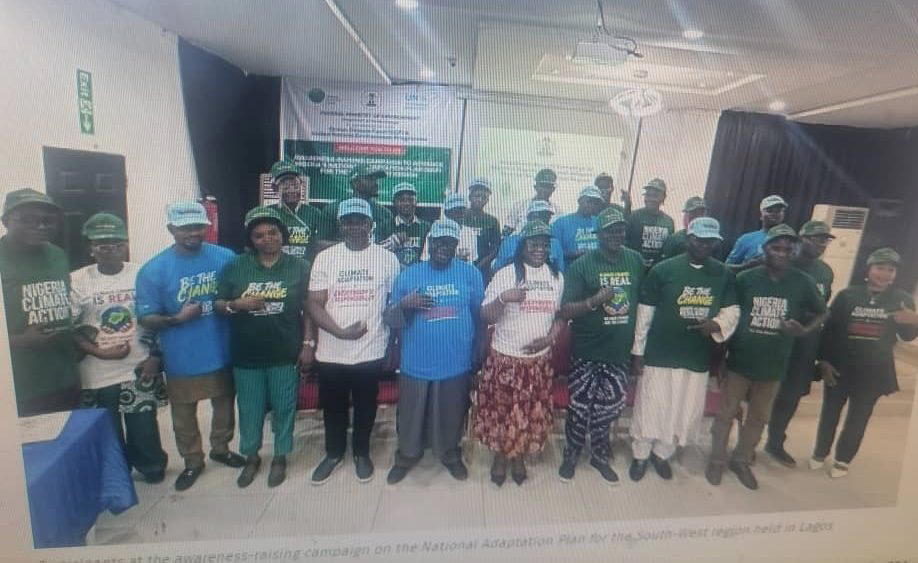
The Department of Climate Change in the Federal Ministry of Environment under National Adaptation Plan (NAP), last week in Lagos held a one-day stakeholders’ conference on awareness-campaign to advance Nigeria’s National Adaptation Plan (NAP), even as stakeholders noted that flooding and other challenges of climate change remain major risks.
Participants at the conference comprised representatives of Ministries of Environment from South-West Region including Lagos, Ogun, Oyo, Osun, Ondo and Ekiti, government officials, climate change experts and the media.
Remarking on the essence of the awareness campaign, Prof. Emmanuel Oladapo who gave insight into the overview of Nigeria NAP document, said the campaign which is meant to cover the entire country, is to prepare and to ensure that Nigeria has a planning process to adapt to the impact of climate change in the country.
According to Prof. Oladapo, “Through the exercise of the National Adaptation Plan, as requested by the United Nations Framework Convention on Climate Change for developing countries will lead developed countries to formulate this process. We have done that, we have conducted all the building blocks to this process and through that we have been able to identify the major hazards.
“And we have been able to see the exposures, we have been able to identify the risks, we have been able to identify the vulnerabilities. And through that, we have been able to come up with the adaptation strategies and options on how we can adapt and adjust to the impact of climate change in the country.
“So, the major hazard that we have identified in terms of climate change impact in Nigeria is flooding, droughts and desertification, sea level rise, and heat waves. Those are the major hazards that we have identified in terms of climate change impact in Nigeria.”
On financing the project, he said “Yes, when it comes to adaptation, finance is needed, but beyond finance, there are some practices that we need to imbibe. So, everything in the document is not just about project but practices that can assist Nigerians to adapt to the impact of climate change and when it comes to the area of finance, the project also outlines the adaptation finance strategies
“And this means the need for government at the national, at the subnational, even at the local government, to start thinking, to start including adaptation planning into the annual budgetary allocations. This is very important so that we don’t have to be depending on foreign bodies, foreign governments to finance this process for us in the country because climate change has come to stay.
“And for us to be able to keep our means of livelihood, for us to be able to adapt so that all of these hazards and the projected extreme weather events that are most likely to happen will not affect us adversely. We need to start thinking, we need to start planning. And those are the things that we are able to do so that everybody will be on board, like we have said.
“Addressing issues of climate change is everybody’s responsibility, and so we must start planning, we must start allocating resources for it, even at the national level,” Prof. Oladapo stated.
In his remark, the National Project Coordinator of the National Adaptation Plan, Kayode Aboyeji, said the initiative has reached a critical stage of disseminating findings gathered across the country, pointing out that adaptation plan was developed in line with the request of the United Nations Framework Convention on Climate Change for developing countries to establish strategies for adapting to climate impacts.
According to Aboyeji, the importance of the awareness campaign is to create awareness on the national adaptation plan for Nigeria, stressing that the process started some time ago and now it has come to a critical point where “we need to disseminate the information on the findings that we were able to gather across the country to prepare and ensure that we have a planning process to adapt to the impact of climate change.”
He noted that the project has identified major climate hazards affecting Nigeria after conducting nationwide assessments across geopolitical and ecological zones, adding that “We have been able to identify the major hazards of climate change in Nigeria, the exposures, the risks and the vulnerabilities such as flooding, drought, desertification, sea level rise and heat waves among the major climate threats currently facing the country.
On financing climate adaptation efforts, he noted that while funding remains important, behavioural change and government commitment are equally critical.
“When it comes to adaptation, finance is needed, but beyond finance, there are practices and changes of mindset that Nigerians need to imbibe,” he said.
He added that the adaptation plan recommends that federal, state and local governments begin integrating climate adaptation into annual budgetary allocations rather than depending heavily on foreign donors and climate funds.
In her remark, Iniobong Abiola-Awe, a director at the Department of Climate Change, Federal Ministry of Environment said Bola Tinubu administration is committed to addressing climate change challenges in Nigeria.
Disclaimer
Comments expressed here do not reflect the opinions of Vanguard newspapers or any employee thereof.