
By James Ogunnaike, Abeokuta
Security experts have identified the proliferation of small arms and light weapons as a major driver of insecurity in Nigeria, warning that weak post-judgment management of seized weapons is compounding the problem.
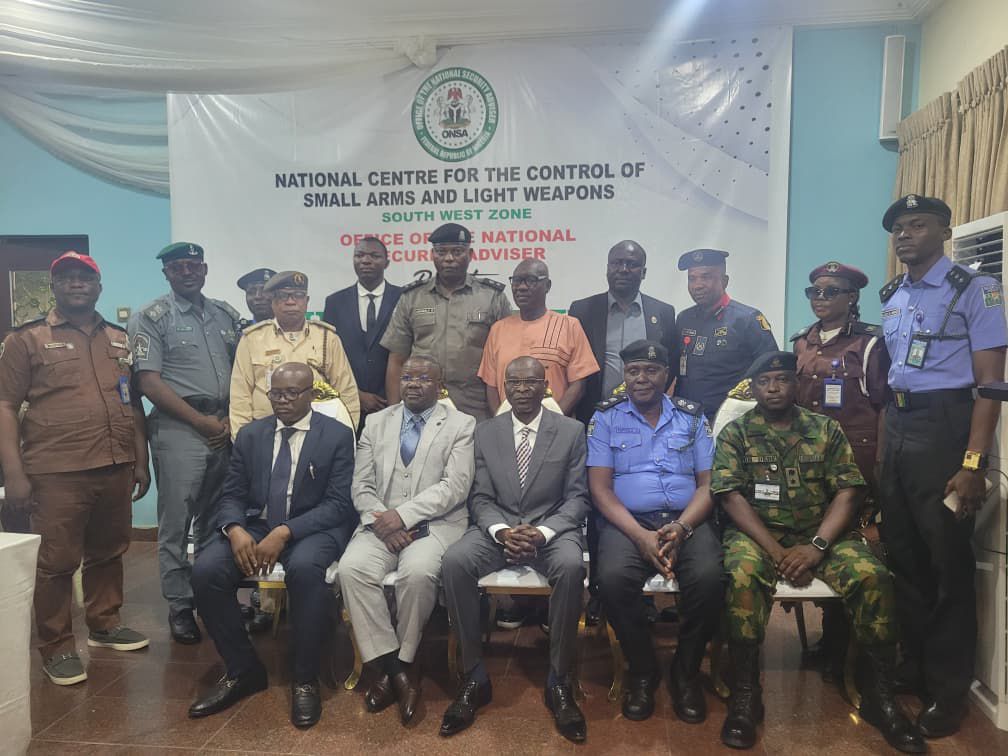
They raised the alarm on Thursday at a one-day seminar on “Effective Post-Judgment Management of Small Arms and Light Weapons”, organised by the National Centre for the Control of Small Arms and Light Weapons (NCCSALW) in Abeokuta, Ogun State.
Speaking at the forum, the South-West Zonal Director of NCCSALW, CP Abiodun Alamutu (rtd), lamented critical gaps in the handling of weapons after court rulings, describing the phase as a “silent but potent vulnerability” capable of undermining both the justice system and national security.
Addressing participants, including the Chief Judge of Ogun State, Mosunmola Dipeolu, and the Attorney-General and Commissioner for Justice, Oluwasina Ogungbade, Alamutu posed a critical question on the effectiveness of judicial outcomes.
He explained that weapons tendered as exhibits during trials often become security threats if not properly documented, transferred and destroyed after proceedings.
Alamutu said, “the critical interval where a weapon transitions from legal evidence to a potential security liability must be handled with absolute procedural integrity. No weapon that has seen the inside of a Nigerian courtroom should ever find its way back into the hands of a criminal.”
He noted that Nigeria’s responsibility extends beyond domestic concerns, referencing its obligations under the ECOWAS Convention on Small Arms and Light Weapons.
“As a signatory to the 2006 ECOWAS Convention, Nigeria is bound by Article 17, which mandates that all illicit weapons seized or recovered must be collected and destroyed. This is not just policy; it is a matter of international law and national responsibility,” he said.
To address the lapses, he advocated a structured “roadmap of finality” anchored on immediate transfer of forfeited weapons, recognition of storage as a temporary measure, and enhanced coordination among the judiciary, law enforcement agencies and NCCSALW.
“A judicial order for forfeiture is only as strong as the physical transfer that follows it. We must eliminate the gaps where weapons remain in armouries long after their legal purpose has been served,” he added.
Warning against prolonged storage, Alamutu described it as a major risk factor.
“Every day a confiscated weapon remains in storage is another day it is vulnerable. Our goal must be secure transit leading to one final destination — verified destruction.”
He also called for transparent and traceable communication among relevant institutions.
“We cannot afford administrative black holes. Coordination must be transparent and digitally traceable to ensure that judgment truly means disposal,” he said.
Highlighting the broader security implications, Alamutu urged stakeholders to translate judicial pronouncements into tangible safety outcomes.
“The safety of our communities is the ultimate verdict,” he said.
On the wider insecurity challenge, he attributed the surge in banditry and terrorism to the widespread circulation of illicit arms, many of which are in the hands of non-state actors.
“So far, we have discovered that the major enabler of insecurity, banditry and terrorism in the country is the proliferation of small arms and light weapons. A large chunk of these arms are in the hands of non-state actors.”
While acknowledging successes at border points in intercepting illegal weapons, he said the focus must now shift to retrieving those already in circulation.
“We have made tremendous progress at the borders. But now, we want to divert our attention to mopping up arms already in circulation. This requires the active collaboration of traditional rulers, community leaders and other stakeholders,” he said.
Alamutu disclosed that the South-West alone may have about five million illegal arms in circulation, stressing the urgency of decisive action.
“We should not take things for granted. Estimates suggest the figure runs into millions, possibly five million or more. This calls for immediate and coordinated intervention,” he warned.
Also speaking, the Ogun State Commissioner of Police, Bode Ojajuni, emphasized the need for improved coordination in handling recovered weapons.
“We have many of these arms that have been recovered and are in police armouries. I feel that the centre should devise another avenue to mop up these weapons immediately,” he said.
Ojajuni cautioned against delays in transferring recovered arms, urging the establishment of a uniform system across states to ensure timely handover to NCCSALW.
Meanwhile, a resource person at the seminar, Kunle Olawuni, decried poor documentation and weak inter-agency protocols, which he said create loopholes for theft, substitution and re-circulation of seized weapons.
Olawuni, who heads the Department of International Relations and Diplomacy at Chrisland University, called for a transition from paper-based processes to a secure digital tracking system linked to case records and exhibit identifiers.
He also advocated the adoption of modern armory standards, including periodic audits and strict accountability measures.
According to him, “Only a transparent, technology-driven system can guarantee that seized weapons are not recycled back into criminal networks.”
Disclaimer
Comments expressed here do not reflect the opinions of Vanguard newspapers or any employee thereof.