
By Ndahi Marama, Damaturu
The Acting Secretary to the Yobe State Government (SSG), Dr. Mohammed Goje has said that the Governor Mai Mala Buni’s Legacy projects in the last seven years has really paid off, as many people across the 17 local government areas have benefitted directly or indirectly, especially from the security stabilization initiatives, educational transformation and healthcare delivery system.
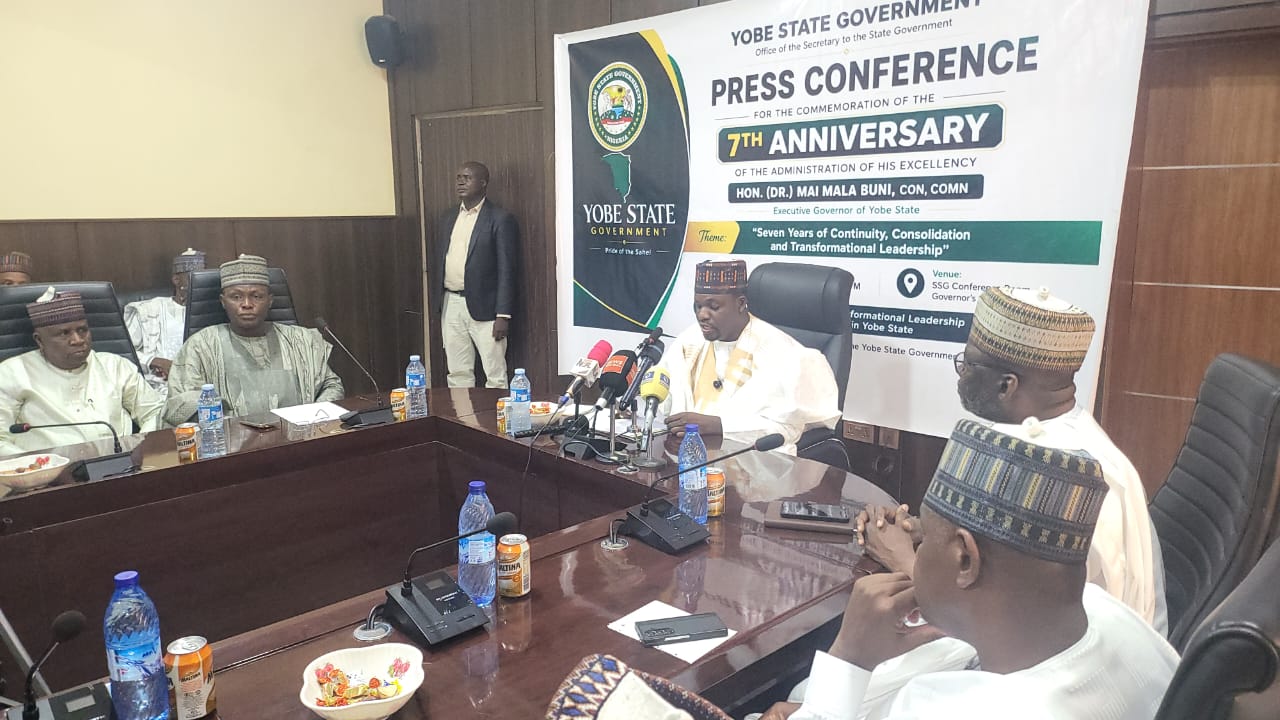
Goje made this disclosure on Friday while briefing Journalists about the modest achievements recorded, and in commemoration of the Buni’s administration themed: “Seven (7) Years of Continuity, Consolidation and Transformational Leadership”.
The SSG flanked by the Commissioner of Home Affairs, Information and Culture, Hon. Abdullahi Bego and host of other Commissioners as well as other top government functionaries at his office in Damaturu said, for over the past years, the Buni administration has steadily pursued a governance philosophy anchored on continuity, post conflict recovery, inclusive development, institutional and system strengthening, peacebuilding, and strategic investments in critical sectors of the economy.
His words: “Against the backdrop of insecurity, humanitarian challenges, and economic pressures confronting many subnational governments, Yobe State under His Excellency, Governor Mai Mala Buni has emerged as a model of resilience, prudent leadership, political stability, and purposeful governance.
“This administration came with a clear vision of continuity and consolidation, rebuild confidence in governance, improve public infrastructure, deepen security and social cohesion, expand opportunities for citizens, and lay sustainable foundations for future prosperity”. Goje said.
One of the most remarkable achievements according to him, has been the restoration and consolidation of peace, security, and public confidence across Yobe State.
“At a time when many communities were grappling with the devastating effects of insurgency and displacement, the administration adopted a proactive, multi-dimensional security strategy anchored on strong collaboration with security agencies, community engagement, logistical support, institutional strengthening, and humanitarian recovery.
“Under Governor Buni’s leadership, the Yobe State Government has provided extensive operational and welfare support to security agencies through the procurement of over 200 operational motorcycles and 60 patrol vehicles for security formations, vigilante groups, hunters, and community response teams among others.
“These strategic interventions, combined with massive investments in road infrastructure, resettlement programmes, education, healthcare, markets, and rural development, have significantly stabilized many previously affected communities.
“Today, economic and social activities have remarkably improved across the state. Markets are thriving, schools are fully operational, many roads are accessible, businesses are expanding, and thousands of citizens are rebuilding productive livelihoods in an atmosphere of renewed peace, stability, and hope”. He explained.
The SSG further said, infrastructure development has remained one of the defining legacies of the present administration, in which the governor has implemented one of the most extensive road construction, rehabilitation, and urban renewal programmes in the history of Yobe State, with strategic investments deliberately spread across all senatorial zones and local government areas to stimulate economic growth, improve connectivity, and promote inclusive development.
At the centre of this transformation, he noted, is the ongoing construction of the iconic Damaturu Flyover and Underpass Bridge, a landmark project that symbolizes the modernization of Yobe’s capital city and reflects the administration’s vision of building a modern, resilient, and economically vibrant urban centre.
This is complemented by the dualization and reconstruction of the 26-kilometre Damaturu–Kalallawa Road, the construction of the 11kilometre Damaturu–Gambir Road, the expansion of Potiskum Road from the 530 Filling Station to Pilgrim area, the reconstruction of the Waziri Ibrahim Bayan Kotu Bypass, and the construction of a new 6-kilometre road corridor linking the Gujba Road Housing Estate to Potiskum Road near Yobe State University Teaching Hospital.
Within Damaturu metropolis alone, the SSG said the administration has undertaken extensive urban road development through the construction of roads in GRA, Afghanistan, Mallamattari, Zanna Zakariya Quarters, Commissioners’ Quarters, and several other strategic locations aimed at improving mobility, decongesting traffic, and enhancing the aesthetics of the state capital.
Beyond Damaturu, he added, was major township and inter-community road projects which have transformed transportation networks across the state. These include the construction and rehabilitation of roads linking Dapchi, Bayamari, Kariyari, Jajimaji, Garin Guna, Karasuwa, Galu, Geidam, Bukarti, Machina, Babban Gida, Nangere, Yusufari, Yunusari, Nguru, Potiskum, Gujba, Gulani, Fika, Jakusko, and Gashua. Notable among these are the 34-kilometre
Jajere–Danchuwa Road, the 17-kilometre Ngelzarma–Mashio Road, the 12-kilometre
Damagum–Gubana Road, the 16-kilometre Nguru–Balanguwa Road, the 18-kilometre Garin Bingel–Danchuwa Road, the 10-kilometre Chumbosko–Tagali Road, the 7kilometre Potiskum–Degubi Road, the 5-kilometre Potiskum–Ngojin Road, and the 5kilometre Fadawa–Daya Road.
Recognizing the importance of rural access and agricultural value chains, Governor Buni also invested heavily in strategic stone-base roads including the 25kilometre Fika–Maluri Road, and the Dawasa–Kukuri Road, thereby improving access to farming communities, reducing transportation costs, and enhancing rural economic productivity.
In addition, numerous township roads have been completed in Potiskum, Gashua, Nguru, Damagum, Yusufari, Yunusari, Geidam, Machina, Babban Gida, Dapchi, Buni Gari, Buni Yadi, Bara, and other communities, while critical bridges and culverts have been constructed along the Geidam–Bukarti and Buni–Gulani corridors to improve year-round accessibility and strengthen climate resilience.
These investments according to him, are far more than physical infrastructure, as they are strategic economic corridors that facilitate trade and commerce, improve access to education and healthcare, strengthen social integration, support agricultural development, create jobs, and connect communities to opportunities.
Recognizing education as the most strategic investment for securing the future of Yobe State, Buni undertook unprecedented investments in educational infrastructure, institutional expansion, access to quality learning, science and technical education, and the empowerment of future generations.
“One of the flagship achievements of the administration is the construction of Seven Mega Schools and Seven Model Schools strategically located across the state, including Damaturu, Potiskum, Gashua, Nguru, Geidam, Dapchi, and Buni Yadi.
“These world-class institutions are redefining public education standards in Yobe State by providing modern classrooms, laboratories, libraries, ICT facilities, and conducive learning environments capable of preparing students to compete in an increasingly knowledge-driven global economy”.
The administration he stressed, has also significantly expanded tertiary education and professional training institutions to includes the establishment of the temporary site of the College of Integrated Sciences in Damaturu, the construction of multiple academic and administrative facilities at the College of Nursing and Midwifery, Damaturu, and the establishment of the Clinical Section of the Medical College at Yobe State University Teaching Hospital (YSUTH).
“These investments are strengthening the state’s capacity to train highly skilled professionals in medicine, nursing, science, and other critical sectors essential for long-term development.
“At Yobe State University, substantial investments have been made in academic infrastructure, including the construction of the Biotechnology Research and Training
Centre (BioRTC), expansion of teaching and research facilities, and enhancement of the overall learning environment.
On healthcare seevice delivery, he said, the governor has undertaken one of the most ambitious healthcare transformation programmes in the history of Yobe State, guided by the principle that access to quality healthcare is a fundamental right of every citizen.
“Over the past seven years, the administration has invested heavily in expanding healthcare infrastructure, strengthening referral systems, improving maternal and child health services, upgrading health institutions, and bringing essential healthcare closer to communities across the state.
“A landmark achievement of the administration is the construction and completion of 143 Primary Healthcare Centres strategically distributed across the 178 political wards of Yobe State.
“This unprecedented investment has significantly expanded access to basic healthcare services, reduced travel distances for patients, and strengthened primary healthcare delivery, particularly in rural and underserved communities”. Goje explained further.
Disclaimer
Comments expressed here do not reflect the opinions of Vanguard newspapers or any employee thereof.