
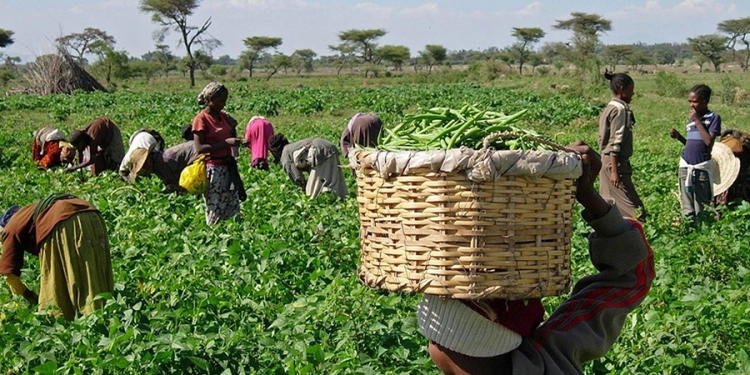
File image
By Gabriel Ewepu
After three years of huge economic reforms which heavily affected the agricultural sector, stakeholders in the sector have expressed mixed reactions over the performance of President Bola Tinubu based on his campaign promises to boost food and nutrition security.
Below are the views of the stakeholders who spoke to Vanguard.
It’s still a long way to food security –NABG
Appraising the promise on Access to Finance by farmers as contained in the Manifesto, which it also said the governance and structure of the Bank of Agriculture (BoA) will be reformed to address, the President, Nigeria Agribusiness Group, NABG, Arc Kabir Ibrahim, said despite this promise and three years down the road, there is still a lot to be done in terms of access to finance.
Ibrahim said: “My view on APC’s, albeit Mr President’s Manifesto in 2023, is that it is work in progress and it really needs reappraisal by making sure all policies and strategies geared towards Nigeria’s food system are implemented to the latter and transparently too.
“The BOA is currently going through reinvigoration and repositioning and this should be hastened. The CBN intervention in Agriculture is now measured and somewhat circumspect but can be efficacious if properly coordinated and implemented properly. There’s a lot of work before Nigeria becomes food secure with the current level of insecurity and several other challenges like climate change and low mechanisation, among others. In a not so easily discernible sense the Nigerian farmers are now doing Agriculture as a business. We can attribute this reawakening to the challenges in the cost of inputs they now face in the overall Agricultural ecosystem due to the liberalisation policy of the Tinubu administration.”
Farmer Cooperative effective, well organised – AFAN
In her assessment, the Chairman, All Farmers Association of Nigeria, AFAN, Federal Capital Territory, FCT, Dr Nkechi Okafor, acknowledged that under the Tinubu administration in the last three years farmers have been better organised and managed as far as farm cooperatives are concerned as promised to be strengthened in his manifesto, which makes it effective for interventions to reach them along various value chains.
She said, “The government didn’t just start the issue of encouraging farmers to form cooperatives as has been their yearnings. Since, I started as a Farmers’ advocate years ago, it has been on the lips of every government that to help farmers, it is best done when they are in a cluster or in a cooperative. This is to enhance coordination and monitoring and evaluation of the project or programme. They believe farmers in the cooperative cannot all default at the same time so working with cooperatives becomes their most cherished. Actually, in All Farmers Association of Nigeria (AFAN), I can tell you that the recognition we are gaining now to coordinate the affairs of farmers in Nigeria as the Apex body wasn’t been there before.”
Mechanisation still far from farmers’ reach – WIMA
Speaking on mechanisation as one of the key issues the Tinubu-led administration said it would address, the President, Women in Mechanised Agriculture, WIMA, Aisha Bako, said, “We have seen an increase in efforts for mechanisation equipment. We have even received an offer from one of the government organisations but affordability has been the issue. Unfortunately we in WIMA have not been able to benefit from this as we don’t have finance or are unable to meet the criteria set for accessing them. Let’s see what the future holds. Maybe a women focused fund will be developed or created.”
Visible efforts in farmers’ groups, but with weaknesses – DeBranch Farmers
Farmer Cooperatives was one of President Tinubu’s cardinal promises.
Chief Executive Officer, CEO, and Co-founder, DeBranch Farmers Limited, Sandra Victor-Gwafan, asserted that within the three years of President Bola Tinubu, farmers’ cooperatives have been strengthened, and are well organised including at the State level.
Victor-Gwafan, said, “As the CEO of DeBranch Farmers Limited, and someone working closely with smallholder farmers and rural communities in Northern Nigeria, I believe the conversation around farm cooperatives is very important to the future of agriculture in Nigeria.
“Three years into the administration, there have been visible efforts by government at both federal and state levels to strengthen farmer groups and cooperatives through intervention programs, input support initiatives, mechanisation discussions, and access to some financing windows. However, from practical experience on the ground, the impact is still not yet at the scale many farmers expected. Many cooperatives still struggle with limited access to affordable finance, inadequate extension support, weak storage infrastructure, high transportation costs, and inconsistent access to modern equipment. In many rural communities, cooperatives exist mostly on paper without the operational capacity needed to truly deliver economies of scale for farmers. Another challenge is that many genuine grassroots agricultural businesses and farmer groups still find it difficult to access government programs due to bureaucracy, information gaps, or policy implementation delays. Tax incentives and structured benefits specifically targeted at cooperative members are also not yet widely felt by most rural farmers’’
Most of Agric promises still on paper – Processor
The manifesto assured farmers of functional irrigation and Water Catchment.
But in his assessment of the promises a farmer processor and youth leader, Jerry Tobi, claimed that most of these promises ended on paper and no practical aspect of them including irrigation and water catchment for food production can be seen any where three years after.
He stated: “As a farmer processor, youth leader, and someone who works directly with rural farmers daily, I must honestly say that many young people in agriculture are deeply disappointed with the current state of the sector despite the lofty promises made over the past three years. On paper, the policies sound excellent — mechanisation support, farmer cooperatives, irrigation expansion, BOA recapitalisation, access to finance, and private sector collaboration. But physically, at the grassroots level, many farmers are yet to feel these promises in any meaningful way.
“The mechanisation programme is almost nowhere to be found for the average farmer. Smallholder farmers still rely heavily on manual labor while the cost of tractors, harvesters, and inputs continues to rise beyond reach. Many cooperatives that were expected to benefit have not seen real equipment support or structured access systems.
“The recapitalisation of the Bank of Agriculture has been discussed for over two years, yet farmers are still struggling to access affordable financing. Most rural farmers still depend on informal lenders with high interest rates. There is a huge disconnect between policy announcements and implementation.”
He continued, “In the rice sector, many farmers are afraid to cultivate at scale this season because of uncertainty around imported rice. Farmers fear that uncontrolled importation could crash local prices during harvest, leading to massive losses. Without clear protection policies and guaranteed off-take structures, confidence among producers is low.
“The ginger sector is another painful example. Over 120,000 ginger farmers and actors across the value chain have been affected by the high cost of production, disease outbreaks, insecurity, and lack of structured intervention. Many are unable to return to the farms this year because there is no visible recovery framework or direct support mechanism from government’’.
In conclusion he said, “Nigeria has the potential to feed Africa, but agriculture cannot survive on promises alone. Young people are willing to farm, process, and build agribusinesses, but the environment must become more predictable, protected, and practical for producers.”
Disclaimer
Comments expressed here do not reflect the opinions of Vanguard newspapers or any employee thereof.