
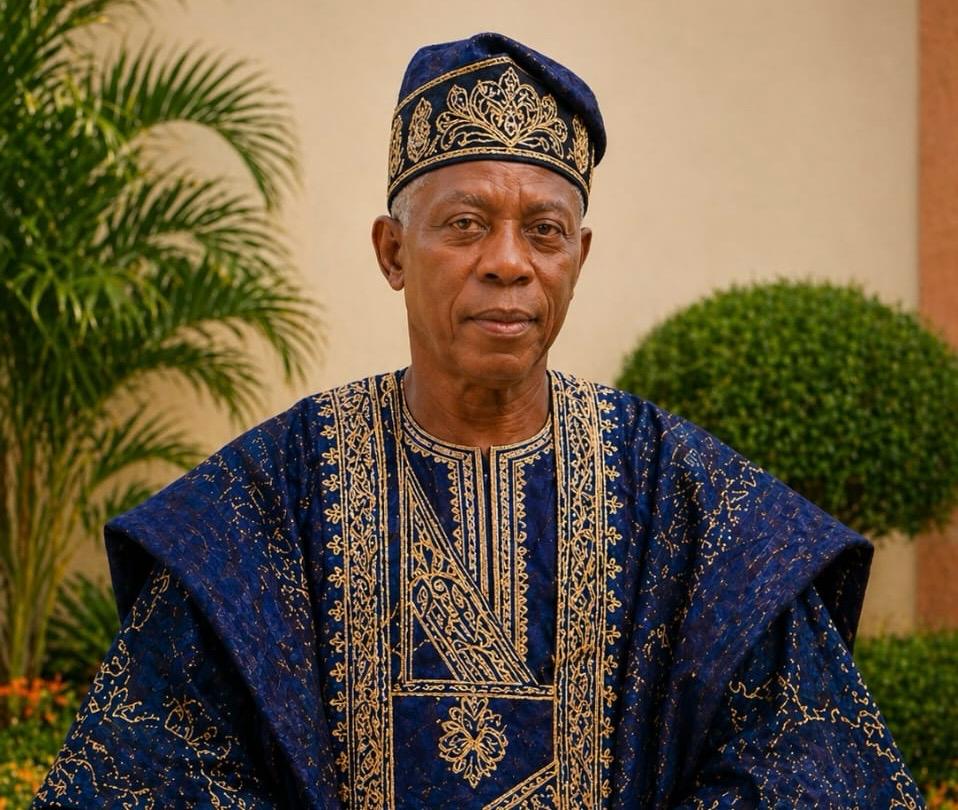
By Adeyemi Haastrup
I had just returned from work when the news came. There are moments in life that do not announce themselves loudly, yet they divide time into before and after.
That evening became one of such moments for me. I had returned from the ordinary demands of the day, carrying in my mind the unfinished thoughts of work, the little worries of daily life, and the quiet expectation that tomorrow would come as usual.
Then the news of my father’s death reached me, and everything became still. My father, Prince Kehinde Adeboye Haastrup, had gone to be with the Lord. For a while, the words did not settle properly in my heart.
Death is something we all know will come, yet when it comes for one’s father, it feels strangely impossible.
It feels as if a pillar has quietly moved out of the house. It feels as if a familiar voice has stepped beyond reach. It feels as if childhood, memory, discipline, family history, and love have suddenly gathered into one painful silence.
What made the news even more piercing was that I had visited him in Ilesa only a week before. He had been ill, and I knew he was not as strong as before.
However, illness does not always prepare the heart for finality. I did not know that the conversation we had that day would be our last physical conversation. I did not know that the face I looked upon, the voice I listened to, the memories we shared, and the father-to-son exchange we had would become my final living memory of him.
That visit now returns to me with a force I cannot fully describe. We sat together and spoke as father and son.
We reminisced about the strength of his youth, the fire of his ambition, the roads he had travelled, the work he had done, the struggles he had faced, and the many seasons through which God had carried him.
In that conversation, I received fragments of a life. I saw again that my father was not only the man we called “Dad.”
He was once a young man full of promise, courage, intelligence and dreams. He was once a man standing before life with energy in his body and plans in his heart.
There was something sacred about that conversation, though I did not know it then. I left him that day with the promise that I would visit again.
It was the kind of simple promise that we make because we believe time is still available. I thought there would be another visit, another conversation, another chance to sit with him, and another opportunity to ask questions, to listen, to laugh, to observe him, and to hold on a little longer.
Regrettably, God had written the final sentence differently. That day in Ilesa became our farewell, even though neither of us called it farewell.
Today, as I write, I carry both pain and gratitude. Pain, because no son is ever fully ready to lose his father.
Gratitude, because God allowed me to see him, speak with him, listen to him and share that final father-to-son moment before he departed. Some farewells are spoken.
Others are hidden inside ordinary conversations. Ours was hidden inside memory, affection and promise.
My father was born on 31 August 1955 and was called to glory on 24 April 2026. He came from a noble and illustrious lineage.
He was a descendant of the Haastrup dynasty and a grandson of the revered Owa Ajimoko II, Oba Alexandra Adejumola Haastrup, whose name remains permanently inscribed in the history of Ijesaland.
His father, Prince Benjamin Adefisoye Haastrup, and his mother, Olori Sarah Bamidele Adetokunbo Haastrup, nee Ibitayo, raised him within a heritage of honour, courage, discipline and royal dignity.
However, my father’s life was never just about royalty. He was not a man who hid behind ancestry. He was a man who lived, worked, fought, built, stumbled, rose, endured and carried his burdens with the stubborn dignity of one who refused to be defeated by life.
From his early years, he showed uncommon intelligence. He was brilliant, sharp and determined. His performance in the West African Examinations Council examination, where he earned distinction grades, revealed a mind that was disciplined and alert.
Beyond academic brilliance, he possessed a practical intelligence, the kind that could understand machines, solve problems, build things, and turn ideas into visible results.
His professional journey took him to Lever Brothers Limited in Lagos, now Unilever Nigeria Plc, where he worked as a technical and electrical engineer.
There, he rose through the ranks through competence, diligence and commitment. He was not a man of empty display. He knew his work.
He respected skill. He believed in effort. He understood that a name may open a door, but only character, ability and seriousness can keep a man standing in the room.
Later, driven by enterprise and courage, he moved beyond paid employment into industrial craftsmanship. He built cold-room freezers for major companies and became one of the early contractors who worked with International Breweries Plc in Ilesa.
By 1984, he had established his own company, taking the bold step into entrepreneurship.
That part of his life always speaks to me. My Dad was a man who dared.
He was not afraid to attempt difficult things. He did not live a timid life. He entered spaces where success was not guaranteed.
He took risks. He built. He tried. He fought for survival. Like many men of his generation, he knew that life could be generous today and hard tomorrow.
Yet, he did not allow hardship to erase his dignity. His life had its struggles. It would be dishonest to pretend otherwise.
He passed through seasons that tested him deeply. There were moments of uncertainty, moments of difficulty, moments when life must have felt heavier than words could carry.
Nonetheless, the measure of a man is not that he never struggles. The measure of a man is that he continues even when struggle becomes familiar.
My father continued. And because he carried those burdens, his story is not distant to me. It is personal. It is the story of the man whose blood runs in mine.
It is the story of the man whose life shaped my own in ways I am still discovering. It is the story of a father who, even in his imperfections, remained deeply human, deeply present, and deeply connected to those who knew him.
In 1978, he married my mother, Olori Helen Omolola Haastrup, nee Makinde, a Princess from Ile-Ife. Their union was a life journey.
Their marriage gave us, his children, a home, a name, a history, and a foundation from which we must now continue.
When a father dies, one does not lose only a person. One loses a living archive. A father carries stories that no book can fully preserve.
He carries the memory of family migrations, old quarrels, ancestral pride, youthful adventures, private mistakes, hard lessons, forgotten names, and silent sacrifices.
With his passing, I feel the weight of questions I should have asked, stories I should have recorded, and memories I should have drawn out more patiently.
Yet, I refuse to remember him only through regret. I choose also to remember the gift of that final conversation.
I choose to see it as mercy. God allowed us to sit together before the curtain fell.
God allowed me to hear him again. God allowed father and son to meet in the quiet dignity of shared memory.
My father was not a perfect man. No father is. No son is. No human being is. But he was my father, and that makes his life sacred to me.
He had his strengths and his weaknesses, his triumphs and his wounds, his laughter and his silences, his victories and his battles. He was not an abstract hero carved out of marble.
He was a real man, made of flesh, history, struggle, love and grace. In his last days, my father found grace.
After the long journey of life, with all its struggles and surprises, he encountered the mercy of God. For a son, there are few consolations greater than knowing that a father did not depart without divine touch.
His life began in royalty, moved through labour and struggle, and ended in the hands of grace. He leaves behind his wife, children, grandchildren, brothers, cousins, relatives, friends and well-wishers.
But to those of us who called him father, he leaves something more intimate than public legacy. He leaves the memory of presence. He leaves the weight of his name. He leaves the lessons of endurance. He leaves the responsibility to live well, to remember well, and to carry forward what is noble in his story.
I left him with a promise to visit again. Now, that visit must wait until another morning, beyond this world, where sickness will no longer weaken the body, where death will no longer interrupt love, and where sons and fathers will meet again at the feet of Christ.
Nle o, Omo Owa.Nle o, Omo Ekun.Nle o, Omo Ajimoko bi Oyinbo.Sun re o, Ejire ara Isokun.
Rest well, my father.Rest well, my prince.
Rest well, child of grace.
Your earthly journey is complete, but your place in our hearts remains secure till we meet again at the feet of Christ.
Disclaimer
Comments expressed here do not reflect the opinions of Vanguard newspapers or any employee thereof.