
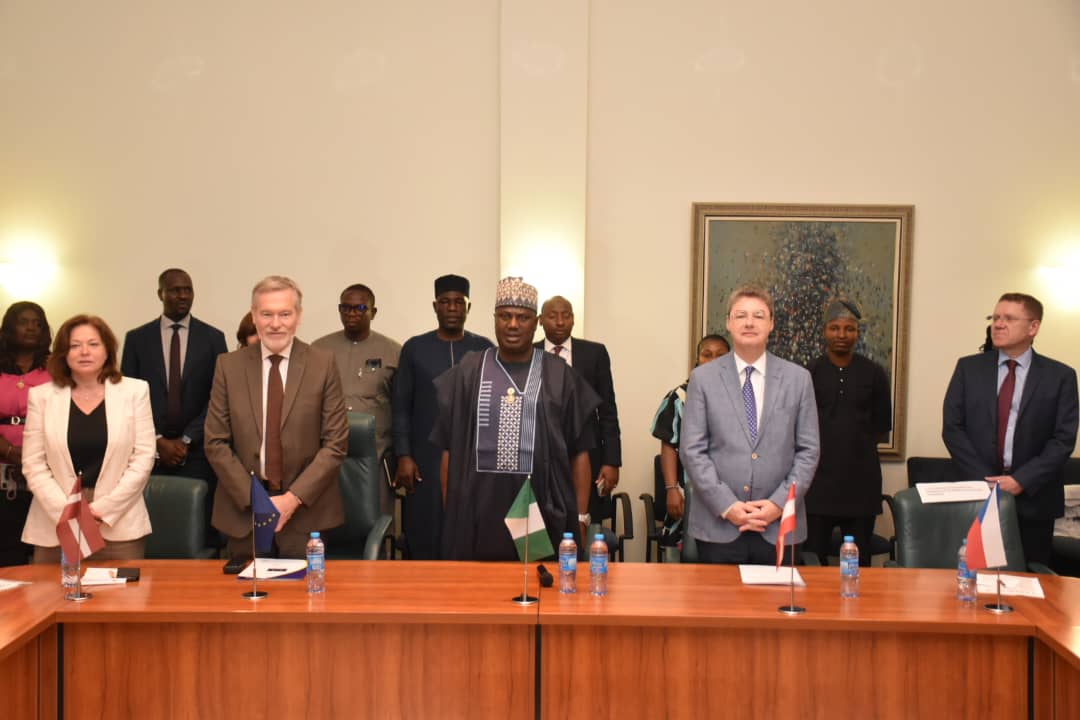
By Gabriel Ewepu
ABUJA – NIGERIA and the European Union, EU, Wednesday, launched EU–Nigeria Twinning Project on boosting food production and food systems with climate-smart technologies.
The Minister of State for Agriculture and Food Security, Senator Aliyu Abdullahi who launched the programme in Abuja, said through the project, that Nigeria would benefit from valuable technical expertise and knowledge exchange with European partners.
Abdullahi also commended the European Union Delegation, the Governments of the Czech Republic, Austria, and Latvia, including participating institutions for their dedication to the important partnership in bringing the project to reality.
He also called on relevant departments, agencies and institutions, development partners, and the private sector to synergy and achieve the purpose of the Project in order to build a resilient agricultural system that guarantees sustainable food security, improves livelihoods, and supports Nigeria’s economic growth.
The Twinning Project is funded by the European Union, EU, with Resident Twinning Advisor, Mustapha Yakubu Madaki, to anchor the Project.
The Project is basically to improve food security and food system using climate smart technologies for enhanced value chains development in Nigeria.
The consortium for the Project include, the State Plant Protection Service of LATVIA (SPPS); The Austrian Agency for Health and Food Safety (AGES); and Czech University of Life Sciences Prague (CZU).
The activities of the Project include an extensive analysis of National Agricultural Resilience Framework document, existing CSA policies and programmes is conducted.
Comprehensive policy review of at least six CSA-related documents- Stakeholder consultations with key actors- Stakeholder workshop.
Policy document revised and updated for adoption to align with CSA principles; Policy implementation strategy will be developed for adoption; Stakeholder Validation Workshop; Policy monitoring and evaluation plan.
The consortium will facilitate knowledge sharing by the EU food chain actors – from institutions to the farmers and other stakeholders: Meetings with competent authorities, academia, NGOs and farmers; Farm and food production site/slaughterhouse visits; Emphasis on CSA practices, food production marketing, and international trade requirements.
Abdullahi said: “This project represents another important milestone in the long-standing cooperation between Nigeria and the European Union. It is particularly noteworthy because it marks the first Twinning Project of its kind in Nigeria, bringing together expertise from the Czech Republic, Austria, and Latvia to collaborate closely with Nigerian counterparts in advancing climate-smart agriculture and strengthening sustainable food systems.
“Agriculture remains the backbone of Nigeria’s economy and a critical pillar for national development. The sector employs a large proportion of our population and plays a central role in ensuring food security, poverty reduction, and economic growth.
“However, like many countries around the world, Nigeria’s agricultural sector faces increasing challenges arising from climate change. Variability in rainfall patterns, droughts, floods, land degradation, and emerging pests and diseases are affecting agricultural productivity and threatening the livelihoods of farmers.
“It is therefore imperative that we strengthen our agricultural systems to become more resilient, productive, and sustainable. This is where Climate-Smart Agriculture becomes extremely important. Climate-Smart Agriculture is not only about responding to climate change; it is about transforming agriculture to ensure that farmers can increase productivity while protecting the environment and adapting to changing climatic conditions.
“Under the leadership of His Excellency, President Bola Ahmed Tinubu, the Federal Government has placed food security at the top of its national priorities under the Renewed Hope Agenda. Agriculture has been identified as a strategic sector for economic diversification, job creation, and national stability. In line with this commitment, the Federal Ministry of Agriculture and Food Security is implementing a range of reforms and programmes designed to boost food production while strengthening resilience to climate change.
“For instance, the Ministry continues to advance the National Agricultural Resilience Framework, which provides strategic guidance for promoting climate-resilient agriculture across the country. We are also strengthening policies that promote sustainable land management, improved soil fertility, climate-resilient crop varieties, and efficient water management systems.
“The EU–Nigeria Twinning Project being launched today aligns perfectly with these national priorities. Through this initiative, Nigeria will benefit from valuable technical expertise and knowledge exchange with European partners.
“The project will support the review of Nigeria’s National Agricultural Resilience Framework and development of technical guidance on climate-smart agriculture techniques, with the aim of strengthening the policy environment and aligning it with international best practices.”
However, he noted increasingly challenges plaguing Nigeria’s agricultural sector including climate change – variability in rainfall patterns, droughts, floods, land degradation, and emerging pests and diseases.
In his remarks, the Head of the European Union Delegation to Nigeria and the Economic Community of West African States (ECOWAS), Ambassador Gautier Mignot, emphasized that agriculture is central to Nigeria’s economy, adding that climate change challenges require strong institutions with well-implementable policy.
Meanwhile, Mignot expressed optimism that the EU–Nigeria Twinning Project would enhance institutional capacity building and ensure that policies translate into tangible results.
Earlier in his address of welcome, the Director, Planning and Policy Coordination, Federal Ministry of Agriculture and Food Security, Ibrahim Tanimu, acknowledged the significance of the Project, noting the caliber of technical expertise from European institutions and Nigerian professionals to work jointly on critical areas of agricultural policy and climate-smart development, and he added that it would translate into resilience agriculture, food security in Nigeria.
Tanimu expressed optimism that the Project will consolidate the efforts by the Nigerian government working hard to address emerging challenges occasioned by climate change impacts on the food production.
Disclaimer
Comments expressed here do not reflect the opinions of Vanguard newspapers or any employee thereof.