
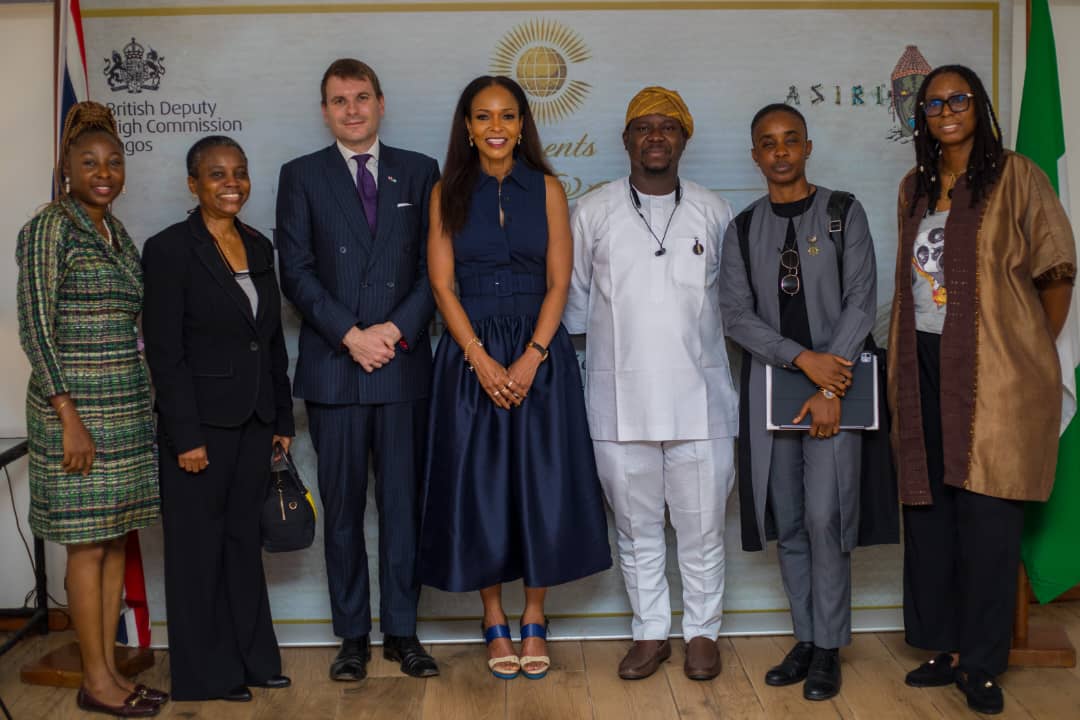
Simon Field (2nd left), Oludamola Adebowale (2nd right) with some Queen’s College Old Girls during the IWD celebration in Lagos.
By Prisca Sam-Duru
With the aim of spotlighting the contributions of Nigerian women to the nation’s socio-political history, while reclaiming their roles within the broader Commonwealth narrative of agency and social change, the British Deputy High Commission Lagos in partnership with ASIRI Magazine launched a significant cultural project titled “HerStory of Nigeria: Women, Power and Protest in Lagos (1910– 1950).”
The project was formally unveiled on March 9, at the British residence, Ikoyi, Lagos, to celebrate International Women’s Day (IWD) and Commonwealth Day 2026.
In his welcome remarks, the Deputy Head of Mission at the British Deputy High Commission in Lagos, Nigeria, Simon Field said that the project represented an amazing opportunity to deepen cooperation on mutual priorities, from security, migration, and shared economic growth, all whilst demonstrating what a modern, ambitious Commonwealth partnership it is.
“As we celebrate International Women’s Day, I must also emphasise that women and girls are and continue to be a true priority for the UK Commonwealth and government partners.”
With the formal unveiling, ASIRI Magazine has kicked off a 15-day active digital campaign across its platforms, sharing archival highlights and educational threads to reach a global audience.
The event featured a panellists session during which history served as a living resource to inspire leadership and civic consciousness among young girls. The panellists session focused on how stories told to women as young girls matter.
Criminal justice psychologist, child rights activist, and Executive Director of Media Concern for Women and Children Initiative (MEDIACON), Dr. Princess Olufemi-Kayode noted that the safe spaces are shrinking for women and girls to be protected from sexual or gender-based concerns.
In her words, “The so-called safe places are not so safe anymore. There’s abuse in churches and mosques. But we have trained personnel to talk about sexual violence at our centre.”
The Project Director, Dr. Oludamola Adebowale in his remarks recalled how the quest for documenting history connected with his familial relationships and then morphed into a national interest. With insight into the challenges of documenting women in history, he told the predominantly young audience how his background in brand research and communications placed him in good stead for championing cultural preservation.
“There’s so much in the current history we need to structure properly. It’s not just about telling the story, but telling the story with proper research and adequate information,” he stressed.
With reference to his research work on film projects such as ‘Funmilayo Ransome-Kuti’ and ‘The Man Died,’ Adebowale demonstrated his commitment to restoring unsung heroes to the centre of Nigeria’s historical framework.
“We started actually 13 years ago, and consistently, we’ve been promoting Nigerian history on our social media platforms. Six years ago, we started looking at the narratives of Nigerian women who have been exploited in the country and how their narratives have affected our social media platform. I would say it is an element of social media structure where I think the voices of women need to be heard not just about the past but also about the present.”
He remarked that HerStory of Nigeria is designed as an educational and historical legacy project designed to build a living digital archival repository dedicated to documenting and celebrating the history of women in Nigeria.
At its heart, the project seeks to bring women’s stories to the forefront, preserving their contributions, struggles, leadership, and cultural impact from the 18th century to the present day. Through research, documentation, and storytelling, the initiative aims to create an accessible historical platform housing photographs, documents, oral histories, and archival materials that reflect the depth of women’s roles in shaping Nigeria’s past and present.
The project was supported by several notable partners, including Zapphaire Events, IHS Nigeria, BellaNaija, and Lanre Shasore.
Disclaimer
Comments expressed here do not reflect the opinions of Vanguard newspapers or any employee thereof.