
… As experts warn high maternal deaths, out-of-pocket spending threaten health system
By Chioma Obinna
The Federal Government has called for stronger collaboration with the private sector to transform Nigeria’s healthcare system and accelerate progress toward Universal Health Coverage (UHC).
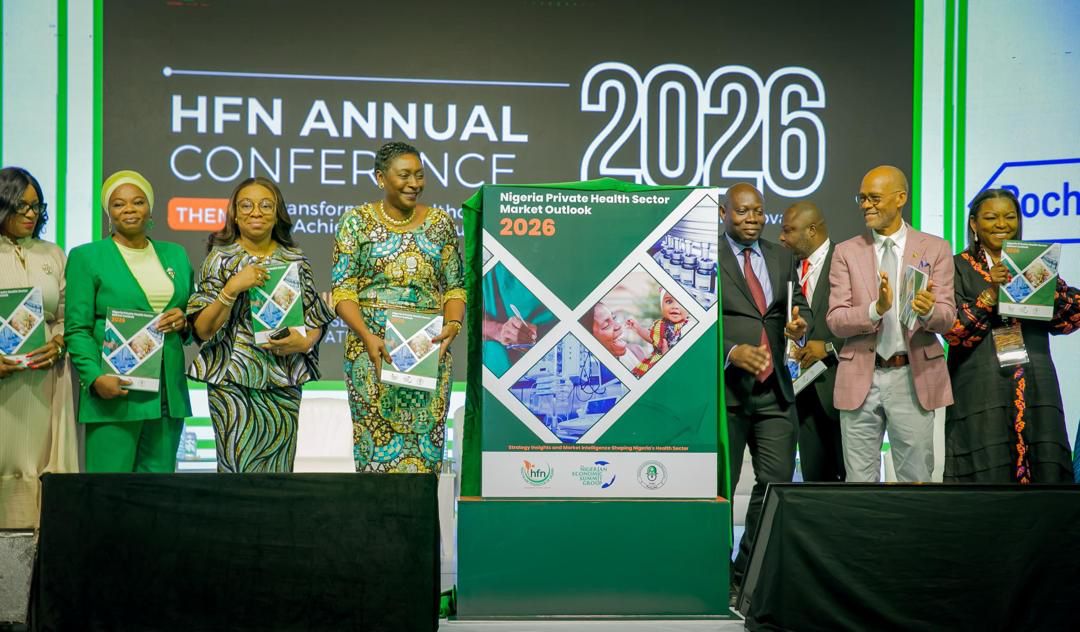
The Minister of State for Health and Social Welfare, Dr. Iziaq Adekunle Salako, made the call at the 2026 Annual Conference of the Healthcare Federation of Nigeria (HFN), themed “Transforming Healthcare: Leveraging Private Sector Innovation to Achieve Quality Outcomes and Universal Health Coverage.” in Lagos, Salako, who was represented by the Chief Medical Director of Federal Medical Centre Ebute-Metta, Dr.Saheed Adebowale Ogunme said the country must harness private sector innovation and investment to address persistent gaps in healthcare quality, emergency services, and financing.
According to him, Nigeria’s rapidly growing population, currently estimated at over 220 million, continues to place enormous pressure on the nation’s healthcare system.
“The theme of this conference speaks directly to the defining challenge and opportunity of our time. Transformation is not a theoretical ambition but a practical necessity, and innovation and partnership are indispensable to achieving universal health coverage for all Nigerians,” he said.
Salako noted that Nigeria still carries a disproportionate burden of global maternal mortality, accounting for nearly one in five maternal deaths worldwide.
He also expressed concern over the country’s high rate of out-of-pocket healthcare spending, which accounts for more than 70 per cent of total health expenditure.
“This means millions of Nigerians face catastrophic health expenses and are at risk of being pushed into poverty because of illness. These realities underscore why health reform is not optional; it is urgent,” he said.
The minister said the Federal Government’s health agenda between 2026 and 2030 would focus on improving healthcare quality, strengthening emergency medical systems, expanding health insurance coverage and deepening public-private collaboration.
He stressed that improving quality of care must be central to expanding access to health services.
“Expanding access without strengthening quality will not yield the outcomes we desire. Poor quality care contributes significantly to preventable morbidity and mortality,” Salako said.
He added that government was working to strengthen emergency response systems through the National Emergency Medical and Ambulance Service.
“In many instances, survival during medical emergencies depends not only on clinical expertise but also on the efficiency of systems. No Nigerian should lose their life because emergency care was inaccessible, delayed or unaffordable,” he stated.
Declaring the conference open, Salako reaffirmed the Federal Government’s commitment to creating an enabling environment for responsible investment and innovation in the health sector.
“Together, we can build a Nigeria where quality healthcare is not the privilege of a few but the guaranteed right of all,” he said.
In her remarks, President of the Healthcare Federation of Nigeria, HFN, Mrs. Njide Ndili, said the private sector was committed to supporting government efforts to strengthen the health system through research-driven investments and policy engagement.
Ndili explained that the federation partnered with the Nigerian Economic Summit Group to conduct an in-depth survey to identify areas where private sector investments could support national healthcare priorities.
“For the private sector, we felt that we needed evidence-based data and information that would guide not just investment but policy. Whatever we do must be driven by research and reliable information,” she said.
She described the report as the first of its kind aimed at integrating private sector contributions into government healthcare initiatives.
Also speaking, a global health expert and Associate Fellow at Chatham House, Dr. Ebere Okereke, said achieving universal health coverage in Nigeria would require predictable policies that encourage private sector participation.
“The private sector must become project-ready and policymakers must create credible, predictable rules that reward the right behaviours,” Okereke said.
“If we do that together, universal health coverage in Nigeria will stop being a slogan and start becoming a lived reality for millions of people.”
Meanwhile, the Lagos State Commissioner for Health, Prof. Akin Abayomi, said the state government was implementing major reforms to tackle workforce shortages, infrastructure deficits and healthcare financing challenges.
According to him, Lagos currently has about 7,000 doctors for its growing population, far below the estimated 30,000 required to adequately serve residents.
“We have a significant shortage of healthcare professionals. That is why Lagos is embarking on healthcare financing reforms that address human resources, infrastructure, insurance, policy and data,” he said.
Abayomi disclosed that the state had passed a bill establishing a stand-alone University of Medicine and Health Sciences to increase the production of medical professionals.
“We plan to ramp up admissions from about 200 to about 2,000 annually within the next three to four years to meet the growing demand for healthcare professionals,” he said.
He also highlighted ongoing investments in health infrastructure and digital health systems across the state, noting that such reforms would help position Lagos as a hub for medical services in the region.
The HFN conference brought together policymakers, healthcare providers, investors and development partners to explore strategies for improving healthcare delivery and strengthening Nigeria’s health system.
Disclaimer
Comments expressed here do not reflect the opinions of Vanguard newspapers or any employee thereof.