
By Prince Osuagwu
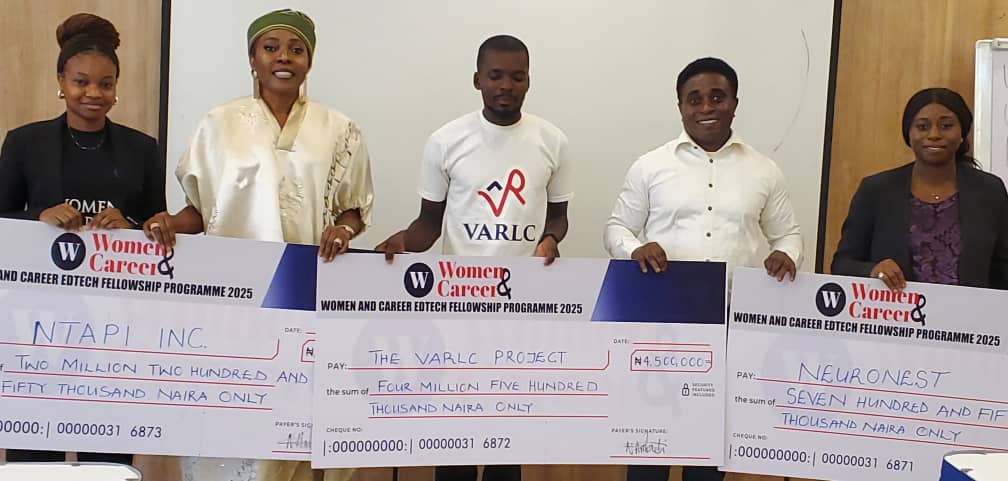
Three education technology, Edtech startups have received a huge boost to their careers when a nongovernmental organisation, Women and Career, recently doled out seed funding necessary to scale their ideas into proper entrepreneurship.
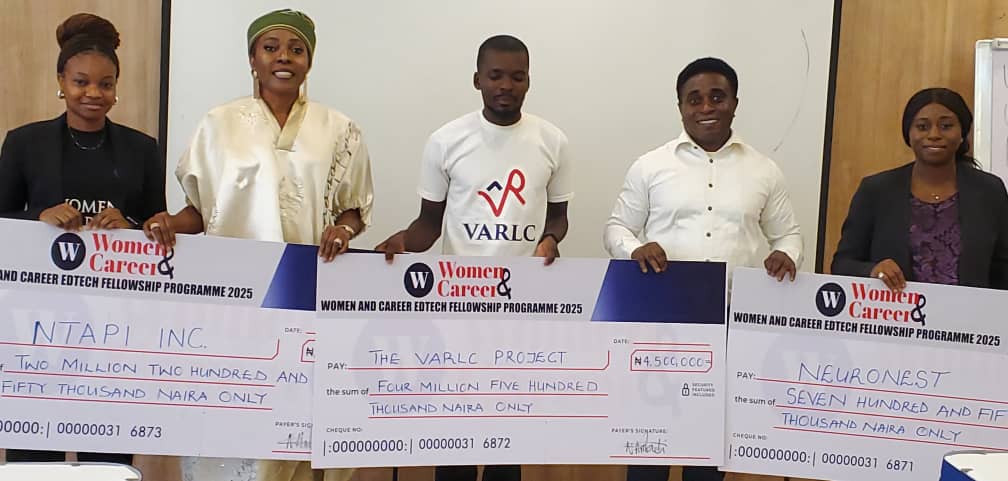
The lucky startups, The Varlc project, Ntapi Inc, and Neuronest were among the finalists after a rigorous 12-weeks training tagged Women and Career EdTech Fellowship Programme, 2025.
The initiative by the NGO which kicked off in Lagos, a few months back is a transformative initiative aimed at equipping Ed-tech startups with the skills, tools, and networks to drive innovation in the education technology space.
The Fellowship Programme accelerates the participation of Startups in EdTech by providing a structured 12-week curriculum that covers entrepreneurship, product development, business growth, mentorship, and capacity building, as well as expert-led sessions, and hands-on projects.
The winners who carted away N7million seed funding were told to use the funding to activate their ideas into business, having been found to hold critical solutions to some of the sector’s intractable problems.
For instance, the first prize winner, The VARLC Project, which carted away N4.5 million, is an edtech startup improving university students’ learning experiences through peer tutoring and connecting them to opportunities.
It is a flexible learning platform, giving every student equitable access to quality learning at their pace and convenience, from the teaching and experiences of their fellow students who have done well in the courses earlier.
The users learn by subscribing on the Varlc App, while the smartest students on campus also earn money by teaching and uploading their lessons on the App.
Another winner, Ntapi is an edtech social network making accessible education fun and affordable for generational learners, in different Nigerian languages.
The platform upskills through preferential learning from following favorite industry experts, and educational influencers on the go. Ntapi describes itself as a marketplace democratizing teaching for educational content creators in SMEs, corporations and foundations by making them first-party course creators.
For it’s sound idea, Ntapi carted away N2,250,000 to help bring the idea to life.
Also, the other winner, Neuronest, is an edtech platform which transforms learning for every mind, particularly children with low pace of assimilation.
It’s an AI-powered adaptive learning platform designed to personalize K–12 education for neurodiverse learners, especially children with ADHD and dyslexia.
It has a simple target of ensuring that every child learns in the way his or her brain learns best.
Neuronest also got N750, 000 seed funding to scale the idea.
Admonishing the winners and other finalist in a compact event in Lagos weekend, guest speaker and Chief Executive Officer INGRYD Academy, Khadijat Abdulkadir admonished the startups to enter into the entrepreneurial world with as much boldness as they would with caution because nobody succeeds without taking a risk.
She said: “In this field, you have to take risks. Get enough data on whatever field you want to play in. Not the data you will sell for money, but one that can help you to understand the field.
“So if you haven’t started the art of actually looking at your data or collecting clean and clear data, do that, because that’s your first point of getting to understand if your business is of value to the people you want to sell it to.
“And, then also, you’d have to be mobile with your ideas. If you build something and discover you’re in an ecosystem where that’s not needed, close it down and move to what is relevant. Don’t be afraid to build for a different ecosystem.
It’s not a crime to try stuff and it doesn’t work. You have to keep trying. It’s just that you must try them all very fast. Don’t try things for too long, if they’re not working”.
She also tasked them to be global in mind when designing their concepts even though they were starting locally, giving example that Facebook which has majority of its use cases in Nigeria and Africa was not designed in the continent.
“If you need to build identification into your products, let it be simple that any social identity can enter into it. Don’t be like, it’s only BVN. In doing that, you’ve decided that if Nigeria doesn’t want your product, nobody else can have your product. That is a failure. So be very mindful when you’re in tech space because it means the whole world should have access to you. Tech is borderless. It means that your success is borderless. So as you go on to build your product and to use technology to scale your product, build for Nigeria, Ghana, Senegal and the outside world. Remember that Facebook was not built for Nigeria, yet, Nigeria is the home of Facebook. “So where could be your home?
However, don’t also start projecting which country will be your home. Just build a solid product that anywhere that it finds itself, it can become a use case. Even if it’s just one functionality that becomes a very significant use case for that country, you are succeeding” she added.
Corroborating her, another top expert, angel investor and Founder&Convener of The Angel-A Collective, Mr Ifeanyi Akosionu also charged the young tech startups to be globally minded and never be in a hurry to think that their ideas have failed, even when initially not getting desirable tractions.
He advised them to look for ideas that are not totally alien but relatively new to what is obtainable in any sector they want to play in, give it a thorough research, build it and stick with it, and that it must surely pick up and become successful.
Giving the participants further encouragement, the Programme Director of Women and Career, Mr Emeka Amadi, disclosed that the NGO was working behind the scene to get both financial and business collaboration support from notable companies, including Mastercard and CoCreation hub, CcHub.
For him: “This fellowship is not just a programme; it’s a call to action to empower Edtechs with the tools to solve real problems in education through innovation.
“We believe that EdTechs must be active contributors to the future of education and technology”.
Disclaimer
Comments expressed here do not reflect the opinions of Vanguard newspapers or any employee thereof.