
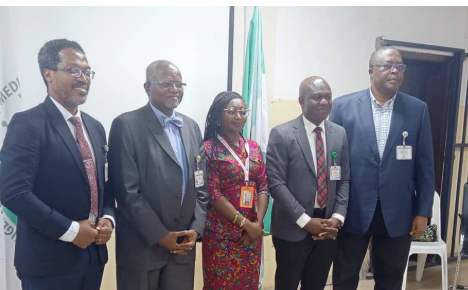
L-R: HOD, Clinical Science Dept. Dr. Paschal Ezeobi; DG, Prof. Oladapo Obafunwa; Researcher Dr. Agatha Wapmuk; Deputy Director of Research, Dr. David Oladele and Director of Research, Prof. Oliver Ezechi.
… Showcases landmark clinical trials
By Chioma Obinna
Scientists at the Nigerian Institute of Medical Research, NIMR, have called for sustained investment in infrastructure, funding, and public awareness to strengthen Nigeria’s research ecosystem.
They stressed the critical role of clinical research in improving health outcomes and driving local scientific innovation.
They spoke at the October Media Chat organised by NIMR, which focused on “Randomised Clinical Trials: A Cornerstone of Translational Research.”
Addressing journalists, the team lead who is also the Deputy Director of Research and Consultant Public Health Physician at NIMR’s Clinical Sciences Department, Dr David Oladele described randomised clinical trials as the bridge between scientific discovery and patient care.
“Clinical research is the cornerstone of translational science. It allows us to test interventions under real-world conditions and generate evidence that informs medical practice and public health policy.”
Over the past two decades, NIMR has conducted and coordinated numerous clinical trials in partnership with local and international institutions. These include studies on antiretroviral therapy for HIV, the SAVVY microbicide trial for HIV prevention, malaria drug efficacy, and COVID-19 treatment and vaccine research.
The institute also validated diagnostic kits for malaria and COVID-19 and implemented public health interventions such as the 4 Youth by Youth (4YBY) HIV self-testing initiative for young Nigerians.
“These studies demonstrate that rigorous, ethically sound research can be successfully conducted in Nigeria. They have informed national policy and strengthened confidence in our research ecosystem,” Oladele
He explained that NIMR currently hosts several ongoing phase I to IV clinical trials, including randomised studies on chronic kidney disease and the Task-Strengthening Strategy for Hypertension, TASSH, cluster trial under its non-communicable disease portfolio.
According to Oladele, the institute’s infrastructure now rivals international standards, with a ten-bedded clinical trial facility, an ISO 15189-certified Central Research Laboratory, a biorepository and digital data centre, and an NHREC-accredited Institutional Review Board.
“These facilities allow NIMR to act as a lead site for multicountry trials and serve as a training hub for emerging investigators across West Africa,” he said.
Oladele identified major challenges limiting large-scale clinical trials in Nigeria, including low research literacy, limited funding for investigator-led studies, bureaucratic delays in ethical approvals, and a shortage of skilled personnel in trial monitoring and pharmacovigilance.
“Most multicentre studies are donor-funded. We need stronger government commitment, private-sector participation, and sustainable national funding to keep our research infrastructure alive.”
Oladele said NIMR is aligning its research agenda with the Federal Government’s Presidential Initiative for Unlocking the Healthcare Value Chain, PVAC, which seeks to boost local manufacturing of drugs, vaccines, and diagnostics.
Through this alignment, NIMR plans to establish a National Centre for Clinical Trials to harmonise multicentre research, strengthen partnerships with NAFDAC, NHREC, PVAC, and academic institutions, and develop regional clusters linking universities, teaching hospitals, and private research organisations.
“Our goal is to ensure that clinical trials directly support Nigeria’s health innovation ecosystem,” Oladele said. “Evidence generated locally should guide national health decisions and drive technological self-reliance.”
He reaffirmed that NIMR’s ongoing and future trials will continue to serve as a foundation for evidence-based public health interventions, advancing Nigeria’s vision of health security and scientific independence.
“By expanding our trial portfolio and investing in capacity-building, NIMR is not only shaping public health policy but also strengthening Africa’s contribution to global science,” he said.
Obafunwa urged consistent government support for research, warning that reliance on external data could undermine local health policies.
“The future of medicine depends on research,” he said. “If we fail to invest, we will keep depending on external data that may not reflect our population realities.”
Also speaking, the Director General of NIMR, Prof John Oladipo Obafunwa emphasised the importance of integrity, transparency, and ethical compliance in clinical research.
“Sound science is built on credibility. Every clinical study must protect participants, adhere to international best practices, and contribute to societal good. Without these values, research loses its meaning.”The pathologist and former Vice-Chancellor of Lagos State University praised NIMR’s adherence to global ethical standards and urged greater collaboration among research institutions, teaching hospitals, and universities to strengthen Nigeria’s evidence base for health policy.
“What NIMR is doing shows that Nigeria can generate its own data and evidence,” he said. “We must continue to build capacity, invest in infrastructure, and create an environment where local researchers can thrive.”
Disclaimer
Comments expressed here do not reflect the opinions of Vanguard newspapers or any employee thereof.