
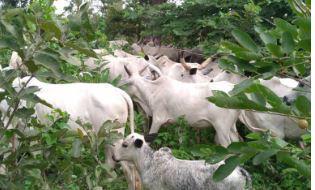
File image.
By Aliyu Ndagi
I spent the first part of my working life in Niger, Kano, Kaduna, Abuja and Kebbi states before moving to Lagos and came to realize that more than 60% of the food consumed in Nigeria is produced in the North. And by North I am referring to all of the open country northwards of Rivers Niger and Benue, including the entire Middle Belt region. All over this large expanse of arable lands most categories of grains and vegetables are cultivated in unbelievably large quantities.
One could drive for hours without spotting a parcel of uncultivated land as endless swathes of maize, guinea corn, millet, rice, beans, groundnuts, vegetables, potatoes, shea nuts, onions, soya beans etc, greets the eyes. And because the expansive farms are cultivated in straight line ridges the sight was always so wonderful to watch especially if you were not the one driving. Food from this massive area has been feeding hundreds of millions of Nigerians for more than a century with the buying and transportation of food items from the North to the Southern region providing vast opportunities for commerce and employment of labour.
Regrettably, all that is virtually gone now as farmers in almost the whole Northern and Middle Belt regions can no longer freely go to their farms to cultivate crops. When cattle rearers do not lead their cows to eat up and destroy the crops, insurgents and kidnappers would seize the farmers and demand ransom payments before they are released. Ransom payments to kidnappers last year was over one billion Naira and has already exceeded two billion this year. From Kaura Namoda alone, 218 victims were released back to their families only last week.
April 2025 marked 11 years since 276 girls were abducted from Chibok Secondary School in Borno state. More than 80 of them have still not been released. In fact, Amnesty International insists that over 23,000 Nigerians seized by Boko Haram and other insurgents in the wild over a period of about 13 years still remain unaccounted for. Kidnapping by violent non-state actors has become big business here. As a result, food shortages arising from depleted agricultural activity have led to serious inflation and a drop in the living standard of the people, especially low income earners.
From former presidents Goodluck Jonathan, through Muhammadu Buhari to Bola Tinubu, the story has remained the same. Promises, promises, promises, but no end in sight. The more government officials promise to deal with insurgency, the more deadly the strikes and kidnappings became. In states like Plateau, Benue and Niger where agriculture is the main occupation, insurgents have even carved out expansive territories for themselves, levying the natives and driving others away from their ancestral lands. Sometimes entire communities are wiped out and the villages burnt down.
The consequences of this terrorism have been grave as people lose their homes and livelihood and are internally displaced from their communities and farms. Many have migrated to other states to work as daily paid labourers, while the lucky ones have found their way overseas in search of a means of livelihood. They carry the deep pain of losing their homes, communities and farms to total strangers and having to cope with the hopelessness of being vagrants. There has been a steady influx of young men and women from these states into Cross River, Akwa Ibom, Rivers and Ebonyi states in the last few years.
Some of the most notable farmers who formed vigilante groups to combat the insurgents in Niger, Plateau and Benue who have had to flee from being captured include Tion Malherbe, Dapchi Lohor, Mohammed Ndagi, Williams Odunayo Usigbe, Adamu Tsoede and Barry Abang. While some of them dissolved into anonymity in cities like Lagos and Abuja in utter fear because the long arm of the murderers has been known to reach their victims anywhere in Nigeria. Others have fled to Ghana, South Africa and Europe in search of a new livelihood, but it is unmistakable that they are bitter about losing their stability in their home country and would love to return back once the insecurity is finally tackled.
Also those who try to resist the insurgents through educational services, public enlightenment and community mobilization. Those who form community vigilante groups are targeted. They are carefully identified, kidnapped and neutralized. Their informants and collaborators within the community betray these active parties and have them eliminated. The lucky ones are those who get the hint early and run away to distant places. Because the criminality is Islamically steeped in anti- western ideology, there are always a few people in the community who align with it and work with them as members of sleeper cells.
The United Nations Commission on Human Rights (UNCHR) which has been working in Nigeria since 1978 needs to do more to help these displaced people as a result of the violent insurgency by Boko Haram and Islamic State West Africa (ISWA). Both groups kill, maim and seize land and territories to administer and levy taxes. Although the United Nations Refugees Agency (UNHCR) has been active in the area of providing protection, shelter, non-food items, etc to internally displaced people, the organization needs to also lend a voice to assist those who have been forced to flee the country as a result of the crisis.
There is no doubt that farmers are losing their livelihood in hundreds of billions of Naira as a result of insurgency, and it doesn’t appear that the government is doing enough. Nigerians are clearly frustrated that the government has been unable to deal the insurgents a definitive blow. The people expect its government to do much more to protect them. President Tinubu who rode on the security agenda to get into office must rise up to his campaign promise to secure the lives of the people. Based on Nigeria’s natural and human resources, no Nigerian ought to experience hunger or displacement, not to talk of migrating to any other country in search of livelihood. Let the government act now, story time is surely over.
ALIYU NDAGI writes from PATEGI in Niger State.
Disclaimer
Comments expressed here do not reflect the opinions of Vanguard newspapers or any employee thereof.