
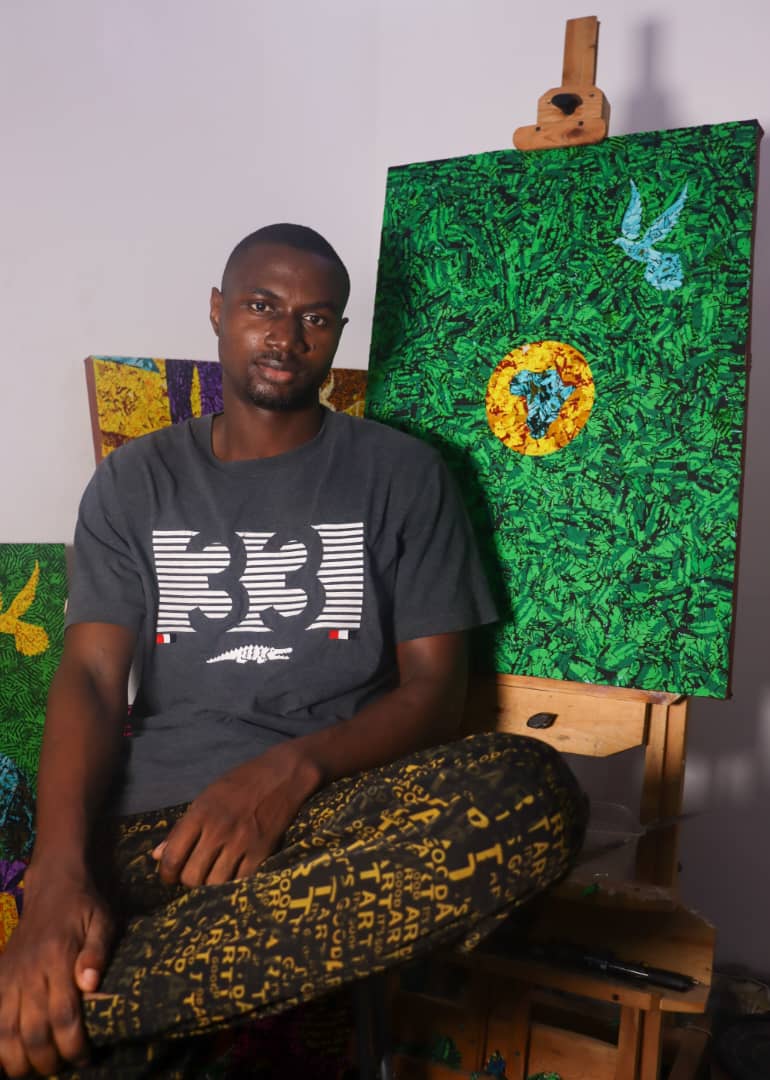
By Onyeka Ezike
Contemporary artist Emmanuel Bankole is set to unveil a thought-provoking body of work in his latest exhibition titled Parable of the Talents: Burden or Becoming. Drawing inspiration from one of scripture’s most contested allegories, the Biblical parables are translated into art as a visual language; often, they are best told as stories that convey morals. The event will be held from September 3rd to 4th, 2025, at the Radisson Hotel, Ikeja, Lagos.
The solo exhibition is a reimagining of the parable—not as moral instruction, but as a mirror reflecting the weight and wonder of being entrusted with gifts. Emmanuel positions the Parable of the Talents as a site of inquiry into the metaphysical burden and blessing of spiritual endowment. The exhibition is curated by Stephanie Ohwo, a seasoned curator.
In an interview, Stephanie explained that the Parable of the Talents engages with a story familiar from childhood, but the exhibition invites a metaphysical reflection on what it means to live with gifts that both empower and burden us.
She said, “For me, this exhibition is not only about the artworks but about staging a space of inquiry where talent is no longer a measure of productivity alone, but a mirror of responsibility, choice, and becoming. It means asking: what do we do with what is placed in our hands, and how does that decision shape the way we take on the world?”
The curator said the audience would experience a renewed awareness of the quiet weight of their own gifts. The exhibition is not a prescription but an invitation to reflect on the talents—spiritual, creative, and temporal—that each of us carries, and how we negotiate them in a world that constantly asks for more.
The takeaway is less about answers and more about recognizing that our gifts are both inheritance and responsibility, and in embracing them, we participate in a larger story of becoming, Ohwo explained.
In the new collection, Emmanuel’s canvases pulse with questions: Are our talents a sacred responsibility or a burden that we bury? His visual language, layered with fabrics, textures, doves, and luminous fields of color, offers no definitive answers. Instead, it reveals the tension between concealment and revelation, duty and transformation, human will and divine guidance.
Central to the exhibition are recurring motifs: the wrapped gift, the sealed money bag, and the persistent dove. Each symbol serves as a reminder of divine origin and the eternal stretch of time. The artist’s treatment transforms surfaces into metaphors of stewardship: what is hidden, multiplied, or squandered.
In an interview, Emmanuel described the show as an invitation to viewers. “The works are not just to be observed but engaged with. Everyone carries a gift, and the question remains: what do we do with it?” With Parable of the Talents: Burden or Becoming, he challenges audiences to confront their own relationship with the entrusted gifts of time, skill, or spiritual endowment.
The exhibition situates itself firmly within the contemporary African art conversation but speaks universally to the human condition. Emmanuel promises to deepen his reputation as one of Nigeria’s most compelling new voices in visual storytelling, marking another bold stride in the country’s evolving art landscape.
One of his works, titled The Charge, is a 22-inch by 30-inch artwork that unfolds from a place of spiritual reflection, where symbolism becomes a language of purpose. The dove emerges as a vessel of peace, divine presence, and sacred guidance. Hovering above a globe, it evokes the tension between the turbulence of the world and the quiet call for reconciliation.
The globe is not just a form; it reminds viewers of the artist’s charge to be a light in this world—to carry healing and offer hope. In every fragment of fabric lies a whisper of purpose: to lead, to serve, to comfort.
As a full-time studio artist, Emmanuel creates emotionally charged artworks that explore themes of self-awareness and spiritual inquiry. His inspiration comes from historical events, biblical narratives, and personal observations, which he uses to express powerful themes. His artistic practice is marked by experimentation with materials and techniques. Emmanuel is known for his innovative use of Ankara fabrics, which he collages onto canvas using mixed media.
Emmanuel believes African art should be a mixture of African textiles and fabrics. He said, “I am a mixed media artist who primarily works with African textiles. My creative process involves carefully cutting and arranging recycled fabric pieces onto canvas—a technique that not only preserves African cultural identity but also promotes sustainability through eco-conscious practices.”
His choice of materials (traditional fabric pieces—Ankara) allows him to weave stories deeply rooted in heritage, yet speaking to universal human experience. Each of his stories is a visual narrative, layered with texture, symbolism, and truth.
“Art enables us to find ourselves and lose ourselves at the same time. At the core of my work is a deep concern for individuals who live below their potential, particularly those unaware of their underperformance. I believe that every purpose has the power to influence countless others, and unfulfilled potential places those lives at risk. I strive to awaken clarity, discipline, and purposeful living,” he said.
Emmanuel is inspired by Proverbs 23:23: “Invest in truth and wisdom, discipline and good sense, and don’t part with them.” His works provoke thought, stir conviction, and inspire action.
Disclaimer
Comments expressed here do not reflect the opinions of Vanguard newspapers or any employee thereof.