
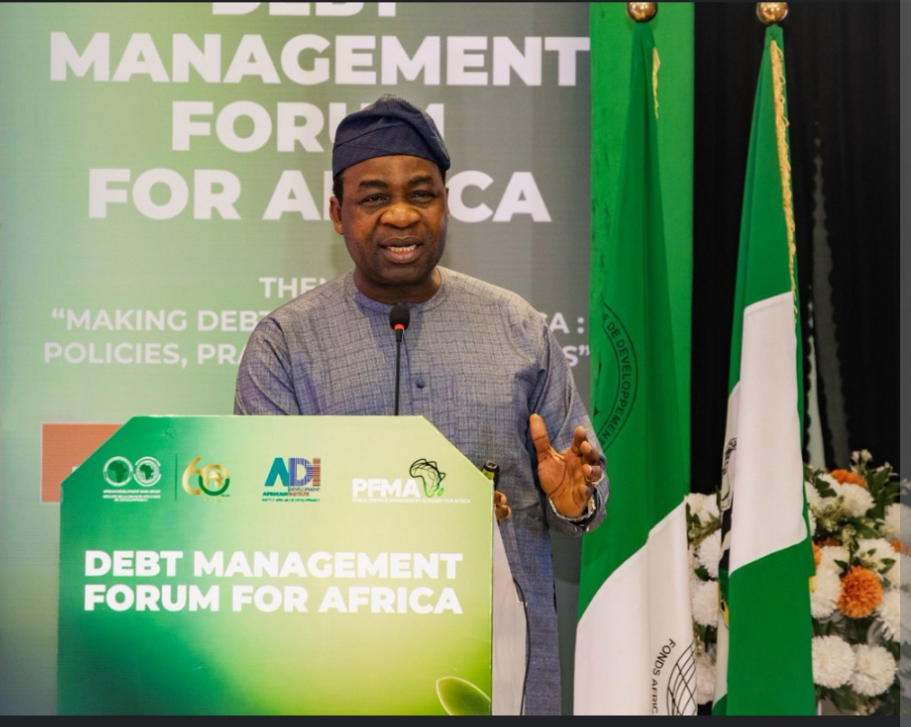
The issue of debt servicing among African countries has continued to generate interest in the continent and beyond with many arguing that devotion of most governments’ resources to debt service are creating a fiscal constraint on there abilities to invest in education, health, and other human development projects.
So, the African Development Bank Group, through its focal point for capacity development, African Development Institute, launched the Debt Management Forum for Africa (DeMFA) in Abuja recently.
The forum aims to amplify African voices and perspectives on debt matters and provide a channel for knowledge-sharing, advocacy, and capacity development on debt management.
In this chat , the Director of African Development Institute at the African Development Bank, Dr. Eric Ogunleye, shares his takeaways from the forum, needs to have continent based rating agency, on debt architecture not favourable to African countries, mismatch in borrowing & repayment and how to make good use of the African legal support facility when negotiating loans among other issues.
Here is an excerpt from Jimoh Babatunde
On takeaways from the two day forum
Let’s start from there. One major takeaway is that there is a consensus among African countries that we’ll set up a debt management forum for Africans.
That is one major takeaway, that this forum is imperative, and is important, and is urgent, given the challenges that the countries are facing when it comes to debt management. How to manage debt transparently, how to ensure that there is accountability, how to ensure transformative management of debt, and even debt responsibility. And more importantly, to ensure debt sustainability.
So I think that is one of the takeaways from this very important meeting.
The second important takeaway that I have also seen is that there is also a consensus among African countries about how and what the DEMFA should do.
First, all the countries that attended say that the forum should focus on policy dialogue.
We need to ensure that we bring countries together like this from time to time for them to dialogue among themselves, to be able to share experiences and have a better understanding of the challenges they are facing.
But more importantly, to find a common solution to dealing with them. That’s another very important takeaway, I see from this meeting.
Another takeaway is the agreement that we need to do this more often. And we need to do it more often because the challenges are enormous, and they are not just enormous, but there are additional challenges, additional extenuating factors that make it even more imperative that we hold this kind of a meeting more often.
The third takeaway is that a group of countries agree that we need to look into solutions.
Most times when we have debt-related challenges, African countries run to the same creditors, who are the cause of that debt non-sustainability.
But the idea now is that we need to look among ourselves. Countries are at different stages of maturity when it comes to managing debt. And so because of that, there are lessons that we can learn from each other.
So looking inward for solutions which include this DEMFA, because it is a home-grown solution, it is an African-focused, an African-implemented initiative that will help countries to deal with their debt challenges.
Then among that are several other issues, for example, like consensus on the importance of helping each other to deal with the common challenges we face with rating agencies.
Rating agencies, as we do know, many of them don’t have the correct risk perception of African countries. Many of them don’t even understand the continent. A number of them do not know the context, the specific issues that each of these countries are facing. So how then would they be able to rate us well, fairly?
And we have also seen cases where the same rating agencies undertake a study and establish that the region is less risky compared to other regions of the world. Yet they still rate us very unfairly. So the question then is where are all of this coming from?
So the countries are agreeing that we have to have an African voice in dealing with such challenges.
There’s also the issue about the global debt architecture, where we have seen that the debt architecture is not favourable to African countries in terms of the loan, the conditionalities that are given, and even the turnover, and so on and so forth.
Even the transparency in some cases of those terms. So it’s important therefore that the countries also agree to say that we need a situation where we can improve the situation in that circumstance.
There’s also the point about tapping into the toolkits and the strategies, the action plans that have been developed by African institutions to deal with the challenge.
For example, there was a discussion about how do we make good use of the African legal support facility. What that facility was created to do by the African Development Bank is to help the countries in negotiating their loans, in ensuring that they have fair terms and conditions of the loans that they are contracting with other countries. And should there be any issue of renegotiation, that is the facility they could fall on that can provide them with legal framework, legal support that will help them to do the negotiation properly ,so that it’s fully done.
So these are some of the key issues and several others. But generally there are issues about capacity development that was agreed has to be provided.
There’s an issue about technical assistance that needs to be provided. There’s an issue about peer-to-peer learning that we need to do. And then the issue about training. So these are some of the key areas that the countries have consensus with regard to how to manage their debts.
On the need for African-owned credit rating agencies.
Excellent. So maybe I missed that. So that’s another area where there’s a consensus.
Again, like I highlighted initially, the point has been that African countries are not fairly rated by these agencies because they don’t know us. They don’t know the context. They don’t know the history. They don’t know the challenges the countries are facing.
In many cases you heard quite a number of feedback where even when they provide a rating, we’re not given sufficient time to respond to what we get.
So they send you a report within 24 hours, they say respond. Or less than 24 hours, some eight hours, some less than that.
I mean, who does that? I mean, even if people are sitting doing nothing. Because you could have long queries for them to respond to them one by one.
Even more worrisome is the fact that from what we heard from the countries, that even when you do take your time and stress yourself to respond to them within that short period of time, it doesn’t change anything.
They don’t even respond to that. They still maintain their position. So based on all these challenges and the fact that there’s no understanding between these rating agencies and the countries, the African Union, with support of the African Development Bank, has decided to come up with an African rating agency so that we have an agency that understands us, that knows the context.
Again, I will allude to the African Development Bank. When we go to African countries, you know what they tell us? They say, our bank. They do not call other institutions, ours, but because this one is sitting here with them, is domiciled here, we live with them, we face the same challenges, so we understand them better and they understand us and that’s why they call us their bank.
So the idea, therefore, will be when we have this African rating agency, they can also call it our rating agency because it will take into consideration their context, their needs, their peculiarities, and so on and so forth.
So that arrangement is already at a very advanced stage where the AU, supported by the African Development Bank, is creating an African rating agency that can provide ratings, sovereign ratings for African countries.
So that is where we are and we believe that when that is done, we can see the fairness in the ratings that the countries will get because they will be objective, that’s our expectation, based on their knowledge and their understanding of the continent, of the countries.
Q: On how the Afrcan countries can be assisted to march their debts and revenues in debt services
Okay, very good question. Maybe put differently, the challenge many countries are facing, number one, is the fact that there is a mismatch between what we are borrowing for and the repayment, even in terms of timeline.
So we’re borrowing for a short term and to implement a project that is long term in nature. So there is already a mismatch.
There is no way your revenues will be sufficient to be able to pay for the loan you have contracted. So what we are putting in place, number one, is to ensure that when countries are borrowing, they need to ensure that their loans are tied to projects. So it’s not just all about borrowing.
I was actually having a chat with someone, I won’t mention the country, who told me that when they came into government that the first challenge they faced was that of loans that were floating.
Call it floating loans, because they were not tied to anything. They cannot even say, this is what this project is meant to buy for us. And remember, what we’re talking about here is responsible debt management and productive debt management.
Productive means you should be able to point out to a certain project and say, this building was financed and achieved by the loan that we collected from this house. But they don’t have that.
So the question therefore is, how then do you get the resources required to pay back? In what most countries do that are managing their debt responsibly and productively is to ensure that before you go borrow, you would have developed a project. Not even just programs, projects. That you know that once you are getting the money, you are using it to finance it.
It’s just like an individual. If you go to borrow and without knowing what you’re borrowing for, compare that to when you’re buying a house. And so you go to borrow to finance that house. So you can see what that loan has delivered.
But if you borrow without anything in mind, as the money comes, maybe you use it to do burial, to do wedding and so on. How do you pay it back? But the house will always be there. If you sell it tomorrow, you can get the value back. So that is the difference and that is what we’re seeing that we’re trying to do.
So countries therefore must make sure that their borrowing is tied to projects. Secondly, countries need to do their cash flows. Cash flows implies that you need to have an idea of what is your streams of revenue compared to the loan repayments. So you have a period of repayment of your loans either on a monthly basis, whether on annual basis, whether every five years. You need to compare it with your strips of revenues that are coming in to know if they matched.
And again, going to an individual, you are earning 10,000, let me use any currency, per month. And that is your streams of revenues. And you’ve gone to contract a loan that you’ll be paying 15,000 as interest every month. You’re in trouble already. It’s clear. You don’t need any soothsayer or any prophet to tell you.
So it’s important, therefore, that countries must have that understanding that you must do your simulations between your loan repayment costs or streams of loan repayment vis-Ã -vis your streams of revenue.
When you do that, then you can be able to match the two and know whether what you are borrowing you will be able to repay. If you don’t or you cannot, if your streams of debt servicing costs is higher than your streams of revenue, definitely you fall into distress. Debt distress, which is a situation many countries have found themselves in today.
But then, what is even more important is the fact that countries should reduce their debt burden. And the way to reduce their debt burden is to ensure that they are able to generate revenues by themselves.
Again, using an individual as an analogy, if you are earning 10,000 and your liability every month is, say, 20,000, it is really already obvious. So what that means is that for you to be able to reduce your debt burden, you have to look for additional sources of income to build up to that 20,000 or even to 30,000 so you can have a little savings.
So the same thing to happen to countries. If countries who look inward within their economy, and most countries have those potentials in terms of revenues that they can generate, many countries are only generating 15 or 20% of their tax capacity, meaning that you have about 75% of your collectible taxes that go uncollected. In some economies we have seen where corporates are only paying about 30% of corporates taxes.
So it’s important therefore that for you to ensure that you reduce your debt burden, you need to increase your revenues. And the way to increase your revenues is not necessarily to increase tax rates. No. Look at some unproductive or uncollected taxes here and there that you have not maximized their income.
So think about how do I ensure that these taxes are collected. How do you go after those businesses that are not paying taxes and are enjoying the benefits, they are making the profits, they are making the money. How do you digitalize your collection system to ensure there are no new cases? That tax or revenue officials don’t collect this money and put it in their pockets and walk away.
It’s only in digitalized systems that that can happen. So these are some of the measures that countries really need to take to ensure that they can increase their revenue generation, their domestic resources which will lessen their burden. Because even though we’re talking about debt management forum, our principle and default is to ensure that we even reduce countries from contracting debt in the first place.
So if countries can be assisted and supported, if they can look inwards into their policy, you have a lot of informal sector businesses that are operating in those spheres who are just going, making money and not paying taxes. Or you have some unproductive subsidies that you are giving to those who do not deserve it. Tax holidays to companies that are already mature and are coming from abroad. They’re coming for business, they’re not coming for free. So if you are giving subsidies to those kinds of businesses, you’re already reducing the potential of your tax collection. So it’s important therefore that you look at that. If you must give subsidies or targeted support, look at home-based, home-grown businesses with potentials, they could be fintech, they could be start-ups, youth-based businesses, gender-based businesses, some women, people who are doing some business that you can support to ensure that they are able to get into business.
On the calibre of people at the forum
We’re talking to the right people. That’s the first thing to establish. And there’s a reason I said we’re talking to the right people. We don’t have just only debt managers. We have a different forum for debt managers, which we call African Debt Managers Initiative Forum. We launched that in Addis sometime in July, comprising of just debt managers, which is like, you have the ministers, then you have the debt managers in the middle, before you even talk about the general staff, technical staff. So, we already have that forum for them, which is already ongoing.
But this other forum, as I mentioned, is called Debt Management Forum. It’s a convening of the ministers of finance. There are a few ministers who were here by themselves, and any other debt managers you see were nominated by these ministers to represent them.
I’ll give you an example, the Director General, Debt Management Office, .s. Patience Oniha, yesterday, represented the Nigeria’s Minister of finance . The speech she read was that of the minister. So, anything you hear, anybody say here, yes, there may be debt managers, but they’re wearing the hat of the ministers.
So, the ministers are here. So, we’re here. That is what it means. I just think that needs to be clarified.
Now, as you do know, the political will, that is the level at which it happens, because it’s the ministers themselves who will take this to the presidents, who appointed them. So, we’re talking definitely to the right people who are represented here in the room, and the decisions that were taken were binding on all of them, because they were being represented. I think that’s an important point to make.
Having said that, I would say the political will is already there, just by means of that. And like we mentioned to you in some of the presentations, we’re doing this in partnership with several other institutions. You’ll notice that in the conversation, in the presentations, you have several other global institutions. Yes, World Bank was here, IMF was there, UNITED NATIONS, OECD, and so on and so forth.
So, we’re all represented, and so the decision we’re taking there is binding. And again, the AU itself is an organ that has that convenient capacity to convene heads of state or countries to take certain decisions. They’re part of the conversation. So, DEMFA is definitely well represented.
On what DEMFA will be doing to make debt management in Africa transparent and sustainable
Excellent. It’s by conveying those people themselves who will make it happen to sit in a room and decide on what to do.
You’ll notice that we had planned to have a communique. We had started writing it, but because of the richness, the wealth of discussion that we heard here, we feel we’ll not do justice to it if we just rush it. Because once we rush it, refining and revising becomes challenging.
Already we have that communique that all the countries would adopt. And once adopted, it becomes binding on us for the implementation.
So, that’s one way that we really hope to ensure that we promote that synergy in ensuring that the decisions that are taken are fair.
We also mentioned several things that DEMFA could do. You’ll notice we already identified two key areas that we need to follow up immediately, which is based on the needs of the countries.
Number one, the countries are saying that what they’re hearing with respect to loan negotiations is music to their ears. So, they really want to know what are those specifics. Let’s dig deeper down. Yes, to know how to negotiate their loans. Again, it doesn’t mean that they have fallen into debt crisis, but some of them, and you heard examples of some countries. Zambia, I said, yes. Ghana also did negotiation. And like we said, we have an increasing number of countries that are in that situation. So, countries are, you can say, they are preparing themselves ahead of time. They say, should we get there, this is what we want. These are the skills we need to know and have now, you know, before that time. So, that’s one very important thing in terms of implementation of what DEMFA will do. And the second thing is the issue of credit rating agencies and the way it’s affecting them is something they want to know better about and what they can do about it. So, there is a consensus to say, let’s do a deeper dive and have a discussion where we can, you know, have this better understanding of rating agencies, the mechanisms they’re using and what countries can do given the challenges they’re having and the way the rating agencies operate is impacting on that.
Like I said, we also have other, which include training, arranging and organizing different kind of trainings, ensuring also there’s technical assistance.
The country may come and say, sorry, I have an issue in this specific area. And I can give you an example. Malawi came to us and said they needed some training on transfer pricing. Because transfer pricing is a way that some companies, especially countries that are offshore, they reduce their tax liability by ensuring that they transfer some of the profits they’re making offshore. So, they saw that as a challenge and they invited us and said, please, we need you to assist us to know how to understand this issue and how to deal with it. And that was done. So, through this forum, that type of specialized request, context-specific, tailored request will come and we’ll use this forum to be able to support those companies to ensure that their real needs are taken care of.
Disclaimer
Comments expressed here do not reflect the opinions of Vanguard newspapers or any employee thereof.