By Ayo Onikoyi
Christian Chukwudi Mathew, an outstanding researcher at Virginia Polytechnic Institute and State University and experienced engineer, whilst at Institute of structural analysis, Faculty of civil engineering, technical university of Dresden, Germany, presented a groundbreaking paper delving into the intricate mechanics of masonry failure under multiaxial loading conditions.
His paper sheds light on the crucial understanding of mortar behavior within a multi-axial stress state, essential for determining its impact on the strength, deformation, and failure mode of masonry structures.
Masonry, when subjected to vertical loads, undergoes complex mechanical interactions between blocks and mortar joints, inducing lateral tension and compression stresses.

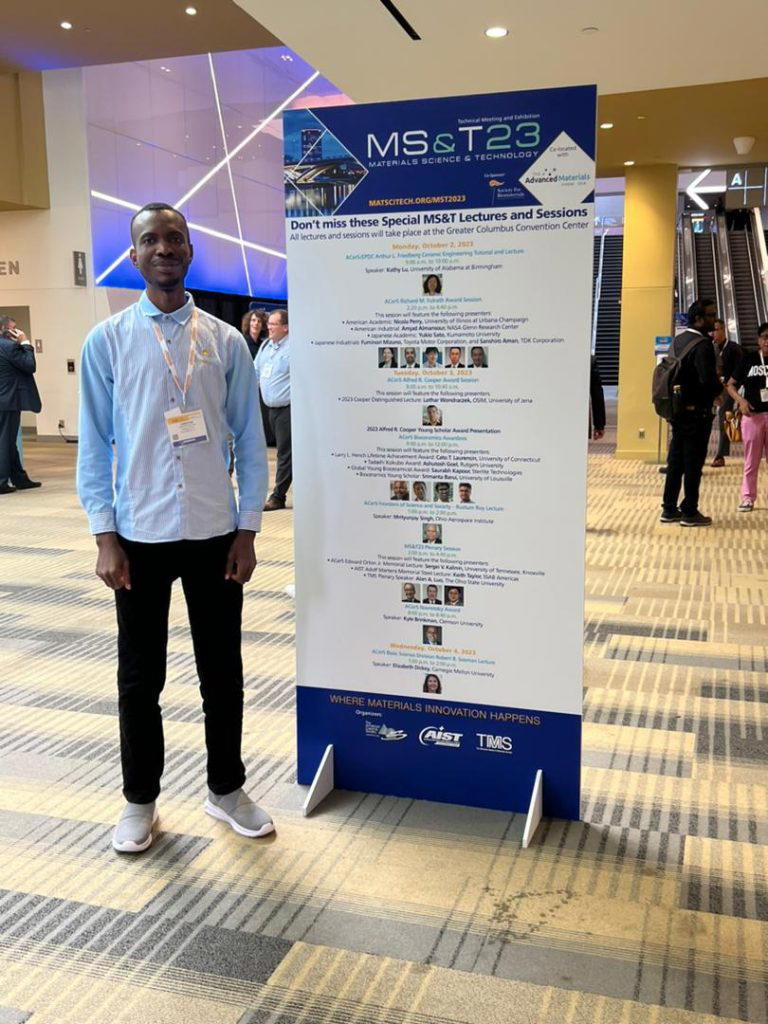
Mathew’s analytical research program was meticulously designed to expand knowledge on mortar behavior under triaxial stresses.
The paper presents comprehensive analysis results of mortar samples under such loading conditions, including compressive strength, elastic modulus, and Poisson’s ratio values. The models he developed, and the applied assumptions were verified by test results and finite element analysis with ANSYS.
The thesis represents a substantial contribution to civil engineering and engineering mechanics. Mathew’s research focused on the intricate details of the failure mechanism and cracking strength of structures, utilizing fracture mechanics as a foundation. His work not only predicted the failure load of structures but also provided innovative solutions through computational approaches, multiscale modeling, and advanced manufacturing techniques. Such pioneering research has the potential to drive technological innovation and elevate the United States’ position at the forefront of mechanics of materials and computational mechanics.
Significant disparities between triaxial, biaxial and uniaxial tests were observed, highlighting the necessity of understanding how mortar behaves under different stress states.
Furthermore, the study compared analytical results of masonry behavior under varying levels of confinement with those of previous researchers, contributing valuable insights into the mechanical behavior of masonry composites.
Mathew’s work emphasizes the shift in mechanical behavior and failure mechanisms of mortar under triaxial compression compared to uniaxial compression.
Depending on the magnitude of horizontal confining pressure within mortar joints, the material’s behavior can transition from brittle to highly elasto-plastic, accompanied by pore collapse mechanisms.
The paper introduces a novel proposal for calculating the cracking strength of masonry, utilizing energy balance criteria.
This proposal, adaptable for unreinforced, reinforced, and confined masonry, offers a versatile model considering various material properties and configurations. Additionally, it presents a Representative Volume Element for porous masonry.
In the realm of masonry research, Mathew’s paper stands as a significant contribution, addressing the scarcity of studies on the failure mechanism of masonry under complex stress states.
By evaluating the mechanical properties of bedding mortar, the study aims to assess damage onset, stiffness, plasticity degradation, and apparent Poisson’s ratio under compression, considering different mortar types.
Masonry walls, renowned for their cost-effectiveness and energy efficiency, play a crucial role in global construction. However, their behavior remains complex, particularly under varying stress conditions. Mathew’s research endeavors to bridge this gap by unraveling the mechanical behavior and failure mechanisms of masonry under both uniaxial, biaxial and triaxial loading.
The primary goal of Mathew’s study is to comprehend the mechanical behavior of masonry and its failure mechanisms, emphasizing differences among composite masonry constructed with various mortar types. By examining lime mortars alongside cement-based mortars, the research aims to discern their influence on overall structural strength.
In conclusion, Christian Chukwudi Mathew’s paper marks a significant stride in masonry research, offering valuable insights into the complex behavior of mortar under different stress states.
Through meticulous analysis and innovative proposals, the study contributes to advancing the understanding of masonry mechanics and paves the way for more robust structural designs in the future.
Disclaimer
Comments expressed here do not reflect the opinions of Vanguard newspapers or any employee thereof.