
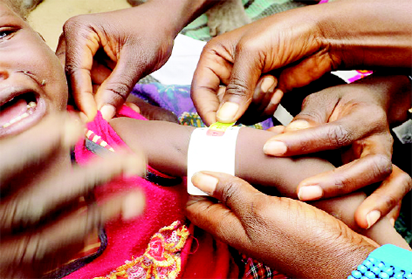
•NRC hygiene promoters conduct Mid Upper Arm Circumference, MUAC screening on a child. Photo courtesy NRC Nigeria/Rosalyn Velds.
…as SCI calls on govt to place immunization on priority list
By Gabriel Ewepu and Tams-Wakama Emmanuella
ABUJA- AS health of Nigerians remains paramount, stakeholders have expressed concern over the acceptance of immunization of children under-5 in parts of the country and came up with strategies to boost it.
The stakeholders who were at a one-day ‘Sensitization Meeting’ to mark the 2023 World Immunization Week’ organized by Save the Children in Abuja, said the myths around immunization exercise in Nigeria is not helping the process to eradicate some childhood diseases.
The Director, Advocacy, Campaigns, Communication and Media, SCI, Nigeria, Amanuel Mamo, pointed out that an enabling environment for expected results on immunization is needed and strengthening the three gateways to deliver Basic Healthcare Provision.
Mamo said: “There must be funding opportunity for the Basic Minimum Package of Health Services (BMPHS) which includes immunizations integrated with other services and implemented at primary healthcare facilities across Nigeria, using data to drive decision-making while ensuring the implementation of the zero-dose operational plan (Z-DOP).
However, according to him, SCI’s report indicated that the under-5 mortality rate in poor households at (133 per 1000) almost triples the under-5 mortality rate of richest households (47 per 1000).
“Only 36 per cent of children aged 12 to 23 months received all recommended vaccines while 18 per cent did not receive any, putting a substantial number of children at risk of vaccine-preventable diseases”, he said.
Meanwhile, he called on federal and state governments to place priority on immunization on their sustainable development agenda.
Speaking during the meeting, CEO and Founder of Maternal Adolescent Reproductive Child Health (MARCH) Health Care Initiative, Comrade Lawal-Aiyedun Olubunmi, while speaking on ‘Myths and Misconceptions of Vaccination’ said the belief system is negatively impacting the effort of stakeholders to ensure every child is immunized.
She said: “Our belief system also influences negatively or positively to accepting our vaccine program in the country. Zero-dose prevalence refers to children who failed to receive any routine vaccination, and Under-Immunized prevalence refers to children who failed to receive up to half routine vaccination.
“In 2018, the National Demographic Health Survey, NDHS, stated that 31 per cent of children; age 12- 23 months had received all basic vaccinations, while 21 per cent had received all age appropriate vaccination, 19 per cent received no vaccination at all.
“In 2020, WHO and UNICEF also revealed the fact that there is an increase in the zero-dose rate of immunization in Nigeria. Look at what we have in 2019, the estimated number of zero-missed dose children was 3.0 million, while in 2020, when COVID came, we had 3.1 million, and till date, it has not really changed significantly.
“There are some common myths and misconceptions on vaccination, in global context, it is generally believed that the vaccine schedule is too aggressive and should be spaced out. Scientifically speaking, the immunization schedule is driven by historical evidence, showing an optimal window of time when vaccines are most effective in preventing vaccine preventable diseases and children are most vulnerable to these diseases.
“Another myth about vaccines is that it is not necessary to vaccinate so early in life. The fact is that many of the diseases these vaccines prevent are most deadly in very young people, which is why they’re recommended at an early stage; newborn, infant and under-5.
“Another myth globally is that it overloads the immune system. The fact is that studies have repeatedly demonstrated that recommended vaccines are no more likely to cause adverse effects when given in combination than when they are administered separately.
“Most of our vaccines are safe, even with a combination like the ‘Pent’, a combination of vaccines put together. However, if it is not safe, the Nigerian government will not introduce it, they will not promote it, and most of these vaccines have gone through a lot of clinical trials endorsed by WHO.
“It is because of how effective the vaccination process is that it was introduced in Nigeria in the year 1956, when smallpox was a national threat. In Nigeria, it is believed that the vaccines make the child sick and cranky, the fact is, it is a waste of time giving a particular injection more than once, forgetting that each of the vaccines have a life-span.
“It is because of all these myths and misconceptions that we are calling on the media to use their expertise to give to the society, information that will help them to come up with an informed decision.”
In another presentation by Head of Programmes, Vaccine Network for Disease Control, Chika Nwankwo, titled ‘Opportunities for Community Mobilization’, said, “Community Mobilization is bringing people together for a common goal or cause.”
According to Nwankwo, using Abuja as a reference, that Routine Immunization (RI) officials were sent out to some areas and were able to vaccinate 1,577 single dose children, “and there are still some children who have never been vaccinated before, not even the polio vaccination, they haven’t taken anything. “Community mobilization speaks on what we are fighting for and what we expect to change. As we are gathered here today, we on community fighting sensitize the public on immunization.
“We can go to naming ceremonies to talk to the parents on vaccination, organize door-to-door awareness, estate meetings, Social Media campaigns, school visitations, and even employ the help of community Chiefs to help sensitize the general public on immunization and the need to vaccinate the children.
“Community Health Influencers Promoters and Service Programme (CHIPS) has been set up and individuals have been trained to go out and sensitize the people on health care.”
However, a senior Fellow, West African Institute of Public Health, Dr Francis Ohanyido, spoke on ‘The role of CSOs In Improving Immunization Coverage In Nigeria’, while pointing out that CSOs are known as the ‘Third sector’ just like journalists are known as the ‘Fourth Estate’ of the Realm’.
“It consists of everybody who gives a stakeholder that is not government and is not a business person, but it is a business of development, humanitarian affairs, and services.
“There is something known as the enabling environment complex. In the enabling environment complex, there is policy, advocacy and standard setting, and they all intersect at a crosscutting.
“We have 3 million zero-dose and this is where you start. CSOs have a role, we are at the health sector, we must understand the season/cycle of budgeting in the area of government we are involved with; the Ministry of Health, in order to know what was stipulated to curb certain diseases, set up standard medical structure and equally upgrade the health care in the country.
“The CSOs are equally tasked with the responsibility of finding out the issues related to immunization in their sector and equally finding solutions to these problems, the ability of a CSO to get information is essential. Core functions of a CSO are accountability and transparency.
Disclaimer
Comments expressed here do not reflect the opinions of Vanguard newspapers or any employee thereof.